

Ever since he was a film critic and worked as a video archivist for Martin Scorsese, director Kent Jones has been documenting the lives of famed auteurs, a pursuit that grew from his dream of studying film with Nicholas Ray, a teacher at NYU in the late 1970s. That dream never came to fruition after Ray’s unfortunate passing in 1979, and Jones eventually dropped out to pursue other ventures, which ultimately led him to his current position. His interest in the behind-the-scenes lives of film directors followed him wherever he went, whether on the selection committee of the New York Film Festival or in the editorial role at Film Comment.
Jones handled the documentary “Hitchcock/Truffaut,” based on the fascinating book by the French New Wave co-founder, as well as “A Letter to Elia,” alongside his former boss Scorsese, where the two discuss the influence the “On the Waterfront” director had on them. These are portraits of artists who have completely changed the landscape. However, Jones’ latest film, and second narrative work, “Late Fame” (screening at the 2025 New York Film Festival in the Main Slate), goes the other way around. It explores the adoration and review of an unrecognized artist’s work. Based on Arthur Schnitzler’s book of the same name, writer Sammy Burch (of “May December” fame) and Jones explore the fine line between pretensions and artistry through the eyes of a reassessed poet’s recently found book and his new team of rag-tag fans, or posers, in the eyes of the viewer.
Ed Saxberger and His Long-Forgotten, Now Rediscovered Poetry
While Burch dissects the duality between fame and infatuation with some interesting notions about New York’s art scene and its development, the film runs through scathing territory regarding its characters. And in some ways, it is the point that they feel insufferable, although the lack of perspective limits the thematic exploration vastly. Burch and Jones paint a picture of change, both in the city of New York and its exquisite, ever-evolving art scene, which ranges from the Andy Warhol collective and the Velvet Underground to the unsung lyricists and poets, as well as its inhabitants. Particularly, they want to show us the urban gentrification and progression that has occurred in the city that never sleeps, and how it has become a machine of its own.
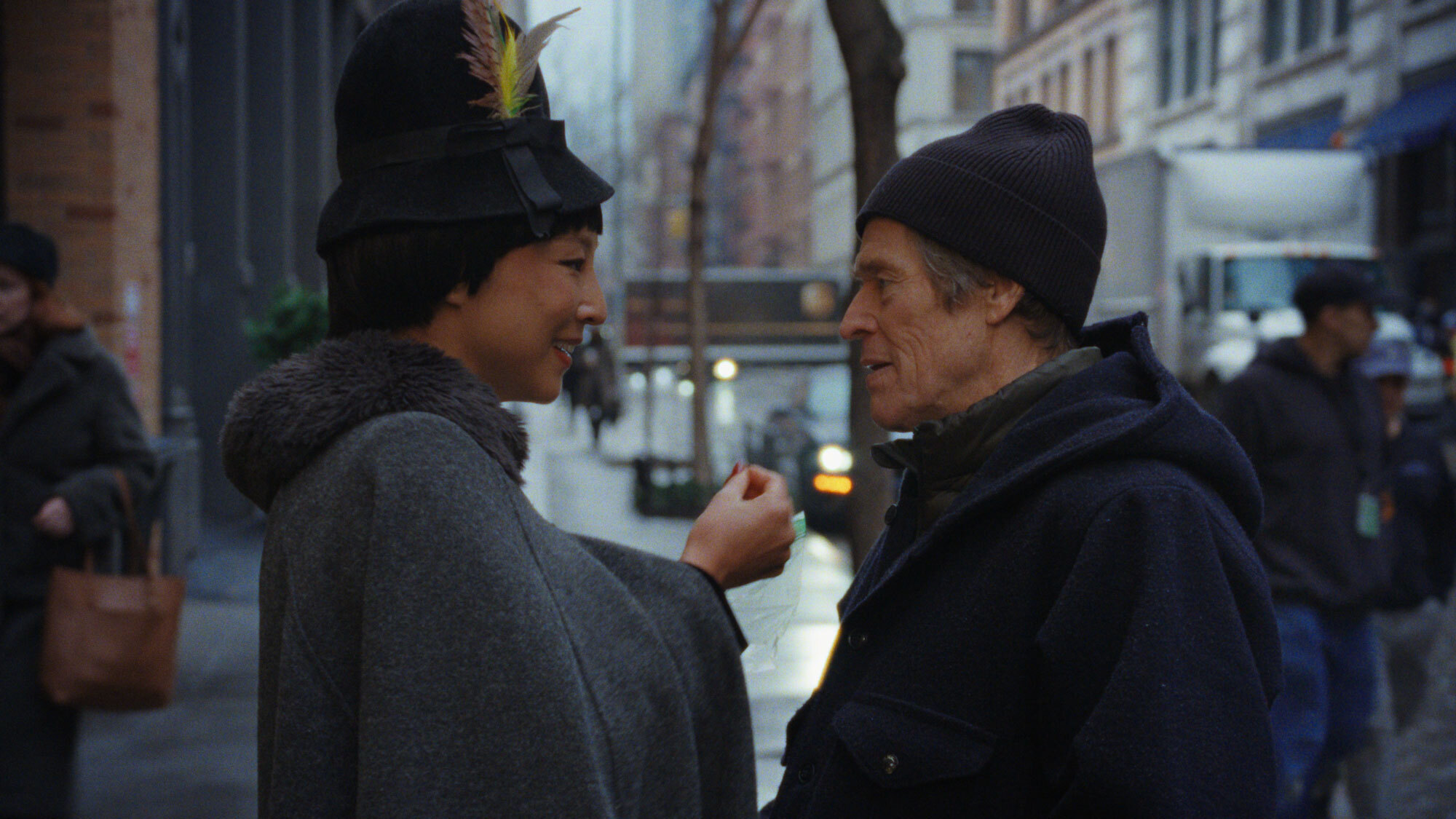
Many artists attempted to create themselves during the ’60s and ’70s, whether through experimental music and films or abstract paintings, as it was a fruitful time for those inspired to craft creative pieces. One of those artists who tried to capture the motion was Ed Saxberger (Willem Dafoe), who moved to Soho in the late 1970s. He participated in the artistic movement through literature, publishing a poetry book of his own, titled “Way Past Go.” Saxberger was one of the many who dreamt of success and fought for his chance. However, he wasn’t a success. His decision to move on to other things in life was born from a failure that has struck thousands of artists. Some things don’t connect with people, or it wasn’t the right time. This is either pure luck or the result of having great connections.
Saxberger settled for a simpler life in New York, working day jobs to pay the bills just like any other. But, as it happens with many artists, his work was rediscovered and reassessed by a group of mid-thirties New Yorkers who “enjoy” searching for unknown creators from a distant path. They are called the Enthusiasm Society, led by Meyers (Edmund Donovan), who greets Saxberger at his door. Meyers asks the former poet to join their group as they discuss his work and its impact, or what they deem it to have done. At first, he declines, although touched by the offer. Later, he caves in, as Saxberger ponders the forgotten years and the change in the artistic landscape. Is this the chance he has been longing for since the ’70s?
The Faux Realizations of Constant Rediscovery
Through this process of learning more about the group and its members, we gain a deeper understanding of the faux realizations that arise from their constant rediscovery. It is more about them and their “taste” rather than the artists whose work they are evaluating. They might say that this is all for art’s sake, but in reality, it is false analogies and impressions that are being uncovered after decades. Saxberger thinks about the potential of leaving his simple life behind and returning to the art world. But what he doesn’t notice about the landscape is its pretentiousness and selfishness. Only the privileged will have the opportunity to create without repercussions.
Meanwhile, those who are not will have to endure the heavy burden of sacrificing everything for art. You can see some of this pretentious behavior in art, as well as in the constant chatter and fights on Twitter, where fans disagree with one another on some weird, random topic to tease. It becomes a debacle on social media that is not that different from the Enthusiasm Society’s purpose for reassessment. The only difference is that on social media, everybody is rushing to share their first opinion. It seems fitting that Buch and Jones want to tell this story today. This is truly perfect timing.
The problem with “Late Fame” lies in the screenplay. Fascinating ideas about New York’s art life (and its changes through the decades) and the worth of being an artist in a landscape that does not appreciate one’s work lack complexity and perspective. You get the sense of nostalgia for a time when opportunities to thrive in various forms of art (film, music, literature) were available not just to those with family wealth, but also to those without, rather than being limited to those with family wealth. That is where Jones, whose academic research and experience help delve into this theme, thrives. However, Buch does not provide enough depth to the characters to allow for a thorough understanding of them.
The Lack of Perspective in its Array of Characters
The script is too afraid to criticize modern-day art appreciation. Its writers opt to create caricature-like portrayals of aesthetes instead. Dafoe as Saxberger is the one who suffers the most from this. Saxberger remains the same, albeit with more nostalgic contemplation. There are no lessons to be learned from caving into the faux persona. Every other character does not grow or evolve upon these impressions. “Late Fame” has sharp ideas on its backbone and in its surroundings. I know Jones and Burch can develop them properly because they have done it before (to an extent) in previous projects. Yet its expression is daft, culminating in a film that often hints at other times yet never defines the present. You can honor the artists of the past. But there is also a need to embrace those who are currently shaping the landscape.