


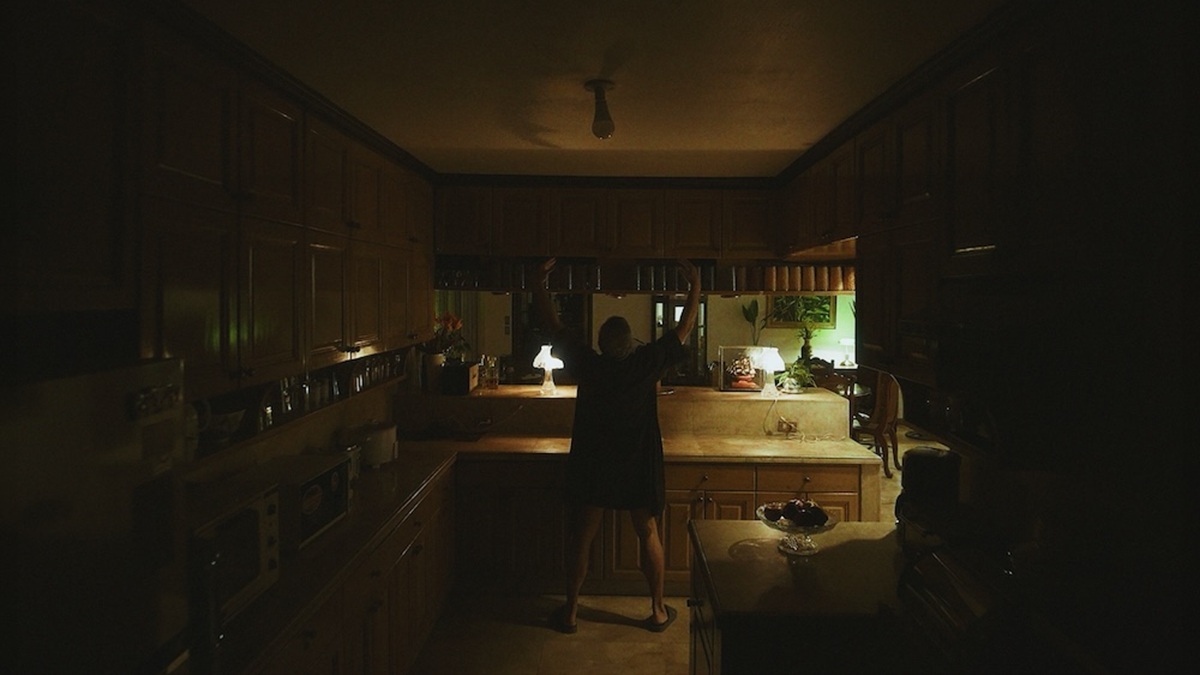
What the hell was Uncle Paul doing with that dog?
It’s the question hanging over the first stretch of Dustin Celestino’s “A.ni.mál,” although Lily Peralta (Maxine Ignacio) already knows the answer. One night, the animal-shelter volunteer drops by the home of Governor Paul Reyes (Reymund Domingo), her father’s longtime political ally and her own godfather, and catches him doing something reprehensible to his dog, Bella. Lily instinctively reaches for her phone and records what she sees.
Showing the video to her parents should settle the matter. Instead, Mayor Dan Peralta (Jojit Lorenzo) starts finding reasons why it shouldn’t. Paul didn’t really hurt the dog, he argues. Lily filmed him without consent. There’s an election underway, Paul’s wife Grace (Bituin Escalante) is running for governor, and a scandal could derail everything. Besides, aren’t there worse politicians committing worse offenses elsewhere in the Philippines? Why not deal with this after election day?
A few repulsive excuses later, Celestino has located the bloodstream of his movie. These people seldom have trouble distinguishing right from wrong. What fascinates him is the speed with which right and wrong become negotiable once pakikisama, utang na loob, money, elections, family loyalty, or plain self-preservation enters the equation.
Even the peculiar styling of “A.ni.mál” invites another look at the word. The periods break it into three beats—A. ni. mál.—with the stress falling on the final syllable. I can’t say whether Celestino intended this particular reading, but spoken that way in Filipino, animál can sound less like the name of a living creature than something you call a person you find contemptible.
The movie spends the next two hours making the obvious question harder to avoid: Who is behaving like the animal here? Bella, or the people committing all manner of kababuyan against animals and fellow human beings while finding respectable language to excuse themselves?
More Cinemalaya 2026: ‘Ganggang’ Explores Bullies Learning to Carry Bigger Weapons
Everyone Has a Price
Celestino has been this politically angry before. What has changed is where he positions himself inside the argument. “Ang Duyan ng Magiting” and “Habang Nilalamon ng Hydra ang Kasaysayan” had characters who could function, however imperfectly, as the filmmaker’s designated conscience. “A.ni.mál” doesn’t offer one. Celestino appears suspicious of practically everybody, and the movie is much funnier for it.
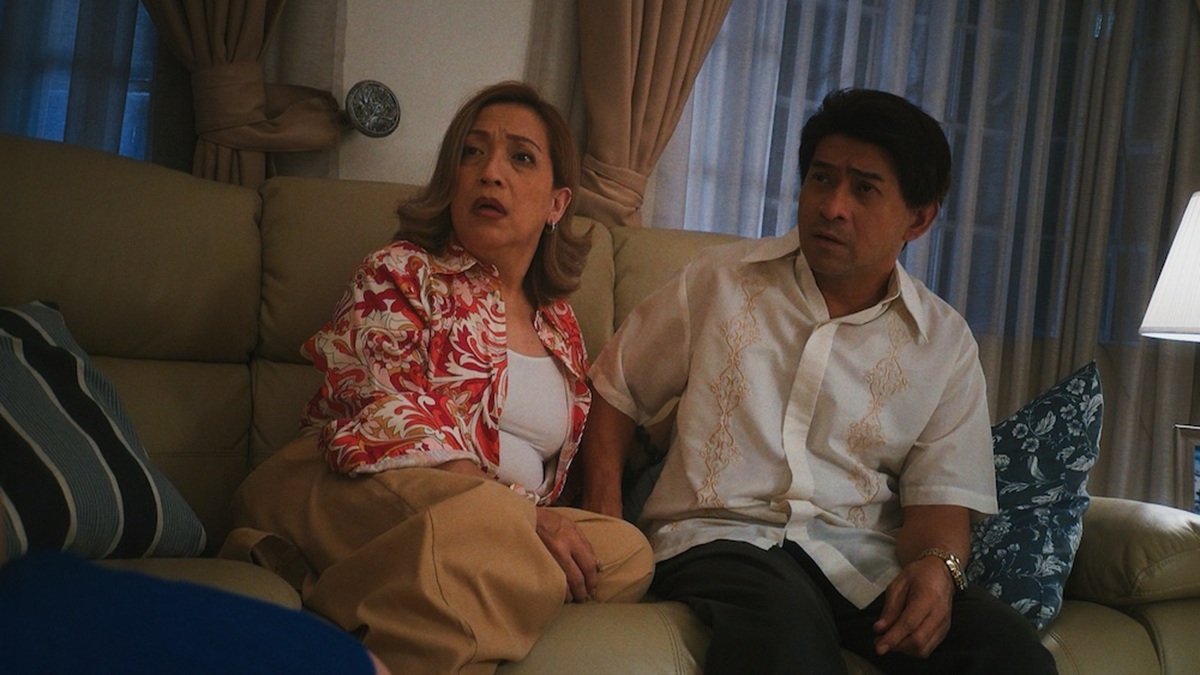
Dan is the most shameless specimen, a career politician whose moral vocabulary has shrunk into favors owed and alliances protected. Paul helped him win. His family benefited from the relationship. Why jeopardize all of that over something Dan has already decided isn’t serious enough to matter? Lorenzo plays him with a maddening assurance, as though any moral surrender becomes defensible if he can explain it for another five minutes. His conspicuously artificial wigs add a wonderfully stupid layer of vanity to the performance; at certain angles, the accidental resemblance to one particular local politician only makes the joke harder to ignore.
Given how central Lorenzo was to Hydra, I did wish Celestino had given him more to chew on here. The reversal is interesting, though. Frances Makil-Ignacio, who had far less room in that earlier film, gets one of “A.ni.mál’s” richest parts as Ofel, and she is marvelous. Ofel is appalled by what Lily has uncovered yet remains entangled in the same political machine, campaigning beside Grace while medicating herself through a life that appears increasingly difficult to tolerate. Makil-Ignacio can make her funny, brittle, exhausted, and genuinely wounded without sanding away the hypocrisy.
Her scenes with Escalante are among the film’s funniest. At a campaign event, Ofel and Grace announce their intention to investigate anomalous flood-control projects despite their own political circle’s involvement in those contracts, then perform a song called “Saklolo” (Lit. a cry for help) for flood victims. Celestino scarcely needs to exaggerate. Makil-Ignacio and Escalante attack the performance with such magnificent sincerity that the scene becomes almost physically embarrassing to watch. It is campaign politics as bad variety television, complete with the familiar Philippine spectacle of public officials treating governance as celebrity performance.
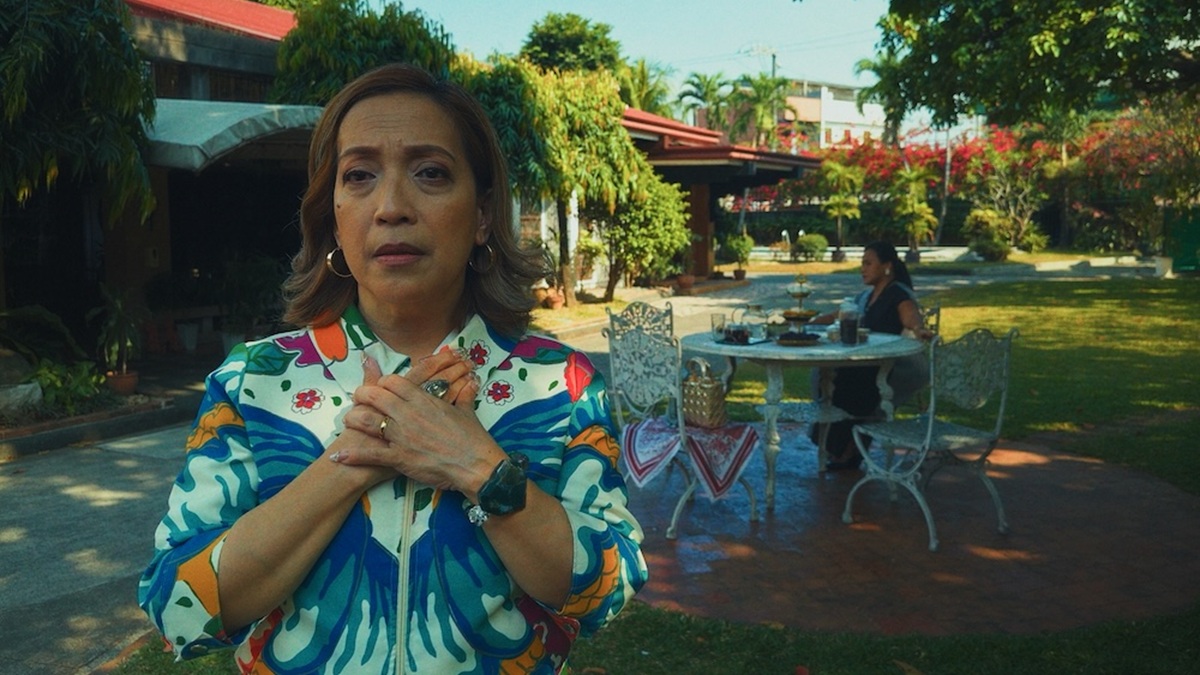
Ramona S. Diaz remarked on that electoral pageantry in “And So It Begins,” observing an actual presidential campaign from the documentary side. Here, Celestino turns the same instinct into grotesque farce. The speeches, songs, slogans, photo opportunities, and supposedly heartfelt displays of concern create an entire political language in which appearing compassionate matters far more than behaving compassionately.
Meanwhile, Lily initially seems capable of breaking from it. She cares about animals, volunteers at the shelter, and recoils from the compromises her parents accept as ordinary political life. Dan even tells her she’s a politician herself and simply hasn’t realized it yet. What first sounds like another condescending remark from her father gradually becomes one of his more perceptive observations.
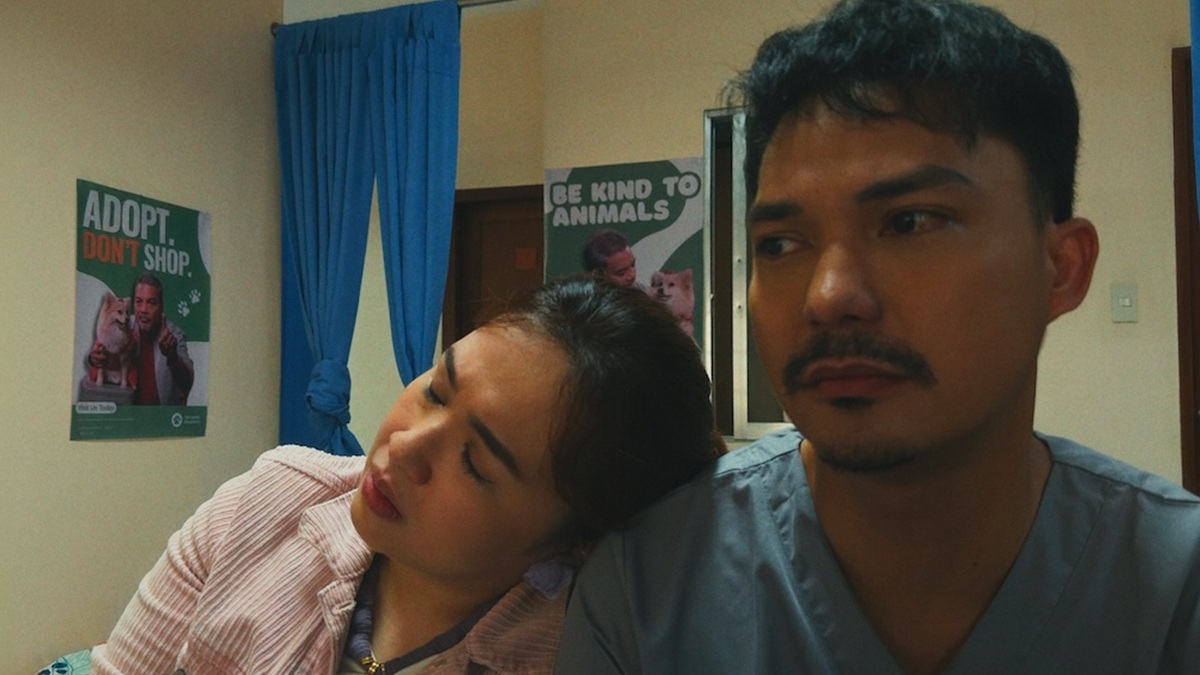
Her interactions with veterinarian John (Anthony Falcon) expose the family inheritance in miniature. John is nice to her; Lily decides he must be interested. She reads ordinary friendliness as flirtation, then reacts to rejection with increasingly alarming entitlement. It’s funny until it becomes deeply uncomfortable, partly because Maxine Ignacio makes Lily so eerily recognizable. I’ve known a couple of Lily Peraltas myself: young people raised around money or influence who genuinely believe they’re more enlightened than their parents, without noticing the smaller ways privilege has trained them to expect other people to accommodate their feelings.
Ignacio gets that contradiction exactly right. Lily isn’t secretly evil, nor does the film invalidate her outrage over Bella. She can identify a rotten system and still fail to recognize how much of that system has taken root in her. Her idealism is sincere, but so is her self-absorption. And the latter keeps ambushing the former.
John fares no better under Celestino’s scrutiny. He may be one of the film’s kinder people, but kindness proves remarkably flexible once Lily tells him who abused Bella. Paul financially supports the shelter. If he is exposed, what happens to the other dogs? What happens to the employees? To John’s livelihood? Why risk all of them for one animal that, as the rationalization goes, wasn’t visibly injured?
John’s argument has enough practical truth to sting. He’s also right that someone born into Lily’s security can afford a kind of performative outrage that costs considerably more for ordinary workers. Yet Celestino doesn’t let practicality settle the ethical question for us. Instead, he pushes it outward. Most people like to imagine that their principles are firm until keeping them threatens the salary, donation, friendship, favor, or convenience on which everyday life depends. How much evil are we prepared to tolerate when refusing it sends the bill to us?
Nobody in “A.ni.mál” gets to occupy safe moral ground for very long.
More Cinemalaya 2026: ‘2 Valid IDs’ Turns Bureaucracy Into a Punishment for Being Poor

Politics as a Bad Variety Show
That universality of compromise is one reason Celestino’s usual didactic streak bothers me less here. He still writes characters who can articulate an argument with suspicious clarity, and nobody will mistake “A.ni.mál” for politically neutral cinema. But he has stopped arranging the debate around people we are plainly instructed to admire or condemn. Hypocrisy keeps scrambling those categories, and satire does more of the work that speeches carried in his earlier films.
The images join in on the fray. Celestino and cinematographer Kara Moreno shot the production using iPhone 17 Pro Max units, an approach that resulted in a deliberately raw, stripped-down visual language. When needed, Moreno shoves the lens unnervingly close to a face, catches somebody from overhead or below, or snaps into a sudden zoom that makes the characters seem trapped under observation.
Those choices can be disorienting, and I wouldn’t call every composition beautiful. Beauty seems beside the point anyway. Nearly everyone in this world is invested in controlling an image: politicians manufacture relatability, advocates advertise virtue, families protect reputations, and Lily’s entire crisis begins because a phone catches something that was never supposed to leave a private room. The film’s production and its scandal therefore share the same basic technology. One phone exposes Paul; another can become the camera watching everybody scramble to contain the fallout.
The closeness also suits Celestino’s theater background. “A.ni.mál” uses demanding long takes and an ensemble of stage actors. Yet Moreno’s mobile camera keeps those exchanges from simply resembling filmed theater. It noses into conversations, watches faces while somebody else speaks, catches discomfort before a character has time to disguise it, then occasionally pulls back far enough for us to see the absurd machinery around them.
That ensemble is crucial to the tonal balancing act. Domingo makes Paul disturbingly ordinary rather than turning him into an operatic pervert, while Falcon lets John’s decency buckle by believable degrees. Escalante is fearless whenever Grace has to perform concern in public, and miserable when confronted with the truth. Lorenzo could have used more screen time, but every appearance reinforces Dan’s talent for converting moral cowardice into common sense. And Makil-Ignacio deserves the world for the way she lets Ofel’s exhaustion coexist with some of the movie’s broadest comedy.
Still, Maxine Ignacio is the discovery for me. Lily is probably the closest thing the film has to a central character, as it begins and ends with her. Ignacio earns that position because she never asks us to choose between Lily the outraged animal advocate and Lily the frighteningly entitled politician’s daughter. They are the same young woman. Watching one identity slowly swallow the other gives the film its cruelest joke. And while Celestino goes after the banality of evil, “A.ni.mál” is far more persuasive when it states it outright. Bad wigs, terrible campaign songs, awkward excuses, wounded egos, nepotism, fake concern: these people aren’t impressive enough to deserve the mythology that political power gives them.
‘A.ni.mál’, and the Well-Oiled [Political] Machine
Then comes the part that makes the laughter curdle. Public humiliation doesn’t necessarily cost anyone an election. Corruption doesn’t automatically disqualify a candidate. A political dynasty can absorb scandal, rearrange itself, then present another member of the family when the next cycle begins.
That’s what’s depressing about the film, although not because Celestino fails to offer a legible corrective. The bleakness feels complete in a way that mere hopelessness doesn’t. We’ve watched each character discover the amount of compromise they can live with, and the political machine survives precisely because those individual compromises keep feeding it. Nobody has to wake up plotting the destruction of the Philippines. Enough people simply need a reason to let the latest offense slide.
Which brings the title back around. Maybe “A.ni.mál” isn’t asking us to distinguish human beings from beasts at all. In Filipino, calling somebody animál is already an act of disgust, a judgment reserved for a person whose behavior has forfeited the respect we ordinarily attach to being human. Celestino looks at politicians abusing animals, abusing public trust, abusing friendships, and using other people as collateral for their ambitions, then strips away the pomp that allows them to appear larger than life. What remains isn’t formidable. It’s pathetic.
And somehow, for the life of me, these animals keep winning.

“A.ni.mál” currently screens at the 22nd Cinemalaya Independent Film Festival. The festival runs from August 6 to 18, 2026. Follow us for more coverage.


2 Comments
Very well written! So spot on. Congratulations 🙂
Pingback: TIFF 2026: ‘Hombre al agua’ | The Movie Buff