


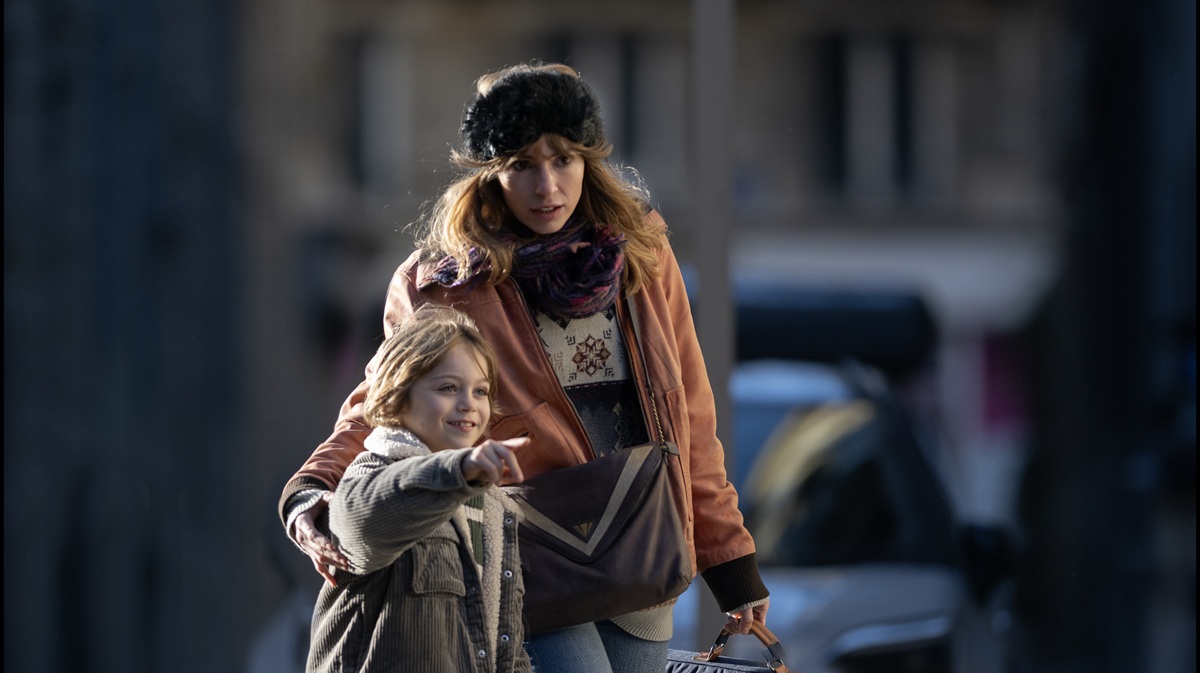
Sometime in the middle of Radu Jude‘s “The Diary of a Chambermaid,” young Maria (Sofia Dragoman) notices something during one of her regular video calls with her mother, Gianina (Ana Dumitrașcu). There’s another child with her, a boy named Louen (Louen Bouteiller), whom Gianina has been looking after while working in France. Maria isn’t pleased. In fact, she demands that her mother stop taking care of him.
When we think about it, there’s something funny about the little girl’s bluntness and her refusal to entertain any explanation. She’s jealous, hurt, and quite understandably angry. Her mama has been away for months, and here she is, spending her days looking after somebody else’s child. It’s a small exchange, but also one of the more painful moments in Jude’s latest film. Gianina hasn’t abandoned her daughter. She’s working abroad to support Maria and her own mother back home in Romania. But try explaining economic necessity to a child who simply wants her mother to come home. Maria doesn’t care about the reasons behind their separation. She knows that another boy gets to spend time with her mama while she has to settle for seeing her through a phone screen.
For a filmmaker whose recent work has included the abrasive “Bad Luck Banging or Loony Porn,” the sprawling “Do Not Expect Too Much from the End of the World,” and the deliberately chaotic “Dracula,” Jude seems to have softened his approach considerably. “The Diary of a Chambermaid” is comparatively gentle, even tender, although his interest in exposing the contradictions of contemporary society remains unmistakable. At 94 minutes, it’s also considerably shorter than some of his recent films, even if certain passages make that running time feel longer than it is.
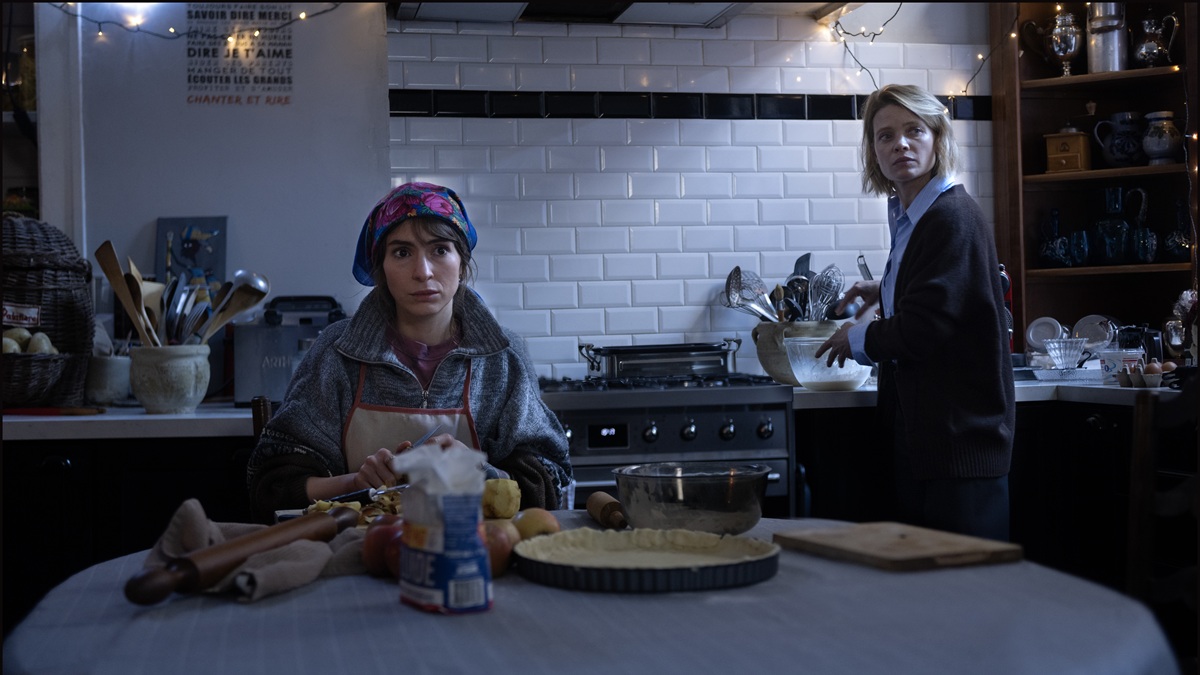
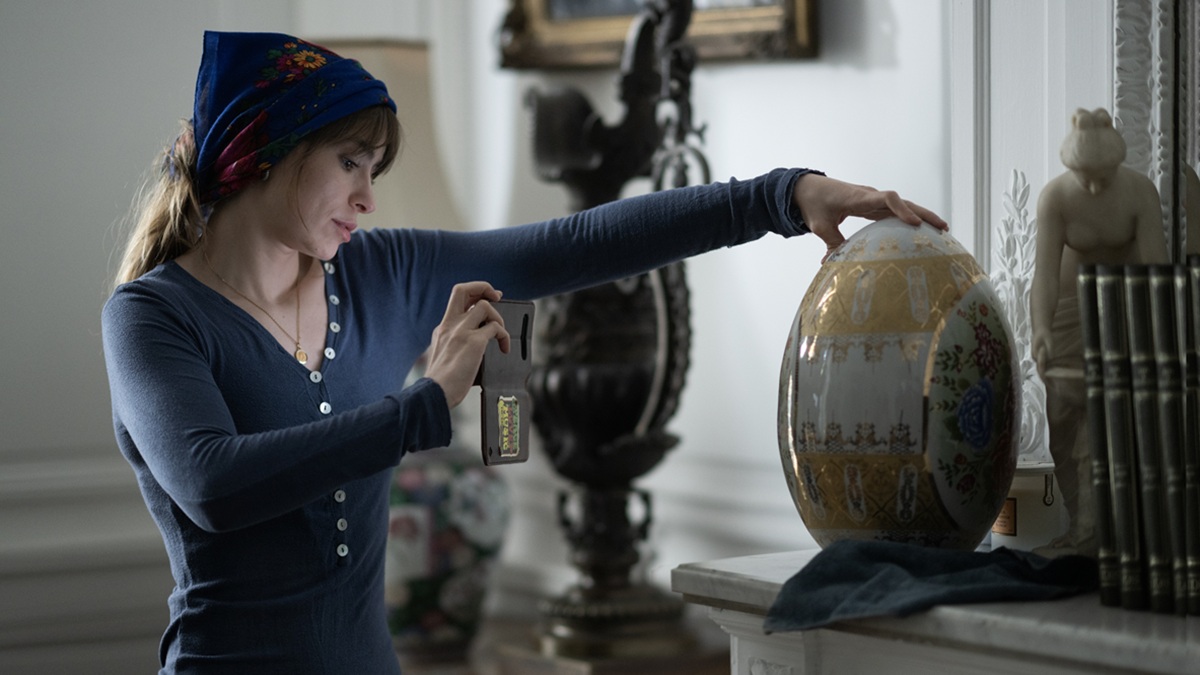
Set in Bordeaux, France, the film follows Gianina, a Romanian migrant employed as a housekeeper, cook, and nanny by the affluent Donnadieu family. Pierre (Vincent Macaigne) and Marguerite (Mélanie Thierry) are her employers, and Louen is their young son. As the film begins in late September, Gianina has already spent several months away from home. Christmas looms in the horizon, and she promised Maria that she’ll return to Romania for the holidays. Until then, her days consist of domestic chores, caring for Louen, and occasionally participating in rehearsals for an amateur theatrical production.
A Mother Away From Her Child
I’ve admired Dumitrașcu since watching her in Monica Stan and George Chiper-Lillemark‘s 2021 film “Immaculate,” where she played an 18-year-old woman navigating the increasingly troubling dynamics of a drug rehabilitation center. I was particularly impressed by how she conveyed her character’s vulnerability without resorting to melodrama.
In Jude’s hands, her performance as Gianina is considerably different, but it demonstrates a similar sensitivity to the uncomfortable circumstances in which her characters find themselves. Gianina is older, more experienced, and painfully aware of her responsibilities. Dumitrașcu plays her with a mixture of professional politeness, quiet frustration, and maternal affection. She’s attentive to Louen, patient with her employers, and reassuring whenever Maria calls. But there’s also something revealing about the way her demeanor changes depending on whom she’s speaking to. Around the Donnadieus, she must remain accommodating even when their requests inconvenience her. With Maria, she can be affectionate and occasionally exasperated, although the distance between them makes even the simplest conversation difficult.
Jude is particularly attentive to the unequal distribution of care. Louen has two parents who can afford to hire someone to look after him, while Maria has a mother whose employment requires her to live in another country. Gianina’s own mother has assumed responsibility for raising Maria in her absence. It’s a practical arrangement, but one that becomes increasingly difficult to sustain as Christmas approaches and Maria grows impatient with her mother’s repeated promises.
What makes the situation especially painful is that Gianina is good at her job. She entertains Louen, tells him stories, and provides the daily attention that Maria herself longs for. Her competence as a caregiver only makes the separation more difficult to reconcile. And because their conversations take place over video calls, Maria can sometimes witness the attention that another child receives. The technology allows them to maintain contact, certainly, but it also makes Gianina’s absence impossible to ignore.
When Ignorance Is Bliss
The Donnadieus, meanwhile, don’t appear to fully comprehend what their employee is going through. They aren’t cruel people, at least not in any conventional sense. Pierre and Marguerite appreciate Gianina’s work and occasionally go out of their way to accommodate her. Their generosity seems genuine. But they’re also accustomed to a comfortable existence in which other people help keep their household running smoothly, and Gianina’s personal circumstances rarely interfere with that arrangement.
Pierre, for example, enjoys hearing Gianina tell Louen stories from Romanian folklore. He praises her imagination, apparently unaware that these stories belong to an actual cultural tradition rather than being something she’s simply invented to entertain his son. It’s a revealing little interaction. He enjoys what Gianina can offer his family without demonstrating much curiosity about the culture from which those stories originate.
The same attitude emerges during conversations about European politics, particularly the Russia-Ukraine war. Pierre and his guests can debate the conflict from the comfort of their home, occasionally soliciting Gianina’s opinion because she’s from Eastern Europe. There’s a certain absurdity to asking a migrant worker for her perspective on international affairs while she’s attending to the needs of the people having the discussion. Their political convictions may be perfectly sincere, but Jude is more interested in the distance between those convictions and their everyday behavior.
And that’s where his criticism of the Donnadieus becomes more interesting. Pierre and Marguerite don’t have to be deliberately exploitative to benefit from an unequal relationship. They can be kind to Gianina, pay her for her work, and express concern for her family while continuing to exercise considerably more control over her time than she does. When their needs conflict with hers, it’s Gianina who must make the necessary adjustments.
More QCinema 2026 Coverage: ‘Fatherland’ Asks What Home Means After Home Is Gone
Performing the Part
Outside the Donnadieu household, Gianina finds herself involved in a theatrical production of Octave Mirbeau‘s 1900 novel The Diary of a Chambermaid, the same work from which Jude draws his film’s title and inspiration. Rather than adapting the novel conventionally, he incorporates it into the story through an amateur theater troupe whose performers include migrants with little or no acting experience.
Naturally, Gianina is cast as a chambermaid.
It’s a rather obvious piece of self-referential humor, but one that Jude develops into another examination of class and power. After spending her days performing domestic labor, Gianina spends her evenings portraying a woman who does much the same thing. The theatrical production gives her an opportunity to participate in something creative, potentially offering a welcome distraction from her work. Yet even here, she’s defined by an occupation that largely dictates how she lives.
The rehearsals also allow Jude to examine the contradictions of supposedly progressive artistic spaces. The troupe wants to give marginalized people a voice, but good intentions don’t necessarily protect participants from the inequalities they’re trying to expose. An ill-considered social media post involving a fellow migrant performer, for instance, has serious consequences for his immigration status. The episode is both absurd and unsettling, especially given the group’s apparent commitment to inclusion.
On Formal Craftsmanship That Often Connects (and Sometimes Misses)
It’s here that Jude makes a very interesting parallel between the troupe and the Donnadieus. Both consider themselves sympathetic to the circumstances of people less fortunate than themselves. Both offer opportunities or assistance that may genuinely benefit those involved. Yet neither is entirely free from the attitudes and power structures it claims to challenge.
I appreciate what Jude is attempting with this play-within-a-film arrangement, particularly how it allows him to examine the difference between portraying exploitation and living through it. There’s also something amusing about watching Dumitrașcu, a clearly gifted actress, portray a woman who is herself an inexperienced performer. Gianina’s awkwardness during the rehearsals provides another register for Dumitrașcu to explore.
Still, these theatrical sequences account for a considerable portion of the film, and I wasn’t always convinced that they needed so much room. The concept is established fairly early, and some of the longer rehearsals seem content to reinforce observations that Jude has already made. They’re often amusing and occasionally pointed, but their accumulation begins to test one’s patience. I found myself wanting to return to Gianina’s relationship with Maria, where the film’s emotional stakes are far more immediate.
The uneven pacing is especially curious given how sharply Jude structures the rest of the film. As its title suggests, “The Diary of a Chambermaid” unfolds through a series of dated entries, some lasting only a brief moment and others extending into longer conversations or performances. Editor Cătălin Cristuțiu moves between these fragments with abrupt cuts, occasionally ending scenes before they reach what might otherwise be their natural conclusion.
Honestly, I enjoyed this approach. The entries capture the repetitive nature of Gianina’s routine while gradually bringing us closer to Christmas, when she’s supposed to return home. Weeks pass, chores continue, and her conversations with Maria begin to carry greater urgency. There’s a contrast between how quickly the calendar advances and how little Gianina’s circumstances change. Jude doesn’t always manage the rhythm successfully, but the fragmented editing gives the film an appealingly unpredictable quality.
In some respects, the diary structure also reflects Gianina’s limited control over her life. Her days are largely organized around other people’s requirements, whether she’s looking after Louen, preparing meals, cleaning the house, or accommodating an unexpected request from her employers. Whatever personal freedom she enjoys must fit into the remaining hours.
That becomes particularly consequential as Christmas approaches. An unexpected family emergency threatens Gianina’s long-promised return to Romania, forcing her to confront the possibility of disappointing Maria yet again. The Donnadieus eventually offer a solution that is generous on its face, but it also allows their own holiday arrangements to proceed with relatively little disruption.
I found the resolution both appropriate to Jude’s larger argument and somewhat frustrating in its abruptness. The film has spent considerable time showing how Gianina’s absence affects Maria, only to move rather quickly through the consequences of their latest separation. I understand the irony behind the employers’ apparent generosity, although I wish Jude had allowed a little more room for the emotional fallout.
‘The Diary of a Chambermaid’: A Filmmaker at His Tenderest Yet
Even so, “The Diary of a Chambermaid” is a worthwhile addition to Jude’s filmography, precisely because it demonstrates how effectively he can examine familiar political concerns without resorting to the more aggressive provocations of his recent work. The humor is quieter, the social observations no less pointed, and Dumitrașcu gives the film a human presence that keeps its more conceptual exercises from overwhelming it.
What I appreciate most is that Jude doesn’t need to turn Pierre and Marguerite into monsters. Their affection for Gianina may be sincere, and their willingness to help her may even be admirable. But the arrangement that makes their lives comfortable still depends on her continued absence from her own family. Maria understands very little about the economics of that arrangement. She only knows that she wants her mother home, and for all the adults’ explanations and accommodations, that remains a difficult request to fulfill.

“The Diary of a Chambermaid” had its world premiere in the Directors’ Fortnight section of the 2026 Cannes Film Festival on May 15, 2026. It screened in this year’s QCinema International Film Festival under the Screen International category. QCinema ran from November 13 to 22, 2026. Follow us for more coverage.

