


“Where is home?”
It sounds like a simple enough question when Thomas Mann is asked it in Paweł Pawlikowski‘s “Fatherland.” He has returned to Germany in 1949 after sixteen years in exile. The country he left is now physically scarred by war and politically divided between East and West. Coming to Frankfurt to receive the Goethe Prize, rumors already swirl that he will travel to Weimar afterward to receive another. For a writer who spent years speaking against Nazism from abroad, the return is loaded before he even steps inside a banquet hall.
So when asked the question above, Thomas doesn’t really answer. “Where my Heimat is, where I belong, is a much more difficult question,” he instead skirts.
And there it is: eighty-two minutes of “Fatherland” could probably fit somewhere inside that distinction between home and belonging.
Pawlikowski doesn’t begin with Thomas, though, and I love that he doesn’t. The first minutes belong to Klaus Mann (August Diehl), speaking to his sister Erika (Sandra Hüller) over the phone. He talks about his writing and his frustrations with contemporary art, but their conversation also clues us into a much older wound: Klaus’ fraught relationship with their father and Erika’s position somewhere between the two men. “You believe in anything, Erika?” he asks her. “Is there anything you still believe in?” Suddenly we realize Thomas Mann hasn’t appeared yet, but he already hangs over the conversation.
The Visual Language of a Complicated Man’s Return to His ‘Fatherland’
It’s an inspired way to introduce a historical figure whose reputation could have swallowed the movie whole. In fact, Pawlikowski has little interest in walking us through Mann’s accomplishments or turning “Fatherland” into a Greatest Hits biography. We meet the Nobel Prize winner indirectly, through people who know what it means to live in his orbit. By the time Hanns Zischler finally appears, the monument has already preceded the man.
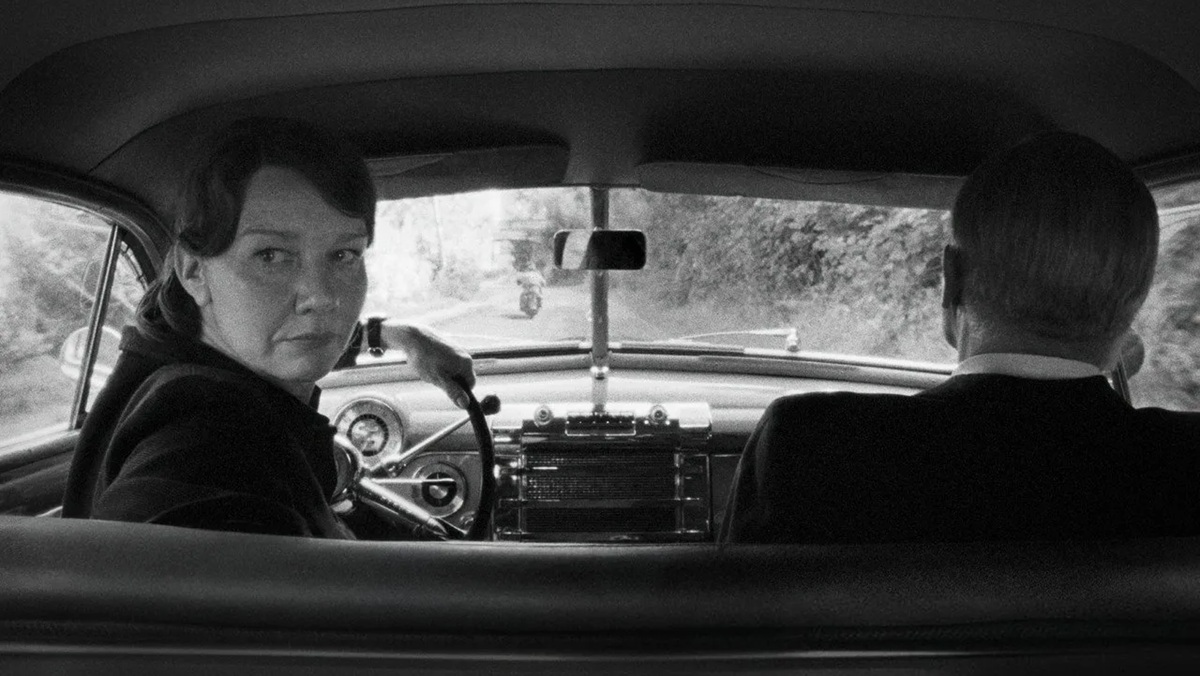
And then there’s Germany. Cinematographer and frequent Pawlikowski collaborator Łukasz Żal photographs the ruins in crisp black and white, beautiful without prettifying them. Buildings stand wounded behind people trying to resume ordinary life, while ceremonies and receptions continue as if society can simply arrange the furniture around what happened. Germany is rebuilding itself, but nobody seems able to agree on what exactly is being rebuilt.
The boxy 4:3 frame makes those spaces even stranger. Pawlikowski and Żal frequently leave people hemmed in by architecture, or place them inside compositions with just enough empty space to feel uncomfortable. The images are exquisite, yes, but there is something constricting about them too. What fascinates me even more is how static so much of the visual language is for a film built around travel. Thomas and Erika move between cities, political systems, and social spaces, but Pawlikowski’s camera often refuses to move with them. The journey continues while the people inside it remain emotionally stuck. Germany is changing around them faster than either seems capable of processing.
Thomas has returned to his country, yet the frame itself sometimes seems unsure where to put him.
“Where is home?”
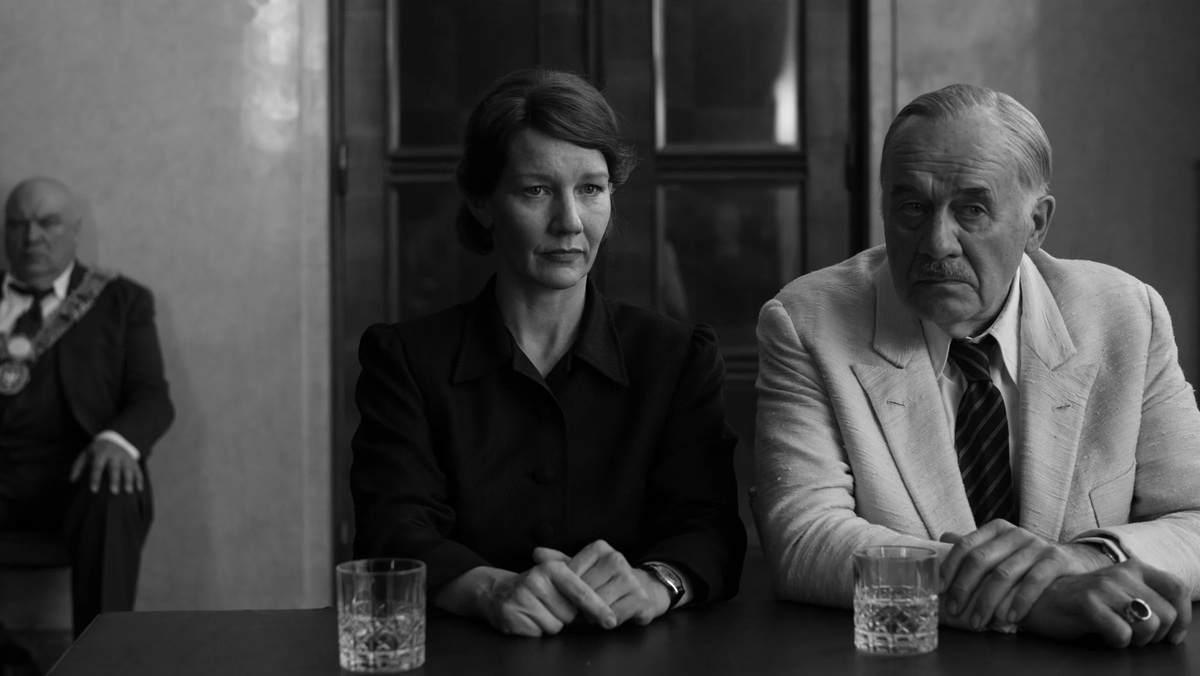
While “Fatherland” features a father-and-daughter return to Germany, the real-life Thomas Mann made this 1949 journey with his wife Katia, not Erika. Pawlikowski and co-writer Hendrik Handloegten make that substantial change deliberately, and the movie even finds an elegant way of acknowledging it when Erika tells a journalist that she had sworn never to set foot in Germany again but came because her mother was unwell.
Historical purists may balk, but I think the choice unlocks the film. Putting Erika beside her father makes the journey something more unsettled than a tour through postwar German politics. Thomas is traveling through a country that cannot decide what he represents, while Erika is traveling through one she wanted nothing more to do with. He can still speak about Germany as an intellectual proposition. On the other hand, she has a much harder time separating ideas from the people who acted on them.
Sandra Hüller is magnificent here because Erika is constantly doing several jobs without the performance ever turning them into a checklist. She translates for her father and watches the rooms around him, sometimes seeming more aware than Thomas of how much hostility his return has stirred up. Anonymous letters call him a traitor, and Erika absorbs some of that ugliness before it reaches him. All the while, she has her own anger toward Germany, and being back there only further fans the flame.
The Daughter Who Translates [for]Him
Speaking of Thomas, there’s something quietly revealing about him making Erika his translator. While she is literally responsible for carrying his words from one language into another, the film gradually makes her a translator in a much broader sense. Thomas can speak beautifully about Germany, exile, and the independence of art. But Erika is often the person translating those ideas back into their human consequences. She understands what certain rooms mean before he does. She knows what certain people represent. And for all the translating she does on his behalf, father and daughter remain remarkably poor at translating themselves to each other.
Pawlikowski lets some of Erika’s anger be funny. Her encounter with her former husband Gustaf Gründgens (Joachim Meyerhoff), who thrived professionally under the Nazi regime, briefly cuts through all the ceremonial politeness surrounding the Manns. Hüller is especially good when Erika’s contempt arrives almost casually. She barely needs to raise the temperature of her voice.
In a year when Hüller appears to be everything everywhere all at once, it amuses me that two of her finest 2026 performances happen to be in black and white. “Rose” gives her an extraordinary physical transformation; “Fatherland,” for my money, gives her the wider emotional canvas. Erika can be cynical one moment and deeply protective the next. Hüller finds the grief underneath without asking the movie to stop and admire it. It is among the finest performances I’ve seen all year.
On the other hand, Zischler has the less demonstrative role, which makes what he does with Thomas easy to underestimate. His Mann has spent so long becoming Thomas Mann that the public identity seems almost fused to his skin. He is articulate, courteous when he needs to be, and very aware that people are listening to him. Even grief initially has trouble breaking through that construction.
It would be easy to read his behavior after the tragedy involving Klaus as simple coldness, especially next to Erika, who cannot pretend to carry on as if nothing has happened. Thomas insists that the journey continue. The ceremonies still have to happen. Speeches must still be given. My first instinct was to resent him for that, but Zischler’s performance makes the response harder to dismiss. Maybe Thomas is hiding behind duty and intellect. Maybe duty and intellect are the only ways he knows how to survive grief without collapsing under it.
What the movie doesn’t do, thankfully, is excuse him. It also doesn’t flatten him into an emotionally unavailable patriarch waiting to be exposed. That ambiguity is a big deal because the final stretch would lose much of its force if Pawlikowski had already told us exactly what to think of Thomas.
Through all these, it’s the difference between father and daughter that becomes one of “Fatherland’s” rawest pressure points. Erika can’t put history at arm’s length because history keeps arriving as something personal. Thomas has survived partly by turning experience into thought and language, perhaps even into principle. Pawlikowski respects why someone would build that wall, but he is just as interested in what it does to the people standing nearby.
What Is Art For?
Everywhere they go, people want something from Thomas Mann. West Germany gives him a prize. East Germany does the same. Journalists and cultural officials keep asking what he thinks Germany means now and what an artist owes the place he came from. Thomas insists that Goethe and German literature existed before Germany was carved into competing political systems, and that art does not recognize those borders.
It’s a beautiful idea. But “Fatherland” spends much of its running time wondering whether beauty makes it true.
Both sides are aware of Thomas Mann’s symbolic usefulness. They have the opportunity to celebrate the returning exile and, in the process, borrow some of his moral stature. Art, then, becomes part of the machinery of cultural legitimacy; even Goethe is territory to be fought over. Meanwhile, Thomas wants to believe the artist can still stand somewhere outside all this. Erika is far less convinced, however, and the movie gives her plenty of reasons not to be.
Pawlikowski keeps returning to music, literature, and performance without treating any of them as decorative signs of refinement. Wagner hangs over certain conversations because great art does not become innocent simply because it is great, while Gründgens represents another ugly bargain between culture and power. In the West, popular American music floats through the air. In the East, songs and choirs carry a different political charge. Everybody wants art to mean something useful.
What happens when the artist refuses that usefulness? More uncomfortably, what happens when refusing to choose becomes its own kind of choice?
Pawlikowski at His Most Human
Ultimately, I don’t feel any of this will convert viewers already allergic to Pawlikowski, and I don’t think the movie expects to. “Ida” and “Cold War” both operate through a similar severity: carefully composed black-and-white images, emotional ellipses, people whose inner lives are often easier to read from what they refuse to say. While I like both films, I have never been surprised when someone finds them remote. Pawlikowski has always been a filmmaker whose restraint looks like rigor to one viewer and self-consciousness to another.
Among his films (including those from the early aughts), “Fatherland” is probably the most human film he has made, which sounds faintly ridiculous when you consider how composed every image remains. Nothing about the filmmaking suddenly becomes loose or naturalistic. Pawlikowski hasn’t abandoned the qualities that make him Pawlikowski. If anything, the control is as apparent as ever.
It’s the people inside those frames that seem messier to me.
Maybe it is the father-daughter relationship. Maybe it is Hüller, whose Erika can puncture the formality of a room with one look. There is more humor here than the severity of the images initially suggests, and more irritation, too. People behave badly, say the wrong thing, or simply fail to understand the person sitting next to them. For all the movie’s aesthetic precision, “Fatherland” allows its characters a certain emotional clumsiness that I don’t associate quite as strongly with “Ida” or “Cold War.” That irony is part of what I love about it: Pawlikowski’s most rigorously controlled surfaces may have produced his least remote film.
In Defense of Austerity
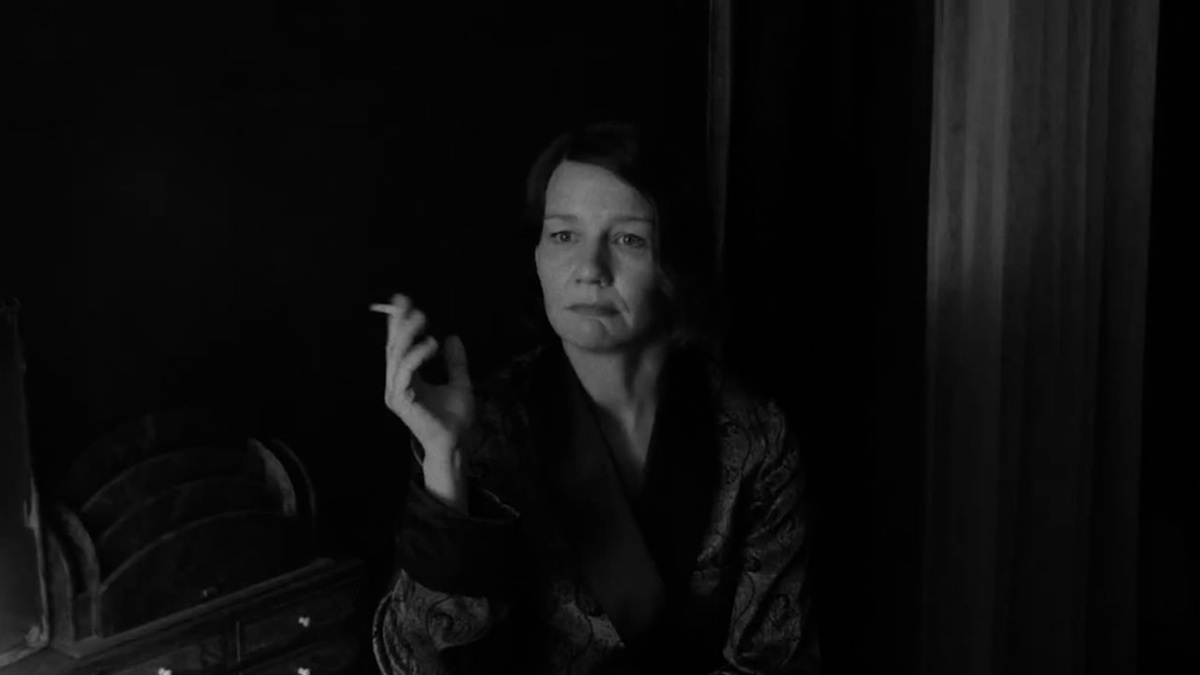
I can still easily imagine someone watching “Fatherland” and finding it chilly or mannered, maybe even smug in its austerity. His preference for long pauses and severe compositions has never been universally inviting. What I experience as breathing room, another viewer may experience as dead air, and I can understand why the control of it all might come off as a filmmaker too pleased with his own craft.
The funny thing is that “Fatherland” may be the Pawlikowski film I’d most want to discuss with someone who dislikes it, because its emotional reserve is part of the argument rather than something I need to defend away. This is a movie about people who have survived history and discovered that survival does not automatically tell you what to do afterward. Germany wants to rebuild itself, Thomas wants to keep speaking about art and civilization, and Erika carries a far more immediate anger toward the people who helped destroy both. Klaus, from the opening sequence onward, seems unable to find anything sturdy enough to believe in.
Pawlikowski doesn’t dramatize those tensions through cathartic confrontations. Often he simply leaves his characters sitting there, and the silences accumulate without being shaped into obvious emotional cues. Żal’s images work the same way. Roads and hotel rooms can carry as much unease as an argument, while bombed buildings pass outside a car window and Thomas and Erika occupy the same frame at very different emotional distances from what has happened.
Another filmmaker might underline the resemblance between the damaged Mann family and the damaged country surrounding them. Pawlikowski trusts it enough to leave it alone.
When Bach Finally Breaks Through
Very late in the film, Thomas and Erika walk into a ruined church and hear Bach. By then, nearly every encounter with art in “Fatherland” has carried some other burden. Goethe is fought over by competing states, Wagner cannot be separated from the history surrounding him, and music at official functions becomes another part of ceremony and ideology. Here, nobody is asking anything from it. Bach simply exists.
And this, finally, gets through to Thomas. For all his eloquence about art and its independence from politics, music reaches somewhere his arguments cannot. The public figure recedes, and for a moment we see a grieving father beside his daughter. His earlier coldness looks different now. Perhaps the feeling was never absent; perhaps he simply had no language for it.
That small rupture brought me back to the question “Fatherland” asks almost from the beginning: “Where is home?” Germany can no longer provide an easy answer, and neither can exile, family, or even art. Pawlikowski leaves the question unresolved, which feels right for a film so suspicious of neat resolutions in the first place.
“Fatherland” is the first film I’ve seen in 2026 that I have no hesitation in giving full marks. More than that, it’s the Pawlikowski film I most want to keep talking about which, as far as my appreciation for messy family dynamics go, isn’t that much of a surprise anyway.
“Fatherland” had its world premiere in the main competition at the 79th Cannes Film Festival on May 14, 2026, where Pawlikowski won the Best Director award. It will screen in this year’s QCinema International Film Festival under the Screen International category. QCinema runs from November 13 to 22, 2026. Follow us for more coverage.

