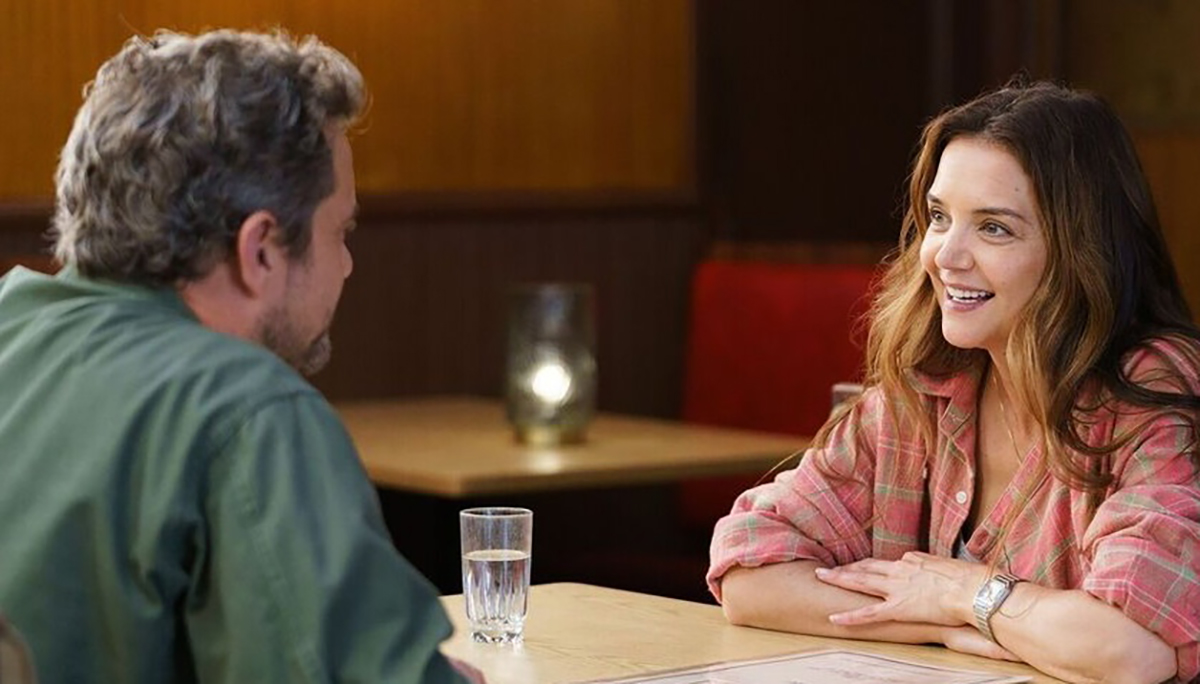
World premiering at this year’s Tribeca Festival, Katie Holmes’ new film, “Happy Hours,” is a sweet comedy/romance that reunites her with “Dawson’s Creek” star Joshua Jackson. At a clean 1 hour and 20 minutes, the film is less a typical rom-com and more a treatise on re-exploring lost love and how relationships can feel when you’re in your forties. The film — written and directed by Holmes — is funny, yes, but also vulnerable and real. And amidst it all, it’s a very New York movie. Filmed in New York City, this is one of the few modern films I’ve watched besides “Bella” and Chris Evans’ “Before You Go” that feels like a love letter to the city. And yet the film is also tentative. At the world premiere screening at the BMCC Tribeca Performing Arts Center, Holmes called this “Happy Hours Part 1.” And at the end of the film, you can see she likely has more to tell.
A decidedly New York film, what struck me most watching “Happy Hours” after spending a weekend in the city was how much it avoided the common tropes. There’re no flyovers of the Manhattan skyline. No full island shots or marketing cinematography intended to sell the city like many rom-coms. “Happy Hours” is not a sexy movie with top-up camera angles of the Empire State Building. It inhabits its restaurants, streets, and areas of Central Park intimately. It’s street-level; its leads — Holmes and Jackson — walk through Midtown as they reconnect and feel out their rekindled experience. There’s not one shot by cinematographer Michael McDonough that takes you out of the city. It makes the film feel that much more personal.
Past Loves and Reconnection
The plot of “Happy Hours” is derived from standard stuff. Homes’ Liz is a divorcée living in NY, a photographer who was once much busier than she is. She’s reeling from her divorce; maybe not so much because of its ending but of the dreams of love it derailed. Meanwhile — and as she rebuffs celeb photos shoots because she wants to photograph actual people enjoying their lives — she runs into her high school boyfriend, Andrew McCloud (Jackson). Their relationship ended without closure. And while neither holds real resentment, they hold pain and a lot of questions. The way that Holmes handles their reconnection defies standard room-com logic. There’s no ‘meet cutes’ here; Andrew and Liz feel each other out tentatively, cautiously. It feels real.
But that’s not to say “Happy Hours” is a melodrama, either. A host of characters played by actors and actresses such as Joe Tippett, Mary-Louise Parker, Constance Wu, John McGinty, Donald Webber Jr., and Chloë Kerwin make the film very funny and likable. Tippett and McGinty (the latter who is a deaf actor who addressed the packed crowd in ASL) play best friends of McCloud; they attempt to have weekly lunch dates in Midtown at their favorite restaurant even though they — but mostly McCloud — are pulled in different directions. Wu brings a lot of comedic moments as Liz’ ‘boss’ I suppose, and Webber Jr. plays a very likable jazz musician Liz supports through her photography. “Happy Hours” — which has nothing to do with bars — has a soul to it. Jackson’s Andrew writes exploration/self-discovery novels and Liz wants to show the real side of New York. That they’re cautious with each other speaks to the difficulty in trusting your heart again and adult relationships. Holmes has an eye for their reconnection, and it shows.
‘Happy Hours’ prioritizes understanding over romantic cliches and reality over fantasy.”
Not a Rom-Com, but Still a Romance
“Happy Hours” is also interwoven with flashbacks from the leads’ past, played with much talent by Jack Martin and Johnna Dias-Watson. They play Liz and Andrew as teenagers, before circumstance caused them to drift apart. They sell the story to us well, appearing as teenagers in love. Yet Holmes’ thesis — through Martin and Dias-Watson — is not that it was a childish, young love, but real love. As adults who have grown accustomed to love’s ups and downs, Liz and Andrew both work to address what brought them apart and what failed to bring them back together. Andrew’s friends (Tippett and McGinty) add levity to the movie by teasing Andrew while also trying to help him. Liz has less support, but Louise-Parker, as her aunt, lends comedy and a shoulder to cry on.

There are a few issues with “Happy Hours” that might irritate some viewers (although the world premiere was met with much applause). For one, it doesn’t propel like a rom-com. Andrew and Liz feel out their past, present, and possible future in a pace that feels real rather than exciting. Sometimes they skirt actually reconnecting due to the script’s necessity; but underneath that I actually feel Holmes is trying to say something about how being hurt sucks and how people are apprehensive to experience that again. Additionally, the obligatory “almost connects” between Liz and Andrew can sometimes get taxing. But at the film’s time limit it’s negligible. And Martin and Dias-Watson are so good in their flashbacks sequences that you really believe Liz and Andrew have something rare. I expect great things in both their futures.
Soulmates May Exist After All
But under it all, “Happy Hours” is about hope. It’s not cynical as many movies are, and it’s clear that Holmes — and Jackson, through his acting — feel that true love is possible. It also helps that both still have terrific chemistry. But the thing that stuck out is how unlike Joey and Pacey they are. This is not “Dawson’s Creek.” They’re adults with real problems (and some surprises). Jackson makes us believe his character’s emotions fully and Holmes follows suit with a guardedness that is sometimes frustrating yet believable. And all along the film’s run, original songs written and performed by the sublime Nora Jones —as well as a flashback scene featuring a remastered track by Blondie — add levity in needed places. This is a romance film after all, and Music Supervisor Joe Rudge wants us to smile.
A love letter to New York.”
All-in-all, “Happy Hours” is a good film. It’s light yet sometimes heavy, and nostalgic and pensive while still offering hope. Jackson and Holmes have great chemistry, and I can’t remember a time old lovers were ever asked to answer for their past behavior in such an understanding and forgiving way on-screen. Holmes stated after the screening that the inspiration for “Happy Hours” was “Before Sunrise,” and teased there was more to come. And at the end of the film, I wanted Liz and Andrew to be happy. That’s a credit to a film that prioritizes understanding over romantic cliches and reality over fantasy. And in a world full of easy answers, the ultimate strength of “Happy Hours” is its dedication. Soulmates may exist after all. It just takes a little work.
“Happy Hours” had its world premiere at Tribeca Festival on June 8th. It has two more showings on June 13th at Village East. Follow us for more coverage.