


A few weeks ago, a package arrived at our house under my name. Inside was a bikini set. It had already been paid for. As a man with no immediate use for one, and no one in mind to give it to, I felt a small but unmistakable panic. Other people had seen the parcel. The label said it was mine. Its contents suggested a private life I didn’t recognize.
Russell Goldman’s “Sender” understands that peculiar violation and makes it much, much worse.
Expanding his 2022 short film “Return to Sender” into his feature debut, Goldman opens with Lisa Barr (Jamie Lee Curtis), a former athlete receiving packages she never ordered. The items appear calibrated to mock an injury and the career it ended. Goldman cuts the sequence with an abruptness that makes every new delivery feel like another intrusion, while Cindy Lee’s “Diamond Jubilee” plays with a mellow sweetness that has no business sounding so sinister.
It reminded me of Zach Cregger’s use of George Harrison’s “Beware of Darkness” in “Weapons“: the music floats pleasantly along while the images insist that something has gone terribly wrong. Within two minutes, “Sender” has its hooks in.
The Packages Know Just a Little Too Much
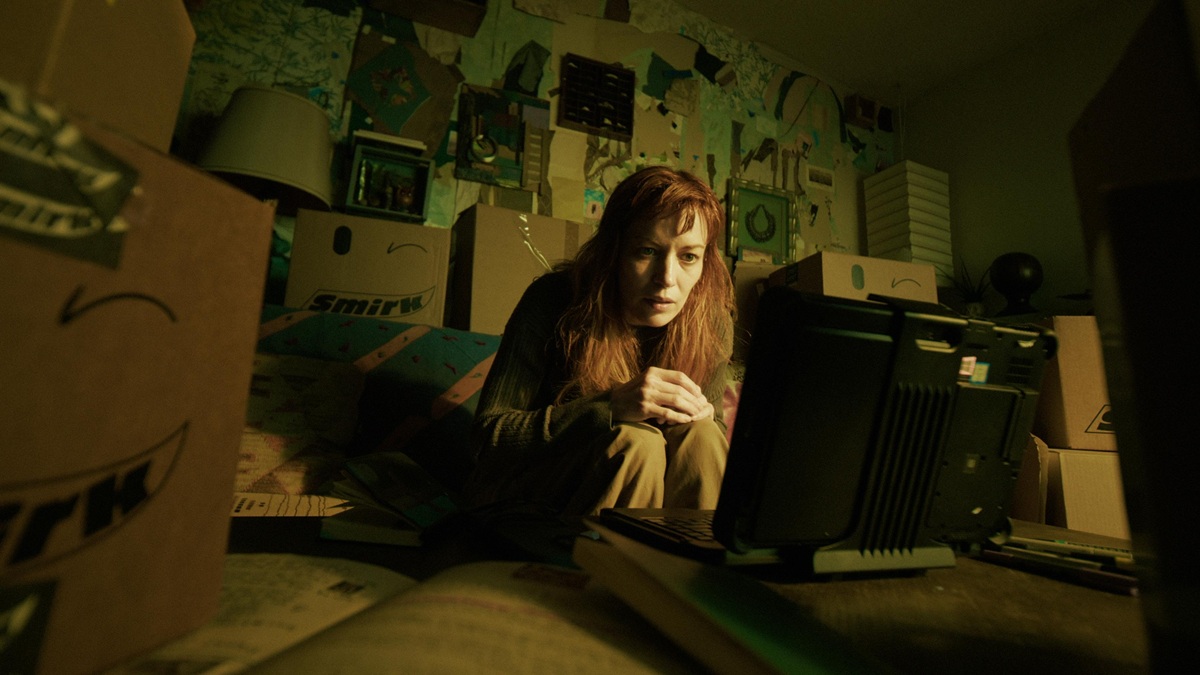
The film then shifts to Julia (Britt Lower), who was fired three weeks ago and got sober at around the same time. She’s trying to start over in a suburban rental, attend recovery meetings, and persuade her younger sister Tat (Anna Baryshnikov) that she can manage on her own. And then boxes of packages arrive. A blender. A corkscrew. Her exact shade of lipstick. Products she didn’t purchase but which seem to know her history anyway.
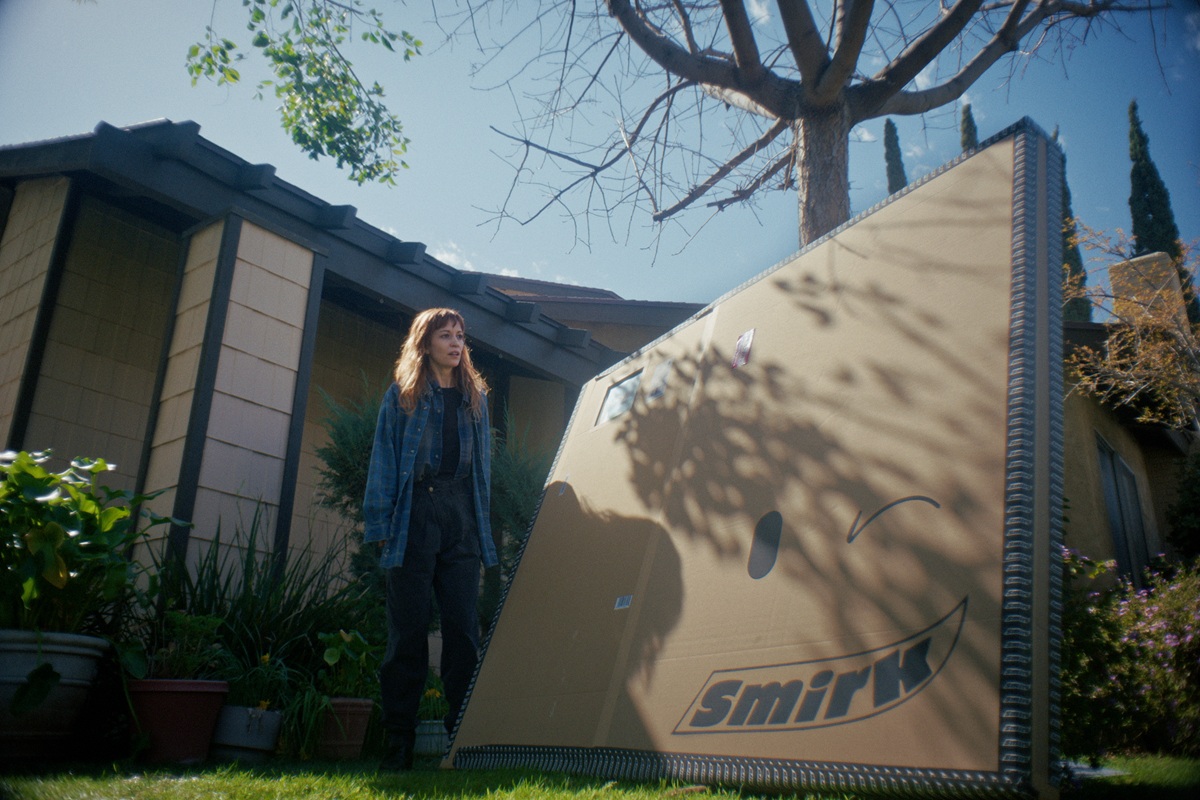
The retailer responsible is Smirk, Amazon with the serial numbers filed off and its smile adjusted into something faintly threatening. Its representatives speak in that polished corporate dialect designed to simulate care while avoiding any actual responsibility. Every answer is clinical, rehearsed, and useless. The company knows where Julia lives, what she buys, and possibly what she regrets, yet no one can explain why any of this is happening.
Julia has surrendered her privacy to a system built to observe her, but her history of addiction has also surrendered her credibility to nearly everyone she knows. Evidence is piling up inside her house, and the more frightened she becomes, the less anyone trusts her. She’s being watched by something that won’t identify itself and doubted by people who believe they already understand her.
That connection between being watched and not being believed gives “Sender” much of its bite. Julia knows she’s vulnerable to manipulation because she no longer fully trusts her own memory. Everyone else knows it, too. Adding to this is the fact that Goldman doesn’t make her easy company. She’s defensive, intrusive, reckless, and exhausting. Lower, however, never reduces Julia to a collection of nervous tics. She gives her the paranoid, hypervigilant energy of someone who keeps inspecting reality because she’s no longer certain it will hold. A glance becomes evidence. A pause sounds like a lie. An act of help begins to resemble control.
That last tension is especially pronounced in Julia’s relationship with Tat, whose concern carries the fatigue of someone who has spent years cleaning up after another person’s crises. Tat wants her sister housed, employed, sober, and alive. Yet her care has gradually hardened into management, leaving Julia to wonder whether anyone around her wants her to recover or simply remain manageable.
When Compulsion Changes Targets
The sharper idea beneath the surveillance plot is the way compulsion can migrate from one object to another. Julia may have stopped drinking, but her need to identify the sender quickly becomes an intoxicant of its own. She opens, sorts, traces, records, calls, and confronts. Every package gives her another reason not to sleep and another task that feels more urgent than recovery. The question isn’t simply whether Julia has replaced alcohol with a mystery. It’s whether the mind, deprived of one obsession, immediately begins searching for another.
“Sender” explores that migration of addiction with more insight than its thriller mechanics initially suggest. Julia’s investigation gives her purpose. But it also allows her to avoid the slower and less satisfying work of remaining sober. Finding the sender promises a clean answer: identify the culprit, stop the boxes, restore reality. Suddenly, it makes sense to someone like her when contrasting it to the process involved in recovery, which offers no such efficiency. It requires repetition, humility, and trust—three things Julia has little patience for.
The film also turns recovery into a battle over authorship. Smirk publishes product reviews under Julia’s name. Tat arranges her living space and watches for signs that she’s slipping. Charlie (David Dastmalchian), the unusually attentive delivery driver, tries to solve portions of the mystery on her behalf. Even the people who genuinely care about Julia keep deciding what she needs, what she remembers, and which version of events deserves to be believed. The packages invade her privacy, but the deeper insult is that someone else is using her name to tell the world who she is.
Through it all, Lower can be funny, abrasive, frightened, seductive, and deeply sad within the same encounter. She keeps Julia emotionally legible even when the film around her deliberately scrambles its signals. Dastmalchian lends Charlie enough warmth to explain why she might trust him and enough oddness to make that trust feel risky. He’s always a welcome presence, and “Sender” makes good use of his ability to suggest kindness and danger without clearly settling on either.
As for the other cast, Rhea Seehorn brings a flinty impatience to Whitney, a woman from Julia’s recovery circle, while Baryshnikov keeps Tat from becoming merely the sensible sister assigned to tell the audience what it should be thinking. Finally, Curtis amounts to a glorified cameo, though in this case the glory counts for something. Her brief appearance gives the opening immediate gravity. Wanting more of Lisa Barr speaks to how efficiently Curtis establishes a whole life under siege, even if the film never gives that character the space her introduction appears to promise.
A Mind Packed Into Boxes
Gemma Doll-Grossman’s cinematography turns Julia’s home into an extension of her nervous system. The yellow-heavy color grade makes the rooms appear warm at first, then gradually stale and contaminated. Package-point-of-view shots reduce Julia to another object being scanned. Low and distorted angles make ordinary conversations look unstable, while cluttered compositions keep shrinking the space around her. The more boxes that enter the house, the less room Julia seems to occupy within her own life. When she briefly feels lighter, the image loosens with her.
On the other hand, Gavin Brivik’s score and Nathan Ruyle’s sound design follow the same logic. Certain scenes hit with aggressive sonic force. Others, meanwhile, withhold the music and leave Julia alone with the house, the packages, and whatever she thinks she can hear inside them. Those quieter passages are necessary because “Sender” is otherwise eager to keep its pulse racing.
Marco Rosas’s editing will likely be the film’s dividing line. The cuts are abrupt, chronology slips, and flashes of memory or imagination arrive without warning. Personally, I liked being made to strain to keep pace. Perhaps that’s the masochist in me. If the point is to place viewers inside Julia’s unstable perception, then the disorientation works. The line between embodiment and gimmick is thin, however, and Goldman sprints along it for 94 minutes. Some viewers will find the rhythm exhausting rather than immersive, and I can’t blame them if they do.
That same strain becomes harder to defend once the film reaches its final stretch. Its reluctance to settle certain threads begins to look less like purposeful ambiguity than uncertainty over how to finish what it has set in motion. The question hanging over any short expanded into a feature eventually asserts itself: has the original idea been deepened, or merely lengthened?
‘Sender’: A Feverish Crisis of Privacy, Recovery, and Self-Doubt
“Sender” finds plenty of new suspects, detours, visual tricks, and paranoid possibilities to fill its running time, though not always enough dramatic shape to justify them. The filmmakers sometimes seem more interested in keeping Julia and the audience disoriented than in deciding where all that disorientation should lead. Its central mystery doesn’t so much tighten as accumulate, until the movie itself begins to resemble Julia’s living room. There are intriguing objects everywhere, but nowhere comfortable to sit.
Even so, I don’t entirely resent those rough edges. This is a feature debut that overreaches in public, made by someone clearly testing how far he can push performance, sound, image, and point of view. I’d rather watch that than a first film polished into anonymous competence. Goldman doesn’t quite stick the landing, but the force and nerve of the attempt make it easy to imagine the places he might go from here.
Which brings me back to my earlier story. I eventually learned that the bikini set wasn’t part of a data-mining scheme or a campaign to destroy my sanity. One of my sisters had ordered it for herself and used my name because she didn’t want anyone asking questions. Fair enough, except that her plan preserved her dignity by spending mine.
“Sender” takes that small shock—the package you didn’t order, the name you recognize, the private assumption suddenly made public—and asks how long it takes for surprise to harden into suspicion, and suspicion into the only thing keeping you going. Its answers are messier than its premise, but the unease is real. For what it’s worth, I still checked the label twice.

Russell Goldman’s “Sender” had its world premiere in competition at SXSW on March 14, 2026. It played as a Marquee Presentation at the San Francisco Film Festival on April 25, 2026. Follow us for more coverage.

