I’ve been into sci-fi and dystopian films lately. 2010’s “The Book of Eli”—starring Denzel Washington—is another in the line of these films, not so much sci-fi but totally dystopian. It features a time period following ‘the final war,’ where America is a wasteland, more “Mad Max” than “Children of Men.” It follows the titular character Eli (Washington) on a quest to traverse the wasteland and “head West” for a purpose that becomes more clear as the film progresses. There’s danger all around. The film’s success is that it makes Eli an engaging, pious, but dangerous character. There’s notes of Robert McCall’s “The Equalizer” here, which he would play four years later. The downsides are the film’s religious overtones, which struggle to find immediacy or imperative.
What makes “The Book of Eli” work is it’s slow, but not too slow. In parts it has the look and feel of Francis Lawrence’s “I Am Legend,” yet in others almost resembles a Western. The film’s directors (Albert and Allen Hughes) do the film service by only hinting at the final war its characters speak of, with interactions Eli has with others throughout shedding light on the remnants of human society that are now known to only a few. Eli holds on to these solemnly and devoutly, while others—such as the film’s villain, Carnegie (Gary Oldman)—peruse their remnants for weapons to use modernly. Along the way as Eli crosses a seeming endless desert, villainous hordes attempt to do him harm. But the man seems impenetrable, taking down threats with the nonchalance of a mercenary or one protected by unknown forces.
Seeking Purpose Amidst Dystopia
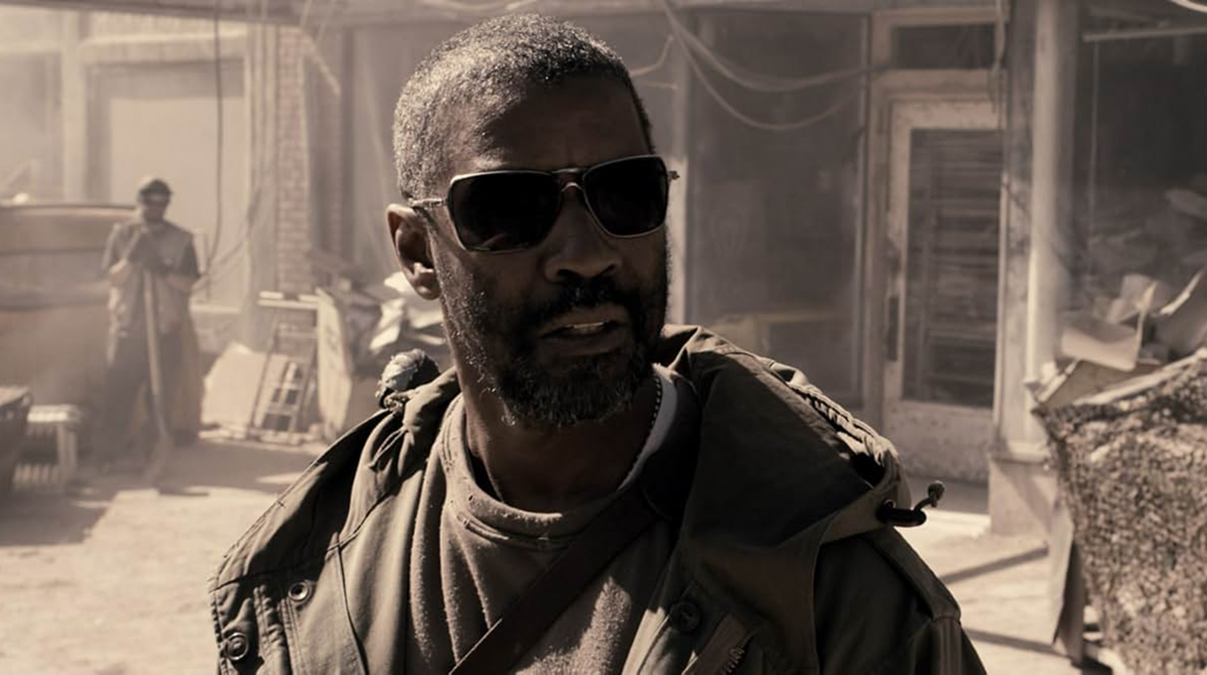
The look that the Hughes brothers and cinematographer Don Burgess (“Forest Gump,” “Cast Away”) give the film is stark and desolate. It’s not one of those films were remnants of American society are numerous. There’s no weed-ravaged skyscrapers or abandoned towns. There’re endless sand dunes, and we sometimes see a broken and rotted car or truck being used as a trap for an ambush by scavengers and hunters. There’s a greyish-brown tint to the film grain, not as bright as “I Am Legend” but not as bleak as “Children of Men.” The sun shines bright and characters must wear protective glasses. We learn the final war “blew a hole in the sky,” which I took to mean the ozone’s destruction—likely nuclear—with the sun now not protector but foe.
“The Book of Eli” gains its imperative when its protagonist wanders into a small town, very Western, looking to replace batteries on a device he owns. Eli’s culture conflicts with his violence. While we saw him cleave a man’s hand off instantly with a machete when he was threatened a scene before, we’ve also seen Eli’s love of music and civilized thought. In a picture devoid of much color, he has a silver iPod and a pair of red Beats earbuds. He listens to funk and oldies as he lies down at night as a sort of meditation on better days.
Of course here in town he finds trouble—or rather it finds him. Thugs and goons attack him out of nothing but territoriality and perhaps boredom. Meanwhile Carnegie yells at his slave/concubine, Claudia (Jennifer Beals), often beating her when he isn’t lording his power over her to her daughter, Solara (Mila Kunis in an unusual role for her). He demands a word with Eli, and through this interaction and word of mouth later that night, he determines the man has a Bible in his possession. It becomes his obsession to possess this; not because he is holy or has any benevolent agenda in mind, but because—as the last remaining Bible on Earth—he feels it will give him the power to control the commoners that inhabit his town as mankind had once been subdued by it prior to the war.
Washington is Fun to Watch

What I liked about “The Book of Eli” are its quieter moments and its action, both of which are plentiful. Discussions Eli has with Claudia and Solara are kind and thoughtful. They hint at a kindness to Eli despite the necessity of his violence. He never attacks anyone outright. They try to steal from him… his backpack, his supplies, his life … and he warns them to back off, which they don’t. Yet Eli is a learned, patient man. He speaks with that solemn reverence often utilized in action films, where the care and attention he puts into his patience translates to the methodical-ness with which he dispatches people when he must. Eli never enjoys it—you never get that impression. He has a job to do (make it West), which is in every way as holy a task to him as Moses parting the Red Sea.
What I disliked at times about the film is the way Washington’s thoughtful character crashes headfirst into Oldman’s Carnegie, sometimes without thought. Oldman is here playing a composite of other lunatic madmen in his repertoire, most notably Stansfield in “Léon the Professional” and Zorg in “The Fifth Element.” There’s little imperative to his actions besides this film’s need to have a villain. He threatens and screams and adopts that crazy-man voice he does so well in the aforementioned films. The screenplay (Gary Whitta wrote the script) makes reference to the final war many times, yet I couldn’t help but think maybe the final war was being fought now, between Carnegie and Eli. I also couldn’t help but notice the clear symbolism of his name and Andrew Carnegie, the steel tycoon who helped build American civilization.
Interesting Despite its Faults

Yet what I found distracting was how forcefully Whitta and the Hughes brothers hammer home how badly Carnegie wants to use the Bible as a weapon. Clearly they are making progressive points here—rightly—but it feels like they are trying too hard. Most of the current post-apocalyptic American populace are illiterate. Carnegie could have written a book himself and claimed it was God’s word and they’d have bought it. But this becomes the focal point of the movie as he and his goons (the best amongst them “Rome’s” Ray Stevenson) try and steal the book from Eli. The whole thing goes back and forth; but I have to say I loved the way the filmmakers ended the thing, and how utterly pathetic Carnegie becomes by the end.
Despite some of “The Book of Eli’s faults, I still ended up really liking the film. Washington is great as always, and I was surprised with the likability and badassery Kunis brings to her role. Their relationship is a forced alliance. But at the end, as Eli thanks God for his “new friend,” it ended the thing in a believable way. Oldman is too over the top, but the rest of the players are fine. The end scene—featuring the venerable Malcom McDowell—is fitting, and I loved the location that would become the savior of civilization. All-in-all a good film and a competent addition to the genre.