


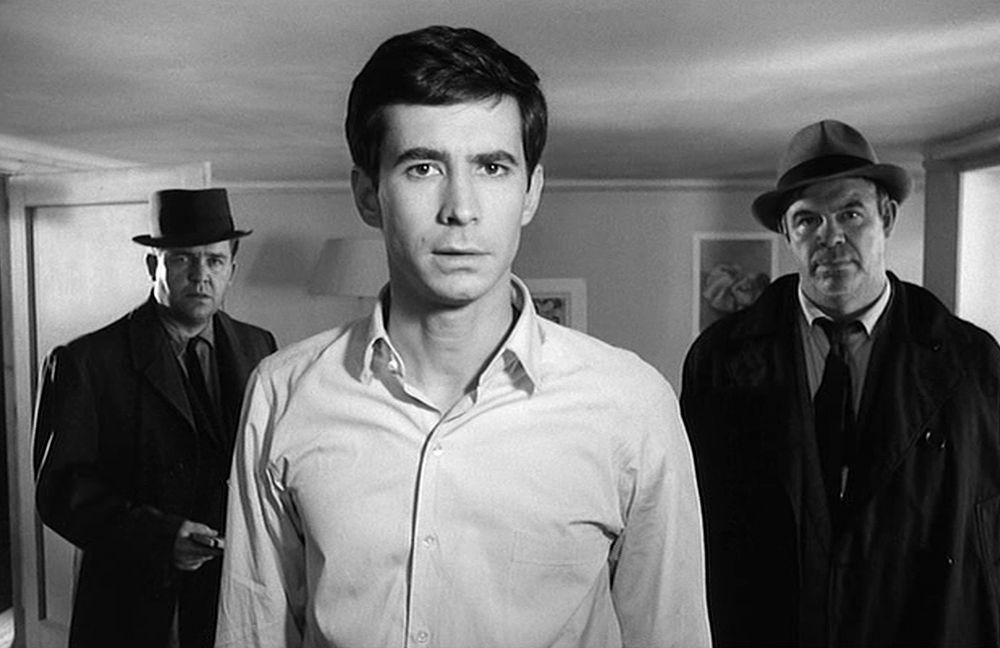
A legal drama that spends no time in an actual courtroom, Orson Welles’ “The Trial” (1962) takes a Hitchcockian conceit—the wrongfully accused plot—and delivers a film that’s rich with contradictions and short on answers. From the brilliant open to the starling finish, Welles constructs an tense atmosphere that’s somehow both claustrophobic and completely wide open. On the screen for nearly the entire two hours, Josef K. (Anthony Perkins) is all nerves and limbs, a fugitive who either doesn’t understand what he did wrong or knows all too well what the consequences will be if he admits guilt. Celebrating its 60th birthday with a new restoration, “The Trial” will play at the Film Forum in New York City from December 9th-22nd, providing an opportunity to see Welles’ haunting and frustrating Kafka adaptation, which for so long had been neglected or unavailable.
The film begins in Josef’s nondescript studio apartment, equipped with a bed, a dresser, and some shirts. Two men knock on his door, and Josef lets them in. He expects it to be his neighbor, Mrs. Burstner (Jeanne Moreau). This scene proceeds at the pace and delivery of a Marx Brothers’ routine, with the two men asking Josef questions while he dodges straight answers while dressing. His resistance meets resistance, similar to Kirk Douglas’ deposition in “Paths of Glory” (1957). They write down Josef’s words to use against him; and even when he’s trying to cooperate, he loses his patience. He corrects one of the men that “ovular is not a word”—which in turn, ensures he will lose the battle. What’s worse is that these nosy detectives have the temerity to try to steal some of Josef’s crisp white shirts.
Welles and a ‘Fear of Completion’
They arrest Josef, but do not take him to jail. He’s told that he will stand trial for his crimes, which are not explained to him. Josef assumes that this is a practical joke put on by some co-workers, until he sees his co-workers rearranging Mrs. Burstner’s pictures in the next room. He thinks that the two men questioning him are cops, a fair assumption that he never discovers. When Josef meets these men again, they’re in a predicament of their own making, admitting to deception and corruption, receiving an actual flogging as punishment. Their admission is about as honest as anyone gets in this story—although Josef at least shows flashes of vulnerability and empathy when he defends Mrs. Burstner’s night work against the usual charges of indecency.
Of the dreamy cast, Perkins and Moreau are the first two stars we meet. Following them are Welles as a bedridden lawyer, and a 23-year old Romy Schneider as his mistress. And while Perkins is indispensable, Welles is always there to remind us whose film it is. The most Orson Welles thing in a movie filled with such touches, he reads all of the actors’ names in the end credits, closing out by saying: “I played the advocate. My name is Orson Welles and I wrote and directed the film.” For a director alleged to have a “fear of completion,” Welles made this one his own, dubbing eleven characters and ensuring that he had full creative control, for the first time since “Citizen Kane.”
Perkins’ Personal Life—Part of the Intention or Coincidence?
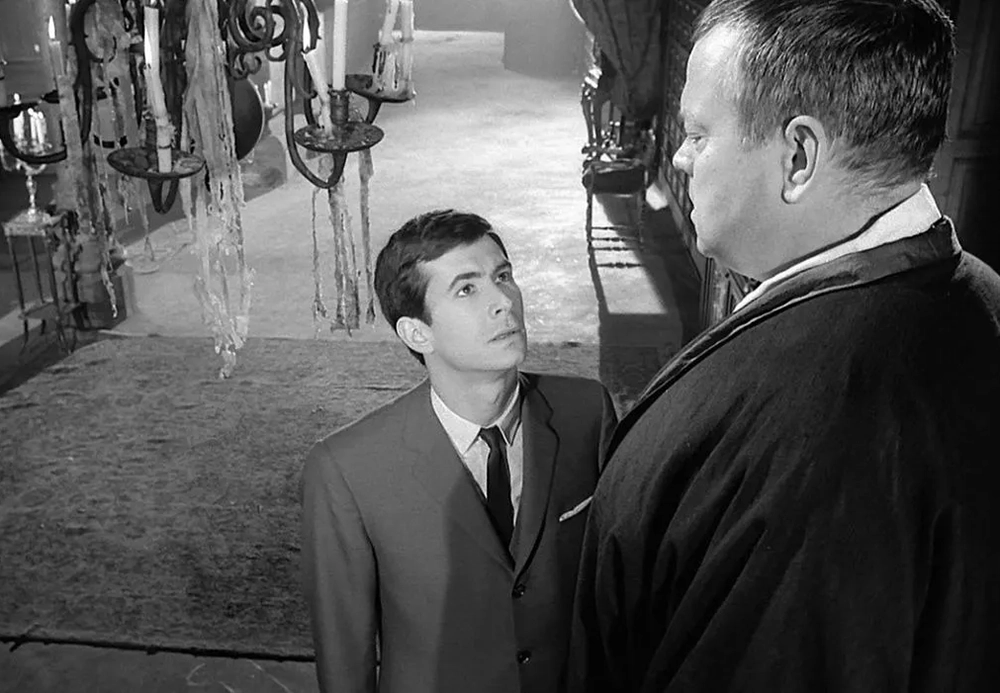
To say “The Trial” was Welles’ takedown of Hollywood—which was happy to ride the coattails of “Kane” but meddled with his follow up (“The Magnificent Ambersons” in 1943) isn’t inaccurate. However, it might be an oversimplification that underestimates Perkins’ contribution. Welles saw Perkins as a natural fit for this role, considering the trial he might be going through in real life, as a closeted gay man living in a high-pressure town that trades in gossip. In an interview, the director, Henry Jaglom, a close personal friend of Welles’, suggested casting Perkins was deliberate, intended to elevate the subtext of Perkins’ private sexual life to amplify Josef’s inner conflict. The film handles this dynamic sloppily. Josef pursues certain women he encounters (in particular Moreau and Schneider) while never having the time or privacy to consummate with them (fear of completion, perhaps).
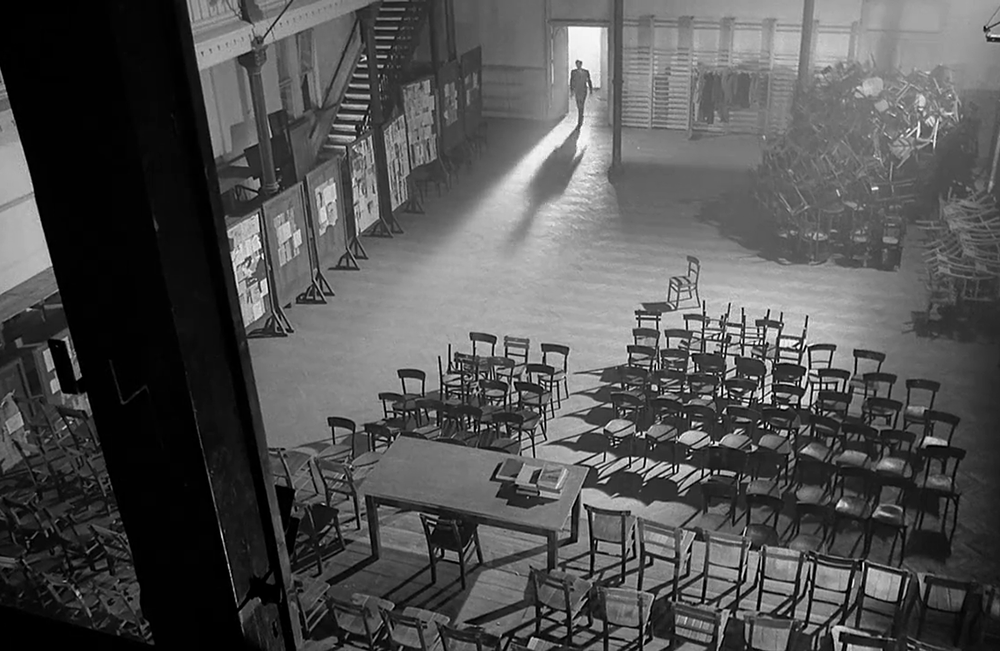
Excluding Perkins’ personal life and Welles’ documented professional struggles as helpful but impertinent context, the film has a life of its own. It’s exasperatingly brilliant, a visual stunner that only lags when Welles allows his character—a lawyer—to preach. Welles’ camera (cinematographer Edmond Richard shot many of Luis Bunuel’s later films) is characteristically restless, making skillful use of the baroque architecture and massive structures to show how overmatched Josef is. He’s a cog in a cruel machine, one which will defeat him whether he’s innocent or guilty. Anything he says or doesn’t say is used against him, including when he accidentally refers to his phonograph as a “pornograph.” The only escape he has is to go to work, where he sits clacking away at a typewriter with hundreds of co-workers. It’s an impersonal, suffocating space that resembles Jack Lemmon’s white collar assembly-line in “The Apartment” (1960).
‘The Trial’ Grips You and Doesn’t Let Go
At its best moments, “The Trial” grips you and doesn’t let go, sending you on the same terrifying dead-end chase that Josef is desperately trying to outrun. By the end of the film, Josef’s out of hope, and maybe it’s understandable that he admits defeat, having been either pummeled into submission or coaxed into confession. In one final explosive moment (anticipating Michelangelo Antonioni’s “Zabriskie Point”), Josef’s world collapses, and he begs for his life to end. It’s not just a cynic’s worldview. It’s Kafka meets Welles, which is to say, it’s a collaboration of larger-than-life artists that deserves its sharp new restoration, and a broader audience to celebrate its diamond jubilee.
“The Trial” opens at New York’s Film Forum on December 9th for a two-week engagement. Film Forum is located at 209 West Houston St., New York, NY 10014.
Support the Site: Consider becoming a sponsor to unlock exclusive, member-only content and help support The Movie Buff!
