



Relationships begin with simple gestures and often end the same way. It’s what happens in between – the emotions, the fights, the breakups – that have lasting impact, an impact that can last weeks, months, or even years. It’s these things, this ‘in-between’ stuff, that is examined in director Hunter Richard’s 2005 effort “London” a psychological mind-trip of a movie that is every bit as somber and depressing as its characters. Yet amidst the anger, the fights, the god-cursing and the drugs, the film manages to strike a sober commentary on relationships – not the good parts we remember and store for a rainy day, but the bad parts, the throes that have the capacity to send us off a cliff on mornings when we draw the blinds and see only bleak hopelessness stretching out before us.
The film opens with this view, as we glimpse its protagonist take a hit from a bong in a disheveled Manhattan apartment and attempt to pass out once again. The lights are out but it’s pure daylight; the only thing that prevents him from passing out once again is a phone call that sends him into a spiral – a friend informs him that his ex-girlfriend, a girl named ‘London’ is having a going away party that night and plans to leave town. The lad begins throwing things…first the phone, then the TV, and finally a basketball straight through a fish tank, heading out into the rain to meet a cocaine dealer in a shady bar while contemplating his next move.
The protagonist is Syd, played with a surprising deal of deft and heart by Chris Evans, better known for his male-model looks and superhero flicks, “Captain America,” “The Fantastic Four,” and “The Avengers.” The dealer in the bar is also a man we’ve seen before, but never like this. Jason Statham takes the role of ‘Bateman,’ who, at first glance appears to be a upper-class banker with a drug side business, but a man who we soon learn much more about as he and Syd tackle the ugly side of life from a locked bathroom of the penthouse where London’s going away party is being held.

On the surface, “London,” is an expose on failed relationships that won’t let go, and the images that haunt us as we try and move on. London is also a woman, played here by Jessica Biel, with a performance, I must say, I wasn’t expecting given her squeaky clean genesis in TV’s “7th Heaven,” or depthless follow-ups in movies such as “The Texas Chainsaw Massacre” or “Summer Catch.” Here she is sexy, dangerous, a bit vulnerable, and, underneath it all, frustrated. Much of the movie is told through flashbacks of her relationship with Syd from his point of view, showing arguments on innocuous topics: sex, jealousy, religion, humanity. Syd is the type of person who needs to push at things, who needs to know he’s right, even if it costs him the women he loves. In fact, this is one of the reasons he loses her: he can’t say those three little words, obsessed with the futility of trying to define human relationships with social convention.
This movie is not subtle. It’s rated ‘R’ and definitely earns it with a script with easily as man f-bombs as the office drama “Glengarry Glen Ross” or any episode of TV’s “Deadwood,” yet interweaves this with insightful dialogue about love, pain, and the dolor that often accompanies the human condition. Most of the acting is passable, particularly from Evans and Statham, who make you forget the action movies that lined their past with what borders on decent emoting. However, the inclusion of other actors is at times nonsensical, most notably the histrionics from Isla Fisher (“Wedding Crashers”) toward the film’s end, as well as the decision to cast Dane Cook as a partygoer, whose sarcastic style really clashes with a film that tries very hard to stay on the level.
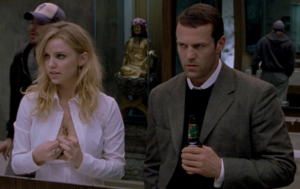 The movie deserves credit for its attempt to show not the chronology of a relationship, but the bits and pieces that make up its whole. Some scenes are over the top (such as a shouting match between Evans and Statham that rides a precarious line between honest discovery and male bravado), while some are markedly shorter than most people would like who’ve stayed around for the film’s 92-minute run-time. The film’s much-anticipated third act, the eventual meeting between London and Syd, feels rushed and doesn’t offer any kind of resolution. However, maybe it’s not supposed to; these aren’t innocents, but battle-scarred losers in a game of love, a loss that leads to heavy depression, panic attacks, drug addiction and even hints at suicide. “London” feels like a cautionary tale, though we’re not often sure of what.
At the end of the day, “London” isn’t a perfect movie, or even one of the top-ten on the subject. Films like “High Fidelity” and “Eternal Sunshine of the Spotless Mind” do an infinitely better job addressing romantic loss, while occasionally throwing the audience a joke or two to keep them from slitting their wrists. However, it does offer an interesting presentation (most of the film takes place in a locked penthouse bathroom), decent acting from most of the cast, as well as a somber soundtrack and a focused lens on people living in New York City we’re not used to seeing. The movie will make you think…however, after it’s over, you may want to walk outside and take a breath of fresh air. “London,” like the cigarette smoke and drugs that inhabit it, tends to hang in the air even after the closing credits.
– by Mark Ziobro

