


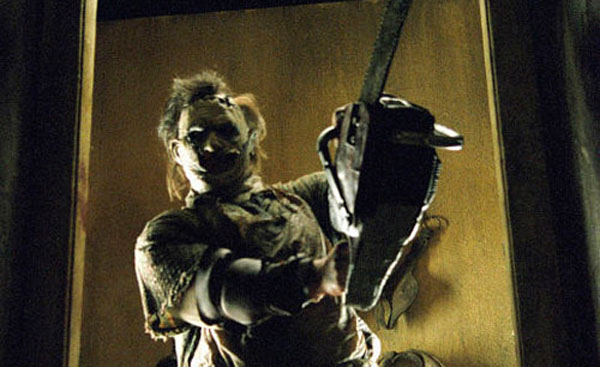
Giving a flat-out, bad review of a movie is actually a really hard thing to do. I think the reason is because, for the most part, most movies really do try. Giving a grade F, a zero stars, two thumbs down, whatever, requires a movie to truly fail. Failings can often be of the acting, direction, or even the special effects. But sometimes these things can all be in line and the movie still fails…for no other reason than the overall feeling it imparts. But at the end of the day, giving truly bad ratings often feels like an exercise in futility – why waste time, and keystrokes, reviewing something that you have very little, if anything, good to say about? It is with these thoughts in mind that I tackle “The Texas Chainsaw Massacre” – not the Tobe Hooper original, but the loathsome and gut-wrenching 2003 ‘remake.’
Most people know the story of the original and the remake really doesn’t bring much new to the table in terms of plot. A group of teenagers are driving through Texas, pick up a hitchhiker who acts strange and ultimately kills herself, and then, stopping to try and report the suicide to the police are lured in to the nightmare world of the Hewitt family. Most notorious is, of course, Leatherface, a deranged psycho who runs amok with a chainsaw, his face the composite of countless victims he’s killed and sewn on top of his deformed countenance.
The original was a relatively scary film, and had some genuine frights. The Hewitt House…Leatherface’s sledgehammer…the meat hook. Further fear was invoked through the close-knit but unstable way the Hewitt family tortured its luckless victims – both psychologically and physically. The original, released in 1974, held true to the then standard modus operandi of horror films of the day – suspense was built through careful direction, a bone-chilling movie score, and creative deaths. Any “Friday the 13th” or “Halloween” film will show the same. However, with the ushering in of a new millennium, the 2000s, these movie tricks have been abandoned in favor of quick scares, and long, drawn-out “torture porn”-esque scenes. “The Texas Chainsaw Massacre,” by Director Marcus Nispel, is an open and closed case in point.

The movie stars such actors as Jessica Biel (“7th Heaven”) and Eric Balfour (“Dawson’s Creek”). But the characters couldn’t be further from these shows that launched their careers. One by one they are accosted, tortured, and killed by the maniac Hewitt family, most notably Leatherface. His drawn out killing methods will less scare you, and more have you turning away in disgust.
To make one thing clear: the deaths aren’t scary. No. The word to describe them is flat-out revolting, in a way to make the “Saw” franchise look like a ‘Lifetime’ special. Exquisite detail is given to the horror his victims feel, and even more detail is then given to watching them writhe in agony for a purpose that is not defined at all. The movie doesn’t want to comment on violence, or present horror in a tongue-in-cheek manner. It simply wants us to live their nightmare. In “Friday the 13th” we know why Jason kills. In “A Nightmare on Elm Street” we know why Freddy kills. In “The Texas Chainsaw Massacre,” we don’t know why Leatherface kills. And we’re not supposed to. He exists so the gore can exist. Period. No amount of exposition can cure this fact.
Likewise, R. Lee Ermey, of “Full Metal Jacket” fame, takes on the role of Charlie Hewitt/Sheriff Hoyt, a ruthless, calculated maniac masquerading as the town sheriff, who enjoys killing teens more than it seems Leatherface does. Acting is not an issue; that is not a problem. Ermey owns his character with an almost Oscar-seeking dedication. But therein lies the problem – Sheriff Hoyt, like Leatherface, exists as objective evil, inserting us into a living nightmare from which death seems the only escape. Motivations for their actions (or the film) aren’t presented.
Perhaps this is what makes the movie’s desperation so profound. Had Leatherface had some motivation, or some method to his madness, we could write it off as done in the name of horror. However, his cold, calculating nothingness fills audiences with revolt and dread. He doesn’t kill people…he slaughters them. And he slaughters them with such unabashed and jerky recklessness, and with such unequivocal malice, that one has to wonder if the hapless victims are being tortured by his chainsaw, or rather by the un-exorcised demons of “Texas’” filmmakers.
 For instance, take one circumstance which shows one unfortunate youth being hung from a meat hook and having a severed limb ‘packed’ with ice. His ensuing struggle to free himself from said hook takes not one, but two protracted scenes of senseless, gut-wrenching disgust until we find him begging a survivor who finds him later to finish him. It’s not horror or fright, but terror elevated to a degree of almost sadistic-voyeurism. The same cinematic effect can be garnered from watching any of the “Faces of Death” series or by visiting a local slaughterhouse and watching cows being gutted. Perhaps a mortician, or an autopsy doctor can watch “The Texas Chainsaw Massacre” without their stomach turning. Ordinary moviegoers, however, will most likely not share this same blessing.
What makes “The Texas Chainsaw Massacre” such a tragedy is that it has a lot going for it: good set pieces, overall-decent acting, and, I must admit, top of the line special effects. But it’s all wasted. Whatever genuine frights or scares the movie dredges up are ephemeral, traded for extended scenes of dolor and despair. While there is some vindication, and a small victory for its hero toward the end, it’s not enough. For all the torture, pain, and suffering that Biel and co. undergo for its 98-minute runtime, the only suitable revenge would be a full-scale firebombing of the accursed Hewitt residence, or to somehow kill each and every family member 5 or 6 times over.
Alas this doesn’t happen. At the end of the movie we are left only with one comforting thought: the movie is over, and at the end of the day it really is just that — a movie. Several teenagers didn’t actually just get brutally tortured for 98 minutes. But, somehow, you still feel just dirty for the effort.
– by Mark Ziobro


2 Comments
Pingback: » The Collector (R)
Awesome article.