


I’ve made no secret of my limited patience for television. In an essay about “Ted Lasso” earlier this year, I wrote about my frustration with shows that stretch promising stories across more episodes than they really need. It’s one reason I’ve always gravitated toward movies. Even when a film overstays its welcome, there’s usually a finish line in sight. But when an invitation to join a virtual roundtable with Ethan Hawke about FX’s “The Lowdown” comes my way, I know I have some catching up to do. By the time our November 13 conversation arrives, I’ve made it to the third episode of Season 2, having squeezed in as much viewing as my schedule allows.
To my surprise, I’m enjoying myself. I want to know where the story is going, and much of that enthusiasm has to do with Hawke, who seems to be having an enormous amount of fun playing a man who can barely get through a day without making things worse for himself.
The Joy of Watching a Well-Intentioned But Reckless “Truthstorian”
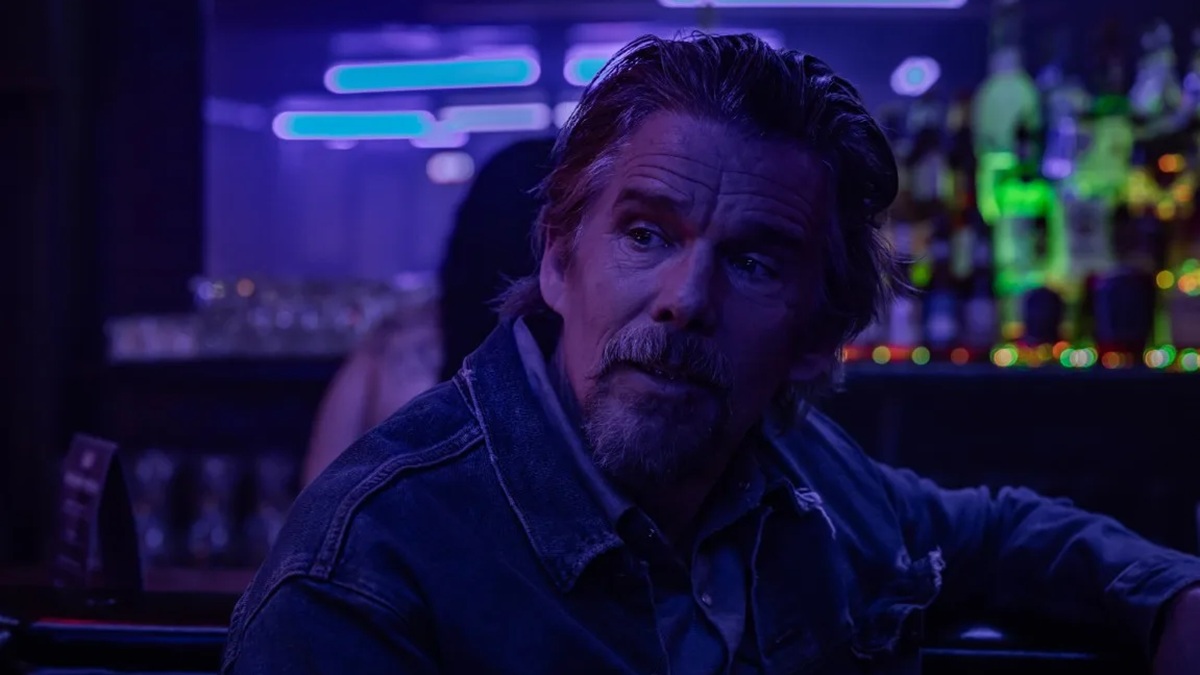
Created by Sterlin Harjo, the filmmaker behind “Reservation Dogs,” “The Lowdown” follows Lee Raybon (Hawke), a self-appointed Tulsa “truthstorian” who runs a rare-books store while investigating corruption, political wrongdoing, and whatever other trouble catches his attention. He’s intelligent, resourceful, and committed to finding the truth, although his instincts for recognizing a bad idea don’t always extend to his own decisions. Sure, Lee can sniff out a conspiracy, but he sometimes struggles to recognize when he’s walking straight into one.
Hawke embraces the character’s recklessness, giving even his most questionable decisions a certain urgency. Lee genuinely believes he knows what he’s doing, and it’s often hilarious to watch that confidence collapse. I also find myself rooting for him, sometimes against my better judgment. His methods are occasionally absurd, but his convictions are sincere. Hawke understands that the audience needs to believe in Lee even when Lee has very little reason to believe in himself.
During our roundtable, which brings together six journalists from different countries, I ask Hawke about the difference between Lee and the traditional noir detective. The classic detective often projects control even when everything around him is falling apart. Lee frequently believes he’s in control without realizing how badly things are going. How, I wonder, does Hawke play that gap between the character’s self-image and how others perceive him without reducing him to a joke?
Hawke lets out a light chuckle, then pauses. “That’s kind of the dance of the show,” he says, describing the difficulty of taking someone seriously when he’s “so self-involved and so ridiculous and trips on his own boots all the time.”
Much of it, Hawke explains, comes down to Lee’s intentions. His “heart is in the right place,” and he hopes audiences recognize that he’s “three steps away from really being a terrific guy,” even if he keeps stumbling over the same shortcomings.
“It’s fun to watch somebody who’s in control and manipulates things well, but I find it more interesting to watch somebody fall on and off, and on and off. I find that really exciting.”
On Embracing Lee Raybon’s Recklessness
Watching Hawke, I never get the impression that he’s standing apart from Lee’s foolishness, inviting us to laugh at him. He commits to it completely. Every ill-advised decision is another chance for Lee to prove himself, and every setback seems to leave him just as convinced that he’ll get things right the next time. There must be an exhausting amount of optimism buried underneath all that cynicism.
“He’s very smart,” Hawke continues, before correcting himself a bit. “I mean, he does dumb things, but he’s motivated for the right reasons, and he’s willing to work hard.”
Hawke finds it more interesting to watch someone repeatedly lose and regain control than to follow a character who knows exactly how to manipulate every situation. Lee certainly gives him plenty of opportunities to explore that preference. His investigations can be dangerous, his personal life is a mess (his complicated relationship with daughter Francis, played by Ryan Kiera Armstrong, deserves a thinkpiece of its own), and he has a habit of charging ahead before considering what might happen next. A more sensible man might save himself a great deal of trouble, although I’m not sure I’d enjoy watching him nearly as much.
I’m also curious about the way Lee understands himself. He spends his days surrounded by books, chasing mysteries, and behaving as though he’s the hero of some grand investigation. Given Hawke’s own interest in literature, I decide to have a little fun with my second question. If he could put one book in Lee Raybon’s hands that might help him understand himself better, what would it be?
Hawke laughs, then offers a rather revealing explanation of the character.
“My hit on Lee is that his problem is that he sees himself a little bit in the third person,” he says. “He sees himself like a character from a novel, and so he’s kind of almost playacting all the time.”
“He’s trying to be Hunter S. Thompson, you know,” Hawke adds.
Focusing on the Actor Behind the Role
I’ve considered Lee’s tendency to overestimate his abilities, but Hawke’s observation gives me another way of looking at his behavior. Lee isn’t just a journalist with an inflated sense of confidence. He seems to have an idealized picture of what a journalist should be, assembled from the writers and fictional investigators he admires. The trouble comes when the man he’s trying to become interferes with the man he actually is.
Hawke also sees Lee as someone who’s never quite left the 1990s. During another exchange, he recalls telling the costume designers that Lee might have owned certain clothes since 1996 and bought his boots in 1992. The character has little interest in smartphones or computers, preferring a world of zines and mixtapes. Hawke even suggests that Lee could be an alternate, middle-aged version of Troy from “Reality Bites” or Jesse from “Before Sunrise,” two characters who helped define the actor’s early career.
It’s an amusing comparison, particularly considering how much of Hawke’s screen persona has been built around articulate, restless men trying to make sense of themselves and the world. Lee shares some of those qualities, though he has a considerably greater talent for making a mess of things.
Hawke knows how easily an actor can become associated with a particular type of character. When asked about Harjo writing the role specifically for him, Hawke acknowledges that such arrangements can be limiting. A filmmaker might have a fixed idea of what an actor does well and keep asking for variations of the same performance. Harjo, by contrast, gives Hawke considerable freedom to experiment and contribute. Hawke likens the experience to working with Richard Linklater, his longtime collaborator, whose trust in his actors has allowed him to explore different sides of his craft.
I find myself thinking about that answer in relation to what Hawke says about Lee. Hawke is conscious of the expectations that accompany his screen persona and enjoys finding room to maneuver within them. Lee, meanwhile, has fashioned an identity from the stories and characters he admires, apparently without realizing how much he’s performing. It’s a curious relationship between actor and character, particularly when the character seems so convinced of his own authenticity.
Going Full Circle, From Being a Father to Being a Son
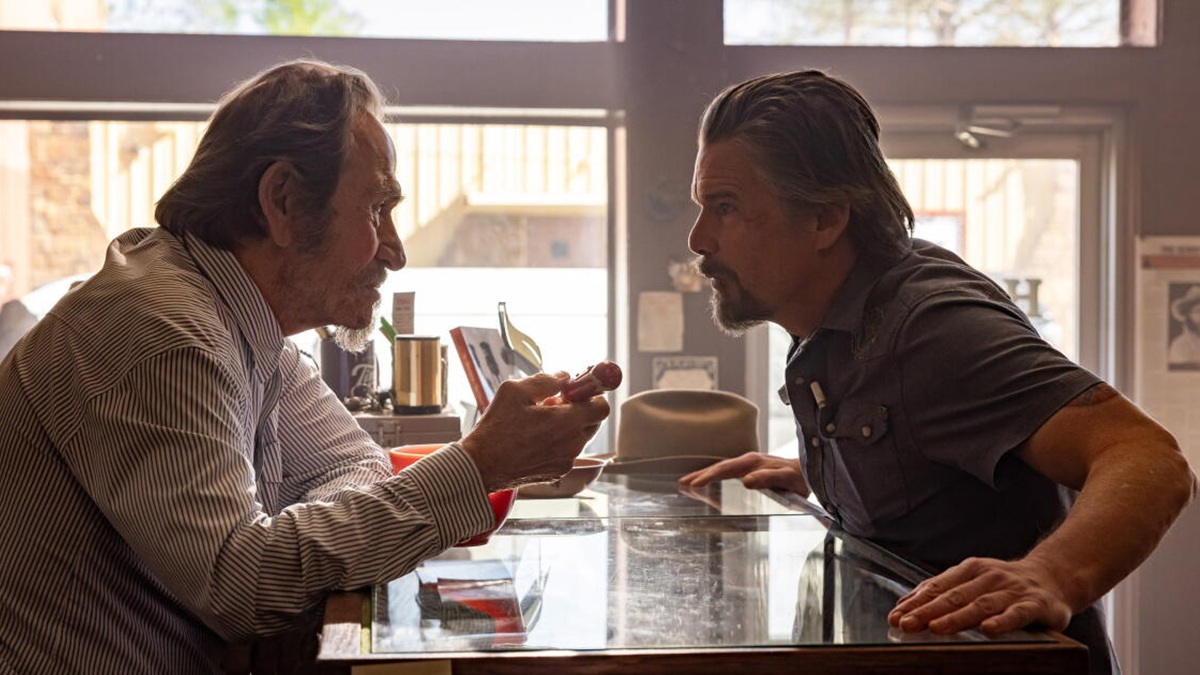
I’m not sure where the rest of the episodes will take me. But so far, Season 2 gives Lee plenty of reasons to reconsider that self-image, although he doesn’t always recognize them as such. The arrival of public defender Ginger (Betty Gilpin) complicates his already disorderly personal and professional life, while the unexpected return of his estranged father, Lee Raybon Sr. (Tommy Lee Jones), brings problems he can’t solve simply by following another lead. I won’t spoil the particulars, but both relationships expose aspects of Lee that his usual bravado can’t quite conceal.
Hawke describes the progression between seasons in surprisingly simple terms. Season 1 concerns Lee learning how to be a parent, while Season 2 finds him learning how to be a son. It’s a strange predicament for someone in his fifties, as Hawke acknowledges, but he also points out that people don’t necessarily figure these things out when they’re supposed to. Lee spends so much of his time investigating other people’s secrets. His own relationships are another matter.
Through all of it, Hawke continues to play Lee with an affection that survives the character’s most exasperating tendencies. There’s still a decent man somewhere underneath the swagger and self-mythologizing, even if Lee makes finding him considerably harder than it needs to be.
It’s fun to watch somebody who’s in control and manipulates things well, but I find it more interesting to watch somebody fall on and off, and on and off. I find that really exciting.
Ethan Hawke, on his character Lee Raybon
Going Meditative?
Which brings me back to my question about books.
For someone who spends so much time reading, investigating, talking, and imagining himself in the middle of some great adventure, Hawke’s recommendation is surprisingly modest. He doesn’t suggest another detective novel, a journalistic classic, or even the writings of Hunter S. Thompson.
Instead, he figures Lee could use “some zen meditation book,” something to help him “understand how to quiet down.”
That makes me laugh. Thinking about it, I suspect getting Lee Raybon to sit still long enough to read it would be another investigation altogether.
More Interviews: Quinta Brunson • Rebekka Karijord • Olivia Wilde • Devonté Hynes

