



On September 20, 1982, military forces raided a house in Davao City where Edgar “Edjop” Jopson was staying. According to sources, he was shot while trying to escape, taken alive, brought to a military camp for interrogation, and killed the following day. He was 34. By then, the former Ateneo student leader had traveled an enormous political distance: from president of the National Union of Students of the Philippines and an advocate of reform, to labor organizer and ranking figure in the underground revolutionary movement. By 1981, the bounty on his head was ₱180,000 (roughly ₱2,100,000, or $33,000, in today’s money).
Katski Flores’ “EDJOP” begins close to that endpoint. Elijah Canlas’ Edjop walks into a barber shop hoping to get a haircut without attracting attention. Another customer catches his reflection in the mirror and thinks he looks familiar. Edjop brushes him off, but before we know much else about him, the film has already established what it means for his face to be recognizable. He’s in hiding, and recognition itself has become dangerous.
The sequence expands outward as authorities close in. An officer briefs a subordinate on the fugitive they’re looking for, and before long Edjop’s hideout is surrounded. He is shot. Only then does the movie move to its second protagonist: his daughter Joyette, played by Jodi Sta. Maria, training as her voiceover explains different kinds of race courses. There are point-to-point races, loops, courses that carry you somewhere and those that eventually return you to where you started.
The metaphor isn’t difficult to decode. “EDJOP” will keep returning to it as Joyette, an endurance athlete who eventually finds success in an Arctic race, tries to understand a father she was too young to really know. Flores cuts between both lives across several decades: Edjop moving toward a historical endpoint we already know, and Joyette trying to work out where his history belongs within her own.
Five years in the making, “EDJOP” looks exactly like a film that has been given time. Neil Daza’s cinematography is handsome without turning the past into a museum display, and Benjamin Tolentino’s editing keeps all those jumps in chronology surprisingly easy to follow. Canlas gives Edjop an alertness that gradually becomes political conviction, while Kakie Pangilinan, making her film debut as his wife Joy, was the performance that surprised me most.
There’s a lot here that works. There’s also another version of “EDJOP” I kept imagining, one that instead stayed almost entirely with the man himself.

Introducing Edjop Through a [Partly] Standard Biopic Approach
The biographical half follows a recognizable path. Edjop comes from a comfortable family, becomes an Ateneo student leader, and gradually encounters social conditions that change the way he understands his place in the country. Historically, Jopson was initially associated with the moderate or reformist wing of the student movement. During the First Quarter Storm, he famously challenged Ferdinand Marcos to put in writing that he wouldn’t seek another presidential term. After graduation, he turned away from more conventional professional opportunities, went into labor organizing, worked with the Philippine Association of Free Labor Unions, and later became involved in the landmark La Tondeña strike. His politics continued moving left until he joined the underground revolutionary movement.
Canlas is good at making that transformation gradual. Edjop watches people before he decides what he thinks about them. He listens to workers and begins encountering lives his upbringing had allowed him to understand mostly from a distance. Later, the film grows much harsher in its imagery, showing armed forces terrorizing rural communities, people killed and villages burned while ordinary citizens ask for better wages and living conditions.
And yet this is also where I think “EDJOP” leaves some of its most powerful material on the table.
The movie tells us repeatedly that the Jopsons are well-off. We see the large family home. We see employees of the family grocery business eventually form a picket line. Dialogue fills in the rest. Historically, the contradiction went even further: Jopson helped organize workers in his own family’s supermarket business, putting him into direct conflict with his father, whose grocery operation had grown from a sari-sari (sundry) store into a thriving enterprise. It’s an astonishing piece of his political development because class consciousness stops being theoretical at that point. Labor isn’t somewhere else. The owner is his father.
Flores has all the ingredients for a sharper visual collision, but the film doesn’t quite build one. We know Edjop is privileged because characters say so and because there’s a big house behind him. We don’t really get the textures of that privilege: how his family occupies space, what comfort looks like from inside that household, how the grocery business positions the Jopsons in relation to the people working for them, or how far Edjop initially stands from the communities he will later live among.
That absence weakens something in his awakening. When Flores shows state violence against farmers and poor communities, she makes it physical. We see bodies, guns, burning structures, terrified people. Oppression has an image. Edjop’s class position, meanwhile, mostly relies on exposition.
Even the grocery picket could have carried more weight had we understood the business before the workers appeared outside it. Instead, the film asks the strike itself to supply both the social context and Edjop’s conflict with his family. The historical irony is considerable: a young man raised partly through the success of a family enterprise finding himself aligned with the people challenging how that enterprise treats labor. The screenplay understands the irony, but the camera doesn’t always give it the same force.
There’s a semiotic thinness here that surprised me because the opening barber-shop sequence shows Flores is capable of thinking through signs. Edjop first registers to another person through a mirror. A face becomes evidence; recognition becomes danger. The large Jopson house later becomes shorthand for wealth, just as burned villages become shorthand for what state power can do to people beneath it. But where the latter images are visceral, the former remains closer to a symbol placed in the frame because we need to know what it means.
I didn’t need “EDJOP” to turn itself into a lecture about class. In fact, the movie already lectures too much. I wanted the opposite: for the rooms, bodies, workplaces, clothes, distances, and relationships inside the frame to make Edjop’s social position tangible before he begins moving away from it. His decision to live among workers and eventually go underground would then involve not just an ideological shift but a visible movement from one material world into another.
The film hinges on the idea that Edjop left privilege behind. For that to resonate, the images should make us feel what was being left.
A Father Everyone Knows Except His Daughter
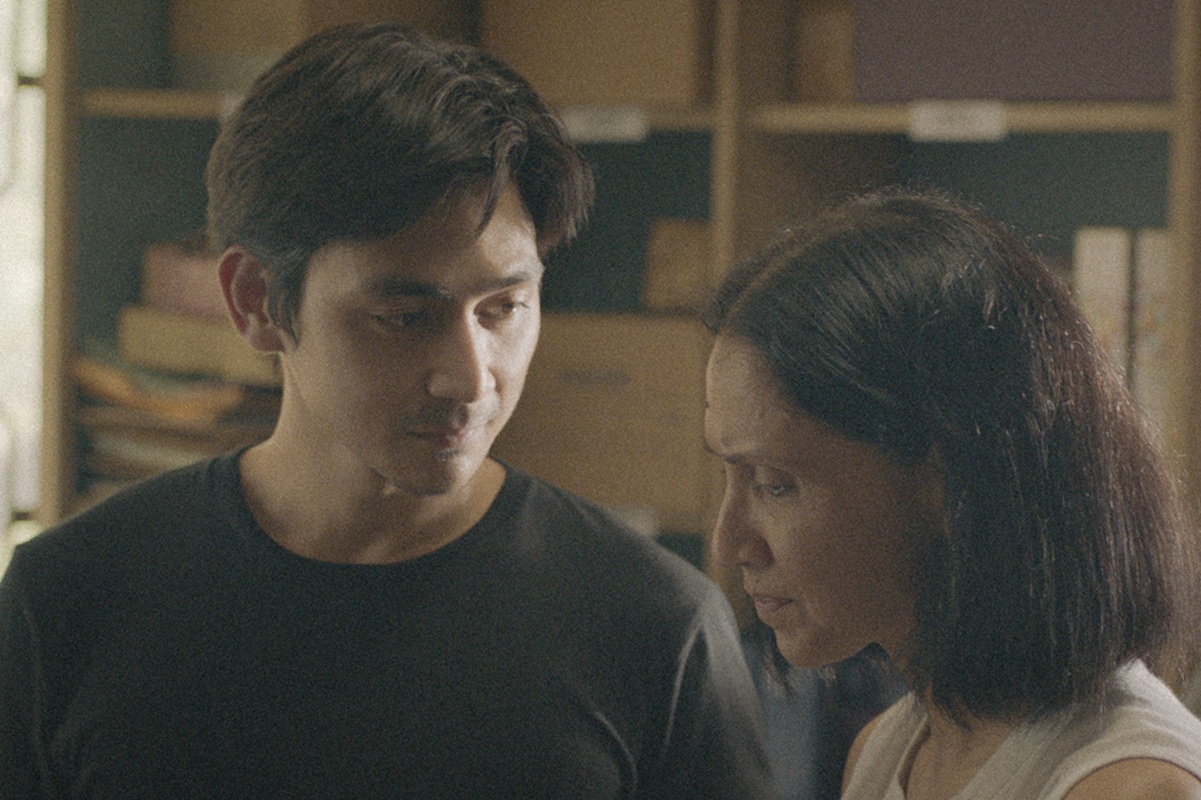
Joyette’s half of the story is more successful in turning absence itself into something we can feel. Other people know Edgar Jopson through photographs, rallies, stories, political history, and commemorations. Joyette simply knows him as “Tats,” a word attached to somebody she barely remembers.
The movie gets some of its best friction from her resistance to public remembrance. When commemorations for Martial Law victims come around, she doesn’t instinctively feel drawn toward them. Everyone seems to possess some version of her father except her. “Never forget” becomes an odd instruction for a daughter who never had enough time with the man to accumulate much memory in the first place.
That was what made me think of Alison Tavel’s “Resynator,” another film about a daughter trying to locate the person inside a father she never truly knew. Tavel had family mythology and the synthesizer her father invented. Joyette has something even more intimidating: history itself. Her father doesn’t belong only to surviving relatives and friends. People have already decided what Edgar Jopson represents before his daughter has figured out what he means to her.
The “Sentimental Value” comparison came to me elsewhere. Joyette eventually visits the Jopsons’ ancestral home, and the house acquires some of the emotional function that Joachim Trier gives the Borg home in his film. Rooms survive people. Objects stay where memories don’t. The idea becomes more painful once Joy, now played by Menchu Lauchengco-Yulo, begins showing signs of Alzheimer’s disease. Joyette has spent much of her life trying to recover a father she cannot remember; now the woman who knew him intimately is beginning to lose her memories of him too.
Conversations with Joy and with Joyette’s brother Noy, played by Cedrick Juan, gradually change the way she looks at the inheritance she once resisted. The movie is affecting whenever it allows those family exchanges to remain complicated. Joyette doesn’t need to dislike what her father stood for to resent having grown up without him, and Sta. Maria is at her best when affection, curiosity, and irritation occupy the same scene.
When the Film Trusts Its Story
“EDJOP” moves through 1958, 1965, 1969, 1972, 1976, 1982, 2003, 2008, 2013, 2017, 2019, and other points in between. Written down, that sounds considerably messier than it plays. Fortunately, Tolentino’s bravura editing keeps the chronology clear, the actors provide obvious visual anchors, and the parallel structure develops a pleasant rhythm once the movie settles into it.
My reservation is less about the time jumps than the amount of guidance surrounding them. There are title cards, explanatory conversations, Joyette’s voiceover, recurring athletic metaphors, and Len Calvo’s almost wall-to-wall score. Individually, most of them work. Together, they occasionally give the movie a nervous habit of saying something and then making certain we understood it.
The triathlon motif is a good example. Joyette understands endurance through the body. She knows repetition, fatigue, long stretches where progress feels abstract, and the discipline required to continue anyway. Connecting that to her relationship with an inherited history makes sense. But we understand the association quite early, and the more often the movie returns to different race courses as metaphors for life, memory, and acceptance, the less room the image has to expand on its own.
It reminded me of a reservation I had with Dustin Celestino’s “As the Hydra Devours History,” a movie that I actually liked. That film found a clever vocabulary in Greek mythology for the exhaustion of living through recurring political crises, then sometimes explained its own allegories until they barely needed interpreting. “EDJOP” isn’t nearly as aggressive about it, but the impulse is familiar. Flores and co-writer Jade Castro have found a genuinely accessible way into a historical figure who may be unfamiliar to younger Filipino audiences. They don’t begin with the assumption that everybody knows what the NUSP was, why labor organizing mattered, or how a reform-minded student leader could eventually decide that reform itself was no longer enough. There’s value in that clarity.
And “EDJOP” is strongest when political awakening comes through experience rather than instruction. Edjop listens to workers. He encounters violence. His understanding of power changes. Whatever a viewer thinks of the ideological destination he eventually reaches, the movie allows us to follow the road toward it. The politics, then, weren’t really my issue. The filmmaking simply becomes more persuasive whenever it trusts action, faces, and images to carry them.
Two Movies That Mostly Find Each Other
This brings me back to the framing device, which remains my largest reservation, albeit not a fatal one.
Edjop’s life already contains a remarkable amount of dramatic movement: the privileged Atenean, the moderate student leader, the labor organizer, the husband and father, the underground revolutionary, the detainee who survives torture and escapes, then the wanted man living clandestinely in Mindanao before his death at 34. Canlas could sustain an entire film built around that trajectory.
Whenever his story gathers momentum, “EDJOP” has another chronology waiting. We return to Joyette training, competing, finding love and losing it, talking to family, or struggling with the strange position of being related to a man who has become public property. At first, I found those interruptions frustrating because Edjop’s story advances through concrete decisions while Joyette’s movement is mostly internal. One drives forward; the other circles.
That imbalance never completely goes away, but I also understand why Flores takes the risk. Without Joyette, “EDJOP” might be a smoother historical biography, but probably also a more familiar one. Her presence, then, changes the question from “Who was Edgar Jopson?” to “What does it mean to grow up as Edgar Jopson’s daughter?”
Sta. Maria gives that question more personality than the voiceover sometimes allows. Her Joyette is practical, guarded, and occasionally annoyed by the obligation to feel a certain way about somebody she barely knew. I liked that the movie lets her resist the rituals surrounding her father before it asks her to embrace anything. The later reconciliation with his legacy may be foreseeable (and boy does the film telegraph it from the get-go), but Sta. Maria keeps it from becoming merely ceremonial.
There’s also something interesting in the unequal movement of father and daughter. Edjop keeps moving farther away from the world he came from. On the other hand, Joyette spends much of the film moving back toward something she spent years avoiding. The race-course metaphor may be overstated, but the structure itself has a nice symmetry: one life becomes history while another keeps circling that history, deciding whether to enter it.
Kakie Pangilinan Makes an Entrance
Canlas’ casting makes immediate sense. He has enough youth in his face to sell the student years, along with a natural alertness that works for someone constantly reading the political temperature of a room. As Edjop becomes more deeply involved in labor and underground organizing, Canlas avoids playing him as a monument. Some boyishness survives the seriousness, and the charisma helps explain why people would listen to him in the first place.
The performance is also at its best when political commitment collides with domestic life. A historical biography can make sacrifice sound inherently noble, especially when we already know the subject will be memorialized. “EDJOP” occasionally allows the uglier side of sacrifice to remain visible. Going underground means leaving people behind, and the person making that choice isn’t the only one who pays for it.
Kakie Pangilinan gives those scenes much of their warmth. I wasn’t familiar with her game, so consider this my apology.
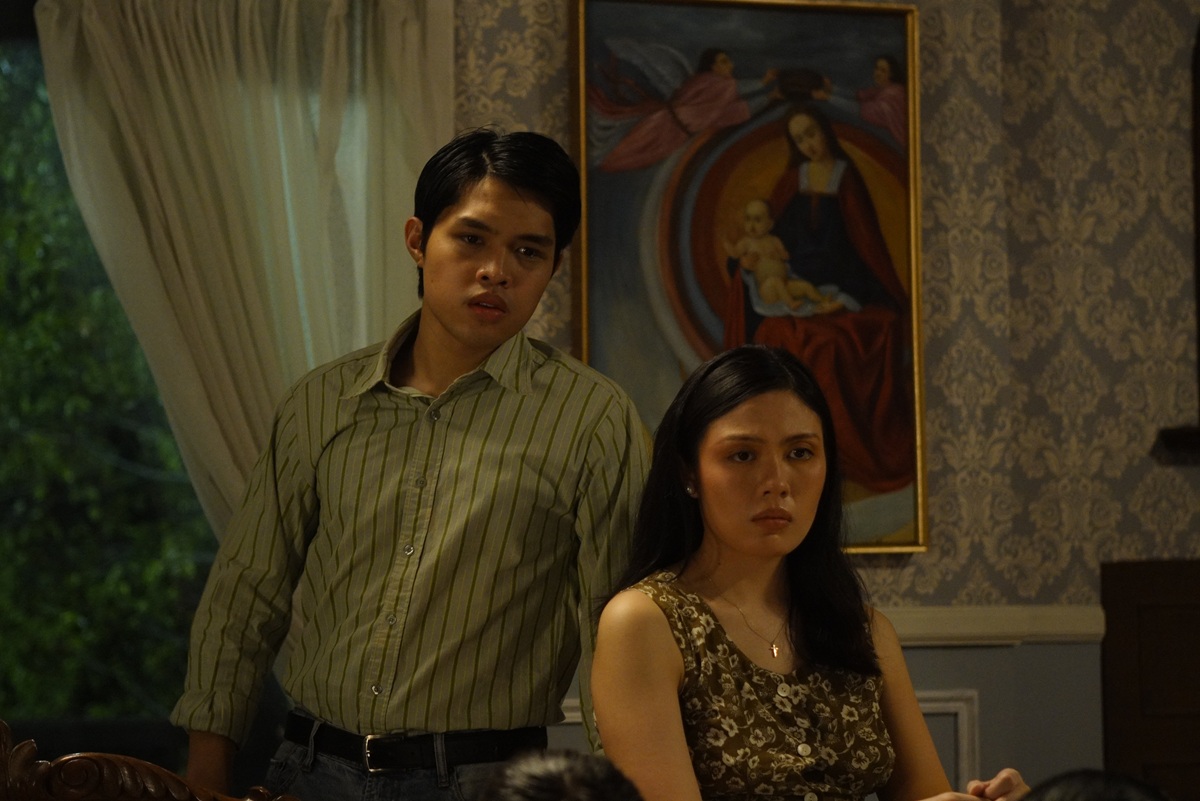
There’s something immediately period-appropriate about her presence. She and Canlas look convincing in the clothes and hairstyles without seeming like contemporary actors playing dress-up. Pangilinan’s voice helps too, with its slightly conyo, kolehiyala cadence and warm timbre. At certain moments she reminded me of a young Sandy Andolong.
More importantly, she can act. Pangilinan doesn’t approach Joy as “Edgar Jopson’s wife,” patiently stationed beside a historically important man. There’s ease in her early scenes with Canlas and increasing unease once their marriage has to accommodate danger as part of ordinary life. She’s especially good at listening. Joy’s worry often arrives in a look before the screenplay can name it. Considering the actors surrounding her, Canlas, Sta. Maria, Lauchengco-Yulo, and Cedrick Juan among them, that Pangilinan still came away as my revelation says plenty. I’m curious where she goes after this.

What a Daughter Can Remember
For younger viewers especially, “EDJOP” may serve as an introduction to someone whose political evolution is more complicated than the simplest version of his legacy. Jopson began as a reform-minded student leader and eventually became a ranking figure in the underground revolutionary movement after Martial Law. His biography crosses class, student politics, organized labor, family, ideological radicalization, and state repression within a life that ended at a very young age.
I still wanted the film to press harder on some of those contradictions, particularly the class distance Edjop crosses and the effect his choices have on his family. But there’s generosity in Flores’ approach too. She doesn’t reduce his life to the final raid, nor does she make Joyette’s eventual acceptance of her father dependent on pretending his absence never hurt.
By the end, Joyette hasn’t recovered some magical cache of childhood memories. She simply knows more. Other people give her pieces. Her mother gives her what she still can. The family home gives physical shape to experiences that happened before Joyette was old enough to comprehend them. She slowly finds a place for herself inside a history that had previously seemed to belong to everybody else. That’s where the “Resynator” comparison finally settles for me. Alison Tavel had to dismantle some of the mythology around her father to get closer to the person. Joyette begins suspicious of the public mythology surrounding hers, then gradually discovers that accepting its place in history doesn’t require pretending she remembers a relationship she barely had.
Would “EDJOP” have been tighter had Flores focused only on Edgar Jopson? Probably. Canlas and the historical material could have carried that film. But it would also lose what makes this version emotionally distinct: the uncomfortable fact that a country can remember somebody far more vividly than his own child can.
“EDJOP” sometimes explains too much and occasionally makes its metaphors work harder than they should. But it’s also thoughtful, beautifully produced, well acted, and sincere in its attempt to bring a political figure back down to the scale of a husband, a father, and a man whose choices continued shaping his family long after his death. The history gives the film its reason for existing. Joyette gives it something more difficult: a reason to ask what remembering actually means.

Katski Flores’ “EDJOP” is scheduled for theatrical release in the Philippines on September 16, 2026. Follow us for more coverage.

