


“Mabuhay,” a tour guide (Pipay Kipay) tells a busload of wealthy Chinese visitors on their way to a Philippine country club. “In English, long live.” She invites them to repeat it, then teaches them something more practical. When it’s hot in the Philippines, we say, “Shit, ang init!”
It’s a terrific introduction, performed with the overeager cheer of a tour guide determined to keep her passengers entertained. The tourists play along, though their interest has limits. They’re headed somewhere the heat will remain little more than local color, a nuisance to complain about between cold drinks, air-conditioned rooms, and rounds of golf.
Nearby, workers discuss trees wilting beneath the sun. Someone expresses sympathy. The response is immediate: don’t worry, if one dies, it can easily be replaced.
Rafael Manuel’s “Filipiñana” keeps finding comedy in that distance between what wealthy people say and what their comfort allows them to ignore. The film is often hilarious, sometimes broadly so, but each joke carries a delayed reaction. The laughter comes first. Recognition follows, and that’s when the smirk begins to wear off.
A Coming-of-Age, Told From Two Perspectives
Set almost entirely within an exclusive golf club outside Manila, “Filipiñana” follows 17-year-old Isabel (Jorrybell Agoto) as she begins working as a tee girl, placing balls in front of golfers at the driving range. She doesn’t understand all the rules of the place yet: which areas she may enter, which members she can approach, or why club president Dr. Palanca (Teroy Guzman) exerts such a peculiar pull on her.
When he speaks to her in Ilocano, their shared language offers a flash of familiarity inside an institution designed to remind Isabel that she doesn’t belong. She soon finds herself holding one of Palanca’s golf wedges, and the need to return it becomes a useful excuse to search for him. Yet the wedge isn’t her only reason. Isabel is already fascinated by the man, even if she can’t explain whether what draws her closer is admiration, infatuation, or something she has spent years trying not to remember.
Running alongside her is Clara (Carmen Castellanos), a Filipina based in New York whose uncle (Carlitos Siguion-Reyna) wants her to return home and help expand the family business. Clara is more educated, more mobile, and immediately alert to the absurdities surrounding her. She questions the excess, notices the labor hidden beneath the leisure, and pushes back against the assumption that a comfortable life in Manila must be preferable to whatever she has built abroad.
Their paths rarely intersect directly, but Manuel treats them as two sides of the same coming-of-age story. Isabel enters the club with little power and gradually learns how it operates. Clara arrives with enough distance to recognize its inequities, then discovers how quickly discomfort can soften once the system begins accommodating her.
When Impunity Learns Golf Etiquette
Golf gives Manuel an almost indecently convenient metaphor for Philippine class relations. The members pride themselves on playing well while employees carry their bags, prepare their equipment, retrieve lost balls, maintain the greens, serve their meals, provide entertainment, and absorb the heat on their behalf. What looks like individual achievement depends on an army of workers trained to disappear from the achievement itself. The poor encounter rules wherever they turn. They’re warned against walking through the wrong area, tasting food meant for members, or failing to satisfy a guest. The rich encounter people willing to bend those same rules before they even have to ask. When Clara wants to accept a penalty for a lost ball, she’s told not to worry. Her uncle doesn’t play with penalties. Nobody will find out.
“Everyone here plays like this,” a caddie assures her.
The line describes far more than golf. It’s Clara’s orientation into privilege—everyone takes the shortcut, accepts the favor, overlooks the infraction, and understands that consequences are negotiable when the right person breaks the rules. She doesn’t need to become cruel. She only needs to keep playing.
Manuel wisely avoids reducing Clara to an expatriate hypocrite who criticizes the country before enjoying its luxuries. Castellanos lets us see the friction between Clara’s principles, her uncertainty about where she belongs, and the appeal of having an entire system smooth the road ahead of her. Her uncle frames his job offer as a patriotic duty, arguing that the country’s brightest people flee abroad, complain from a distance, and refuse to help the Philippines progress. It sounds persuasive until his proposed solution turns out to be expanding a private company’s market.
National service, personal comfort, and corporate growth collapse into one convenient pitch. Clara sees through parts of it. The more unsettling question is whether seeing clearly matters when the structure around her makes complicity this easy.
Dr. Palanca receives similar nuance. He isn’t presented as a cackling villain who wakes each morning eager to exploit his employees. Instead, he can be charming, generous, and attentive. He provides entertainment, speaks Isabel’s language, donates to workers affected by drought, and inspires a campaign song praising his kindness, cleanliness, family values, and open-door leadership.
He may even believe his own benevolence.
Men like Palanca don’t need to think of themselves as villains. Their wealth and stature allow them to preserve a system that protects their appetites, excuses their failures, and converts structural harm into opportunities for charity. No single evil act keeps the cycle going. Status does most of the work.
More importantly, the golf course becomes a microcosm of the Philippines. When you’re poor, ascent comes with guardrails, warnings, and hands telling you where you’re allowed to stand. When you’re rich, even failure can be delegated: someone else will find the ball. Someone else will clean the mess. Someone else will endure the sun.
That’s why the film hits so close to home now. Philippine public life repeatedly shows us rules enforced most aggressively against those with the least room to break them, while powerful people turn every breach into a misunderstanding, private arrangement, or temporary controversy. Outrage arrives, explanations follow, the news cycle moves on, and soon enough the grass looks green again. “Filipiñana” doesn’t recreate one scandal or pin its anger on one politician. It captures the machinery that allows scandal, inequality, and impunity to become ordinary. That machinery survives because the people benefiting from it don’t need to be monsters. They only need to believe the course has always been played this way.

Symmetry is Just Another Chain of Command
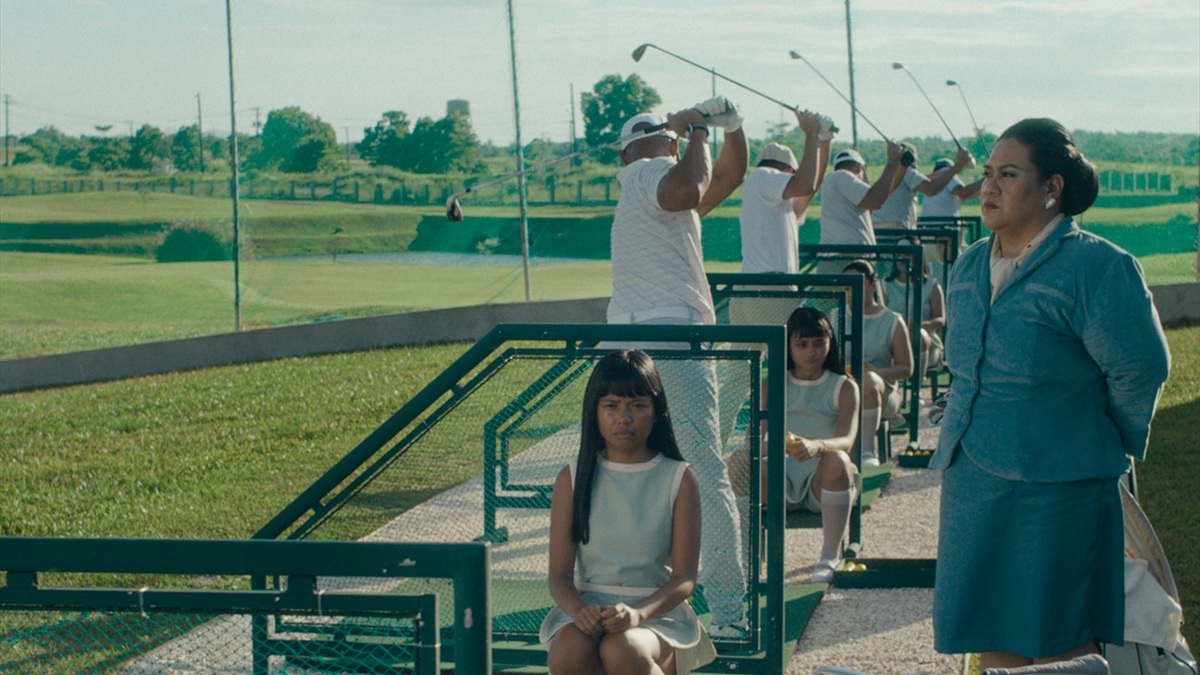
Manuel, who also edited the film, works with cinematographer Xenia Patricia and production designer Tatjana Fanny Honegger to make the country club look so clean that it feels dirty. The lawns are immaculate, the uniforms coordinate, and human bodies occupy carefully assigned positions within the frame. Every surface advertises order. Every composition makes you wonder who has been disciplined to maintain it.
The most immediate comparison is Wes Anderson. Manuel shares his fondness for frontal staging, eccentric symmetry, geometric architecture, and groups arranged as though someone has placed them there with tweezers. Yet the people inside these frames seem imported from Yorgos Lanthimos’ “The Lobster” and Lucrecia Martel‘s “La Ciénaga.” The former supplies institutional absurdity, with people repeating rules and gestures long after they’ve stopped making human sense. The latter, meanwhile, brings the oppressive heat, ambient unease, and ruling class too insulated to recognize its own decay.
Manuel’s symmetry isn’t whimsical. It’s administrative.
At the driving range, male golfers repeat their swings in a neat row while tee girls sit inside identical green stations, waiting to replace each ball. The men appear active and the women passive, though the entire exercise depends on the women’s labor. Elsewhere, employees line balconies, stairways, and hallways until they resemble extensions of the country club’s design. Their uniforms tell us their function before the film allows their individual personalities to emerge. The workers push back against that neatness through slumped postures, wandering attention, gossip, exhaustion, hunger, and jokes. One woman sleeps while others wait. Another steals a quick taste of food. Their bodies keep introducing imperfections into a world desperate to turn them into décor.
Agoto understands that tension instinctively. She gives Isabel the awkward physicality of a teenager trying not to attract attention while constantly ending up in the wrong place. Her shoulders pull inward. Her movements carry uncertainty, as though she’s waiting for someone to correct her even when nobody is speaking. She can look intensely watchful and completely lost within the same shot. Before “Filipiñana”, I considered Agoto’s finest performance to be her work in Sam Manacsa’s short film “Cross My Heart and Hope to Die.” She was remarkable there, but I’m glad to say her best performance now belongs to a feature.
Isabel’s fascination with Palanca looks a little hard to interpret at the start. Agoto never telegraphs whether the girl feels anger, curiosity, fascination, or something closer to a crush. Those emotions remain pent up, visible through the force with which she watches him and the discomfort passing across her face. Once the film begins uncovering the reason beneath that pull, Agoto’s earlier choices don’t register as vague. They look guarded.
Castellanos works from the opposite direction. Clara knows how to carry herself in this environment, even while questioning it. She speaks with confidence, challenges her uncle, and appears capable of leaving whenever she wants. Her performance quietly traces the difference between possessing freedom and exercising it.
The rest of the ensemble matches Manuel’s deadpan pitch, particularly during the film’s comic interludes. Workers speculate about Palanca’s body, members deliver tasteless jokes, performers sing old standards, and campaign chants turn club politics into a miniature electoral circus. The satire works because very little needs exaggeration. Anyone familiar with Filipino social life will recognize the way vulgarity, deference, hospitality, and political theater can occupy the same conversation without anyone blinking.
Someone Else Will Always Retrieve the Ball
Manuel occasionally overplays his formal hand. Some long takes accumulate tension, background labor, and tiny shifts in hierarchy. Others leave us watching the director reach for significance. Once you can feel the exertion behind the stillness, the scene’s airlessness stops feeling organic and begins to look imposed.
The symbolism can also become plentiful enough to announce itself. Golf balls, mangoes, flowers, water, imported vegetation, and manicured grass all carry political meaning. Not every image gains complexity through repetition, and the feature occasionally creates the impression that Manuel has stretched a shorter idea by holding onto certain compositions a little longer than they can bear.
The recurring trees are different. Trucks periodically arrive carrying enormous specimens meant to be planted across the grounds. The club imports living things into an environment that may not sustain them, waits to see whether they survive, then treats their possible death as a maintenance issue. A tree can always be replaced before the empty space becomes noticeable.
The same attitude governs the institution’s treatment of labor. People are assigned a place, exposed to the heat, and expected to remain decorative and useful. If someone disappears, gets sick, or can no longer perform the role, the arrangement itself won’t change. Another body can occupy the space.
That connection between landscaping and labor captures the film’s politics without requiring a speech. The country club doesn’t merely employ people; it organizes them as renewable resources. Someone fills each post, performs the assigned function, and remains useful until fatigue, injury, or the violence of the place makes replacement necessary. The composition stays intact even as the bodies change.
‘Filipiñana’: On Understanding That Impunity Rarely Raises Its Voice
For all its controlled surfaces, “Filipiñana” understands that impunity rarely looks dramatic from inside the rooms where it thrives. It looks like a favor. A joke. A donation. An exception to a rule. It may even look like a powerful man remembering where you came from, or a family explaining that their prosperity will eventually benefit everyone. Manuel keeps the film funny long enough for us to become comfortable in that world. Then he withdraws the distance that made the jokes safe. The club’s rituals begin resembling everyday stories, and its eccentric characters stop looking eccentric at all.
That shift makes “Filipiñana” one of the best films I’ve seen in 2026. It has the visual confidence of a filmmaker determined to control every inch of the frame, along with enough dark humor and anger to question what that control hides. Its excesses remain visible, and its feature length occasionally strains against a premise that might have played more cleanly with a shorter runtime. Yet those rough patches belong to an artist attempting a complete social world rather than settling for a tidy class allegory. That this is Manuel’s first feature feels both exciting and a little scary. He already has this much command of image, tone, and political anger; I can only imagine where he goes from here.
“Mabuhay” means “long live.” “Filipiñana” spends the rest of its running time asking who gets to hear that promise as a greeting, who receives it as a guarantee, and who already knows they can be replaced. By the time the movie ends, the laughter has stopped.
The grass, of course, remains perfectly green.

“Filipiñana” had its world premiere in competition at the 2026 Sundance Film Festival on January 23, 2026, and had its European premiere at the Perspective section of the 76th Berlin International Film Festival on February 15. The film will release in the Philippines on August 26, before having its US release in New York on August 28. Follow us for more coverage.

