


The first time I saw “The Voice of Hind Rajab” it broke my heart. I found myself having to rewatch it again for this year’s QCinema International Film Festival coverage and my heart was broken to pieces even more. What a collective cinematic experience to hear theatergoers sobbing along with you. This is without a doubt the most emotionally crushing movie I’ve seen this year, and without question one of the best.
I need to be clear about something upfront: this is not a film you “enjoy.” That word doesn’t apply here. You don’t leave the theater feeling entertained or satisfied in any conventional sense. You leave shaking, angry, gutted, and maybe—if the film has done its job—changed in some fundamental way. Director Kaouther Ben Hania has made a docudrama that refuses to let you look away, and in doing so, she’s created one of the most vital and necessary pieces of cinema in recent memory.
A Docudrama That Gets Your Attention from the Get-Go
The film opens with text that provides enough context for viewers:
“Gaza, January 29, 2024.
The Israeli Army orders the evacuation of the Tel al-Hawa Neighborhood.
This dramatisation is based on real events and emergency calls recorded that day.”
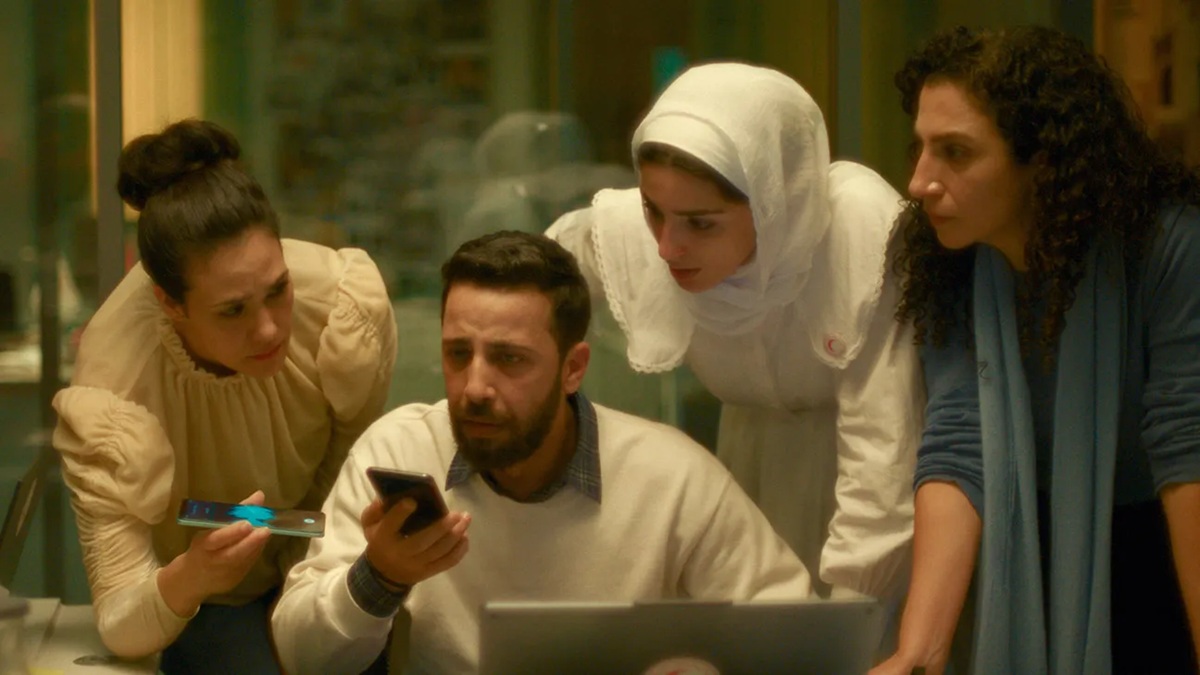
That’s all the setup you get before we’re plunged into the Palestine Red Crescent emergency call center in Ramallah, West Bank. Since emergency calls from Gaza have been transferred to the center since the bombing, workers there receive calls almost every minute where they advise callers on emergency situations (“You have to stop the blood,” “The nearest ambulance is on its way”). The rhythm is relentless, the atmosphere thick with a kind of exhausted urgency that feels both routine and unbearable.
One of these calls is received by Omar (Motaz Malhees): someone from Germany calling to check in on his brother and the latter’s family. They’re among the evacuees of the neighborhood and they’re caught in the crossfires. Realizing it’s been over an hour since the bombing and thinking emerging survivors are unlikely, Omar and Mahdi (Amer Hlehel) try calling the mobile number the brother from Germany gave them. Someone picks up. And then the film reveals something that changes everything: the voices on the other end of the phone are the actual voices.
This is where “The Voice of Hind Rajab” stops being a traditional dramatization and becomes something closer to an act of documentation, of bearing witness. Ben Hania, who previously explored this territory with “Four Daughters,” continues her interest in recreation—using stripped-down re-enactment of personal events to create art about painful realities that real people have faced.
Recreation as Part of Gripping Storytelling
But here, the technique cuts deeper. The actors in the call center—Saja Kilani as Rana, Clara Khoury as Nisreen, alongside Malhees and Hlehel—perform their roles with documentary-like precision, but they’re reacting to real audio, real terror, real pleas for help. The juxtaposition is almost unbearable. You’re watching trained actors do their jobs while listening to people who are living through the worst moments of their lives.
The technical execution is flawless in its restraint. Ben Hania employs a handheld verité camera style that feels immediate without being exploitative. There’s a shot in the film that mixes real video recorded on a phone with the actors, and it’s one of the most quietly devastating visual choices I’ve seen in years. It’s not showy. It doesn’t call attention to itself. It just is, and that’s what makes it so powerful. The film is trying to show us atrocities through recreation, using real audio to avoid the trauma of the images but still make its point. It’s a high-wire act, and Ben Hania never stumbles.
The call center workers are living with the pain of trying to help but knowing they can’t do more. The film establishes early on that there are many other emergencies in Gaza and that any deviation from Israel’s rules could result in the deaths of rescue workers. It makes sure to emphasize that the process Israel demands for those providing help to those in danger is cumbersome and bureaucratic, slowing down rescue attempts when every second counts. These aren’t faceless operators; they’re people carrying the weight of impossible decisions, listening to horrors they can’t fix, following protocols that feel designed to fail. The performances are so lived-in, so raw, that you forget you’re watching actors at all.
Assuming the Vantage Point of Helpless Helper—as an Audience
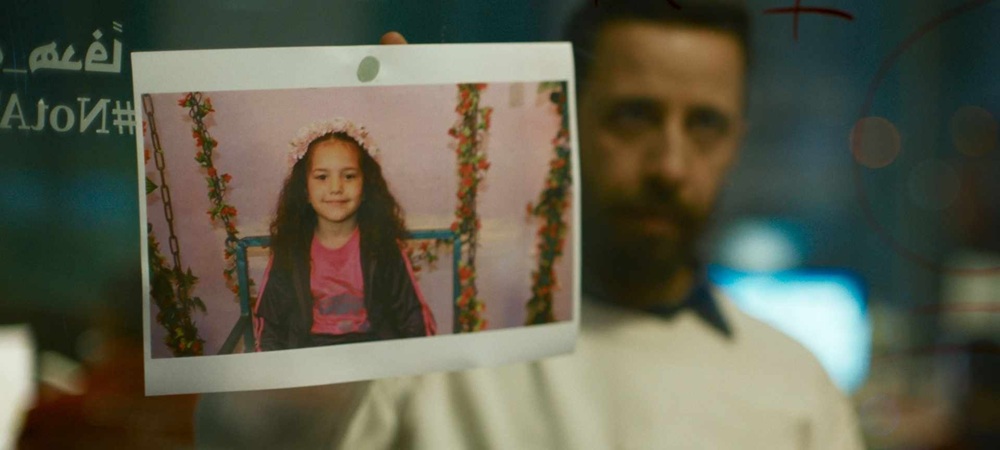
And then there’s Hind Rajab. Six years old. Trapped in a car. Under fire. The film doesn’t show us the images—thank God it doesn’t—but the audio is more than enough. Her voice, small and terrified and heartbreakingly polite, asking for help. Begging. Promising to be good. Trying to reassure the people on the other end of the line even as she’s the one who needs reassurance. At this point, you may also look up the actual accounts of the real-life events that this film portrays. At this point I’m struggling to write about it.
Except I have to. Because that’s what this film demands. It refuses to let you turn away, and it refuses to let you intellectualize your way out of feeling what it wants you to feel. This might be the first film this year where I find myself unwilling to talk about any reservations, simply because I find myself unable to intellectualize it. The direction is so assured that I feel the guilt even as a viewer. I see my convenience of being distant from danger and yet having to hear the actual little girl begging for help that never came something that’s hard to shake.
I know there will be people who will judge “The Voice of Hind Rajab” through a political lens, and sure, it’s impossible to separate the film from what it’s documenting. But dismissing it as propaganda ignores the artistry Ben Hania brings to this. She’s made a film that functions as both journalism and cinema—those things aren’t mutually exclusive. This is, for better or worse, a historical document, a milestone work about the conflict in Israel and Palestine, made with focus and restraint that never sensationalizes.
I also understand the misgivings some might have about the ethics of Ben Hania’s approach here. There’s a valid question about whether dramatizing these events—no matter how restrained, no matter how respectful—risks turning real tragedy into consumable content. Is there something inherently exploitative about actors performing reactions to genuine suffering? Does the film’s existence as a festival circuit entry, as something reviewed and discussed and yes, even praised, somehow diminish the reality it’s trying to honor? These aren’t questions with easy answers, and I won’t pretend to have them. But I also think there’s something about a filmmaker who refuses to let these events disappear into the noise of daily headlines; who insists on making us sit with the unbearable for 89 minutes because that’s a fraction of what the people in that car, in that call center, in Gaza itself, have endured.
‘The Voice of Hind Rajab’: One of the Most Important Films in Recent Memory
Through it all, Ben Hania never editorializes beyond choosing to tell this story. The film lets the events speak for themselves. The voices—those real, recorded voices—carry the emotional weight. The actors provide the structure, but the horror is in the audio, in what actually happened. It puts you in the position of the call center workers: listening, helpless, unable to reach through the phone and save anyone. You can see the exhaustion on their faces, the way they’re holding themselves together by sheer will. That’s what bearing witness looks like. Not just seeing, but carrying. Not just knowing, but feeling.
The ending (which I won’t spoil, though if you know the real events, you already know) offers no closure. It lays bare the grim reality both innocent civilians and rescue workers following procedure ultimately meet. And then we learn about Hind’s only wish: I just want this war to end so I can go to the sea and play in the sand. The theater I was in went silent except for the sound of people crying. Not sniffling. Loudly. I was one of them.
I don’t know how to wrap up thoughts on a film that leaves you this wrecked. Maybe fumbling for adequate words is part of what the film is trying to communicate. “The Voice of Hind Rajab” is one of the most upsetting and significant films of the year. It’s phenomenal cinema and necessary storytelling—probably one of the most important films in recent memory. I walked out of that second screening feeling grateful that a powerful film like this exists, even as I wished with everything in me that it didn’t have to.
“The Voice of Hind Rajab” had its world premiere in the main competition of the 82nd Venice International Film Festival on 3 September 2025. It screened in this year’s International Film Festival, which ran from November 14 to 23, 2025. The film is the Tunisian entry for the Best International Feature Film at the 98th Academy Awards. Follow us for more coverage.

