There’s a cult around “Universal Soldier: Day of Reckoning“, and seeing it once is enough to understand why. On paper, it’s a bargain-bin DTV sequel to a long-dormant franchise; in practice, it’s a lucid, nightmarish work of horror masquerading as pulp, one that turns its own limitations into a source of dread.
I’ve seen the film twice, and both experiences felt like being swallowed whole by a waking nightmare. The first was an unhinged date-night with my JCVD/Scott Adkins–loving girlfriend, after we’d marathoned the earlier “Universal Soldier” films. We anticipated goofy pulp and fistfights. Instead, we sat in stunned silence, immersed in a dread that felt both alien and intimate.
The second viewing was at an Alamo Drafthouse Weird Wednesday screening, projected in 3D. I went with my buddy Sean Chandler, who had just interviewed Adkins. Seeing Van Damme’s nose jut toward the audience, his face flickering like a strobing hallucination, was a collective, almost ritualistic experience of horror — an uncomfortably intimate spectacle amplified by the crowd.
Action Meets Sci-Fi
John Hyams has become a folk hero of American genre cinema. He began with the acclaimed documentary The Smashing Machine (about MMA fighter Mark Kerr, soon to be dramatized by Dwayne Johnson and Benny Safdie) and quickly developed a reputation for economical genre films that exploit their own limitations as strengths.
Day of Reckoning was his breakthrough. In 2012, it divided audiences: some dismissed it as junk, others immediately sensed its rigor and strangeness. Over the years, its stature has only grown; it is now widely recognized as visionary horror.
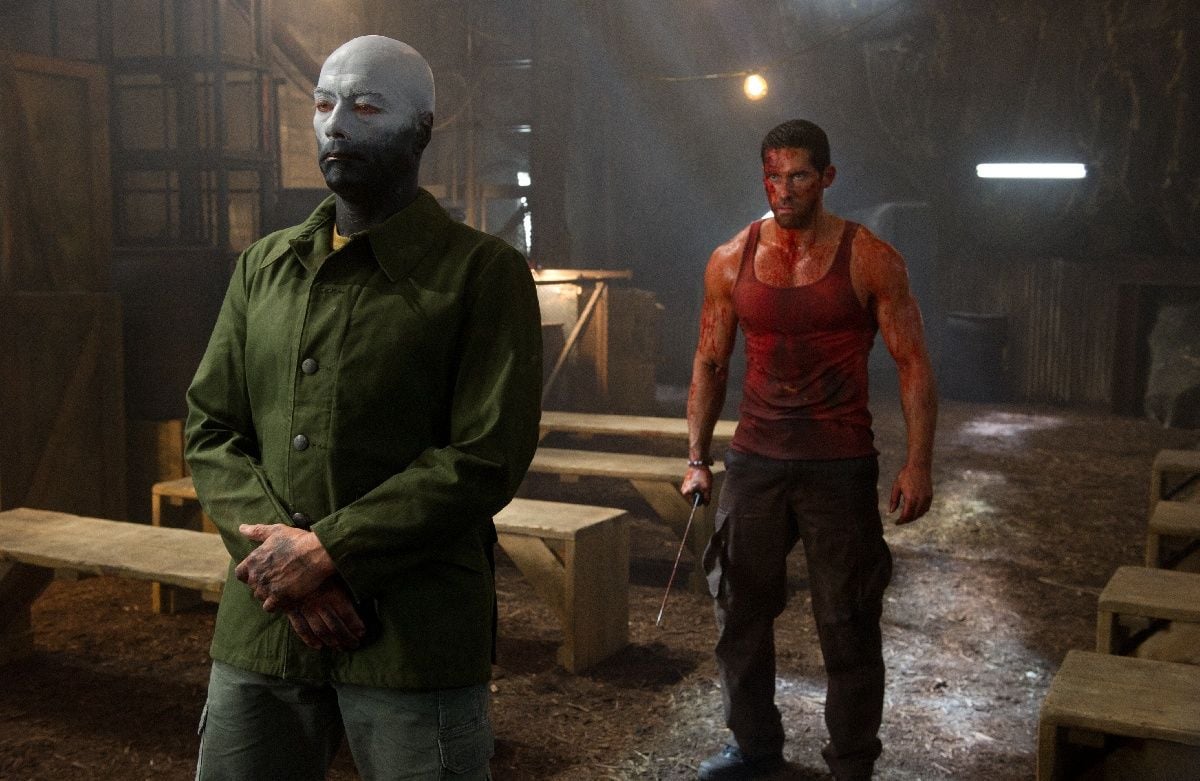
The film opens not with the usual adrenaline but with a bracing POV sequence depicting a disturbing Haneke-like home invasion. A father, John (Scott Adkins), reassures his daughter there are no monsters in the house — only for masked intruders to butcher his family before our eyes. Leading them is Luc Devereaux (Jean-Claude Van Damme), once the franchise hero, now bald, imperious, and staring hypnotically into the camera, Kurtz incarnate.
It is one of the great shock entrances in contemporary action cinema, recalling Henry Fonda in Sergio Leone’s “Once Upon a Time in the West.” Leone weaponizes Fonda’s all-American “good guy” persona by having him murder a child; Hyams weaponizes Van Damme’s heroic screen legacy to destabilize his audience. The violation is not simply in the murders — it is in his presence. A man synonymous with popcorn heroics becomes a spectral, commanding figure of dread. From the first frame, the film signals that nothing is safe and nothing is as it once seemed.
Illusory Maze
What follows is less a revenge narrative than a dreamlike labyrinth. The world is sparse, suburban, uncanny, composed of liminal spaces that disorient. Characters appear and vanish; identities blur. Devereaux seems to multiply like a virus. The film feels closer to Lynch, Haneke, or “Apocalypse Now” than the bargain-bin DTV action it ostensibly is.
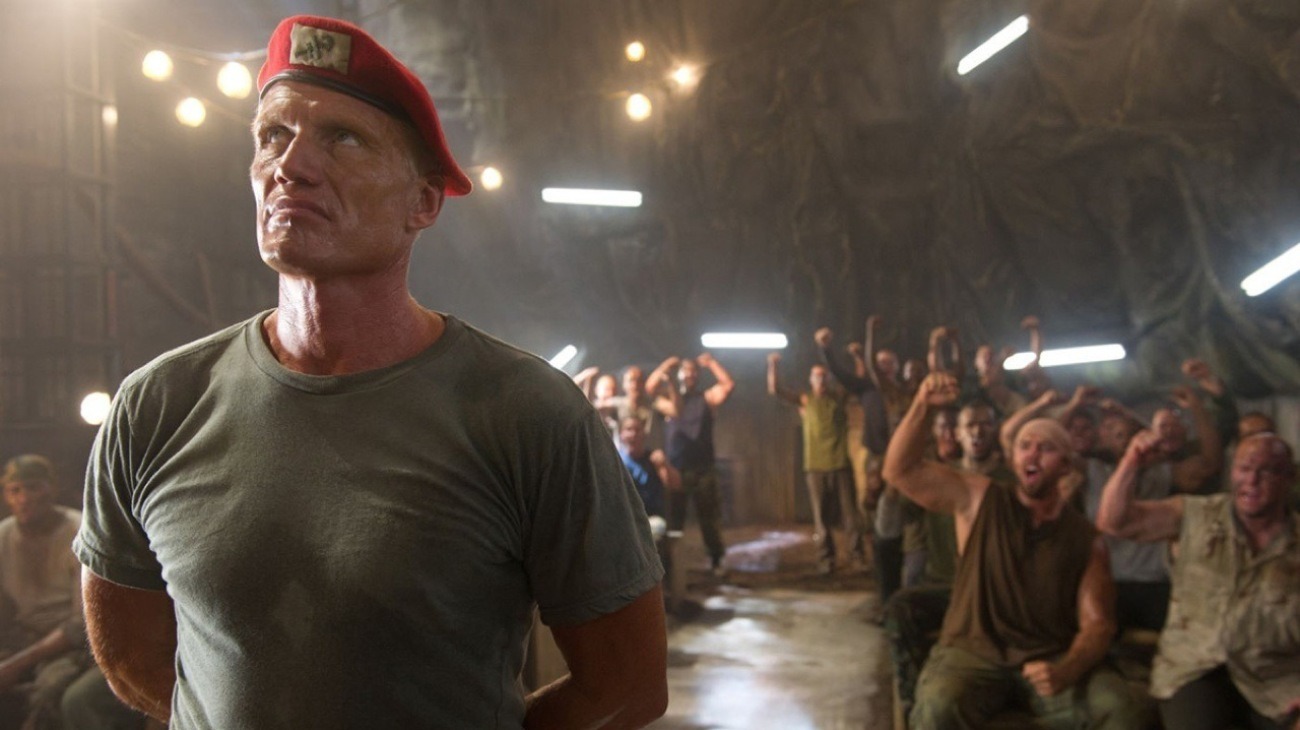
The villains are less human than archetypal. Devereaux, a trance-like specter of evil; Magnus, or “The Plumber” (Andrei Arlovski), a hulking force of destruction like Superman II’s Non; and Dolph Lundgren, preaching a strange gospel of “super-soldier salvation,” a cult leader in scraps of past action-hero glory. Even the stiff, robotic performances heighten the uncanny — these are not people but husks.
Regeneration, Hyams’s previous “Universal Soldier” film, propels and excites; Day of Reckoning invades and oppresses. It traps the viewer. By the midway point, one is not hoping for a fight scene — one is pleading for escape. Catharsis never arrives. The closest is an uneasy convergence, a sense of arrival with no release.
The violence amplifies the discomfort. Shot in long takes with real MMA fighters, each impact is grounded in physical terror. Walls collapse, bones crunch. The spectacle is not cathartic; it is punishing, suffocating. Even quiet moments bristle with unease, a latent threat always poised to erupt.
Lynch-like Surrealism
What makes “Day of Reckoning” remarkable is its controlled surrealism. On the surface, it looks like junky pulp; underneath, it is a tightly composed nightmare. Exploitation aesthetics are elevated into art. Hyams reimagines a macho action franchise as existential horror: memory, identity, and violence as specters. The familiar stars are no longer heroes — they are monsters. What might have been disposable DTV trash becomes unforgettable.
More than a decade later, “Universal Soldier: Day of Reckoning” has earned its cult status. It is a horror film hiding in plain sight, increasingly haunting with time. It also anticipates the stripped-down dread Hyams would perfect in “Alone” and “Sick.”
Enter expecting pulp, and you might end up like I did the first time — silent, stunned, overtaken by its alienating dread. Meet it on its own terms, however, and you’ll find a singular piece of horror cinema, less about fistfights than the nightmare of existence itself.