


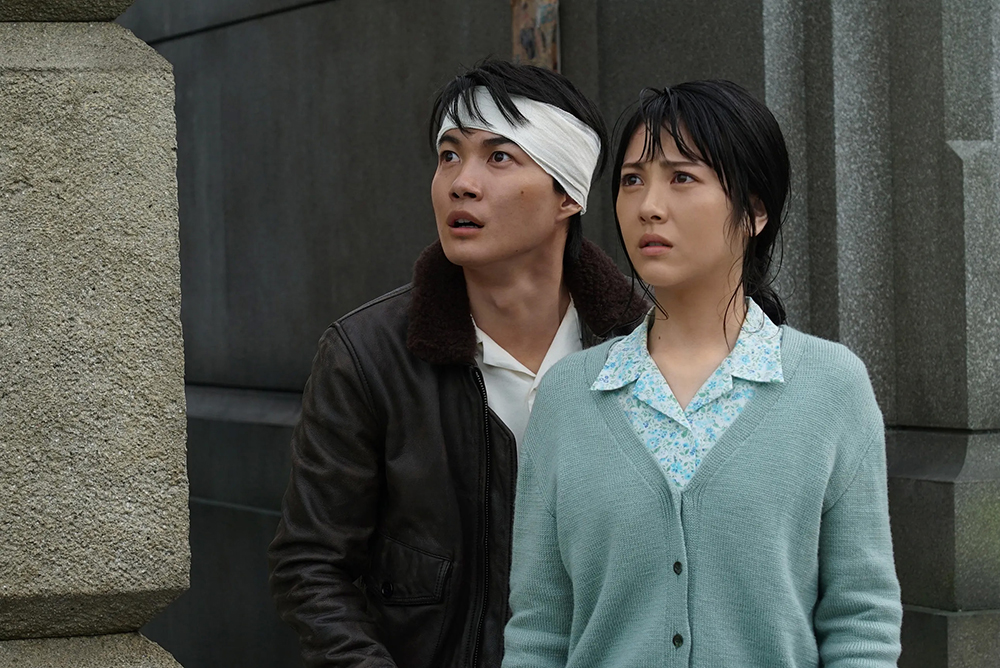
People love a good monster film. The problem is, “Godzilla” has never been a straight monster film; its 1954 opener—and many sequels—are often deeply cultural amidst the destruction. The latest film in the Japanese franchise, “Godzilla Minus One,” is no exception. Written and directed by Takashi Yamazaki, “Minus One” is a post-World War II film dipped with a sense of urgency and a palpable dolor around its characters. It’s at times complicated, balancing themes of love and hope with duty and sacrifice, yet is not afraid to question blind allegiance in favor of humanity. Its destruction is massive, yet contained to only a handful of scenes. And while some thin characterization pulls the film down, it still stays with you after the credits.
Yamazaki’s film focuses on a defected kamikaze pilot, Koichi (Ryunosuke Kamiki), who feigns airplane problems and lands on Odo Island for repairs. However, he has really abdicated his duty to fly a suicide mission. His landing on Odo and fearful temperament leads to the deaths of a handful of fighter mechanics when Godzilla shows up on the island.
Doing Much with a Small Budget
The following scene sets up Godzilla’s prowess, as well as the burden Kochi wears for most of the rest of the movie. His inaction—his inability to perform his duty—has dire consequences. Koici is treated with disdain by some who view a living kamikaze pilot as a failure. However, he reestablishes a life amidst a traumatized Japan, amongst many who don’t share the same view of their government, which has led them to ruin. He stumbles upon a woman amidst the rubble, Noriko (Minami Hamabe), who is caring for a baby who is not her own after a dying mother begs her to take it.
What’s impressive about Yamazaki’s film is its attention to detail of post-war Japan, as well as the CGI around Godzilla it was able to achieve with a budget of only $15 million. We see the destruction of Ginza—a once populous Tokyo suburb—with realism and, oddly, hope. This was not Godzilla, but air raids, and apart from the renowned “Grave of the Fireflies” has not been so truthfully drawn. We’ve seen Godzilla already, of course. But the human story—principally of Koichi, Noriko, and a group of salvage workers Kochi meets who toil to clean up active mines—make up the bulk of “Godzilla Minus One.”
The film’s also drawn with a deep regret and trauma in Koichi that prevents him from living a normal life. As he rooms with Noriku and denies his feelings for her due to inner demons, he looks at a life he could have and wonders if he dares to dream again. Unfortunately, a Godzilla attack on the city will interrupt these dreams, with some plotting that initially irritated me, though most of it is rectified by the film’s conclusion.
Callbacks and a Sense of Urgency
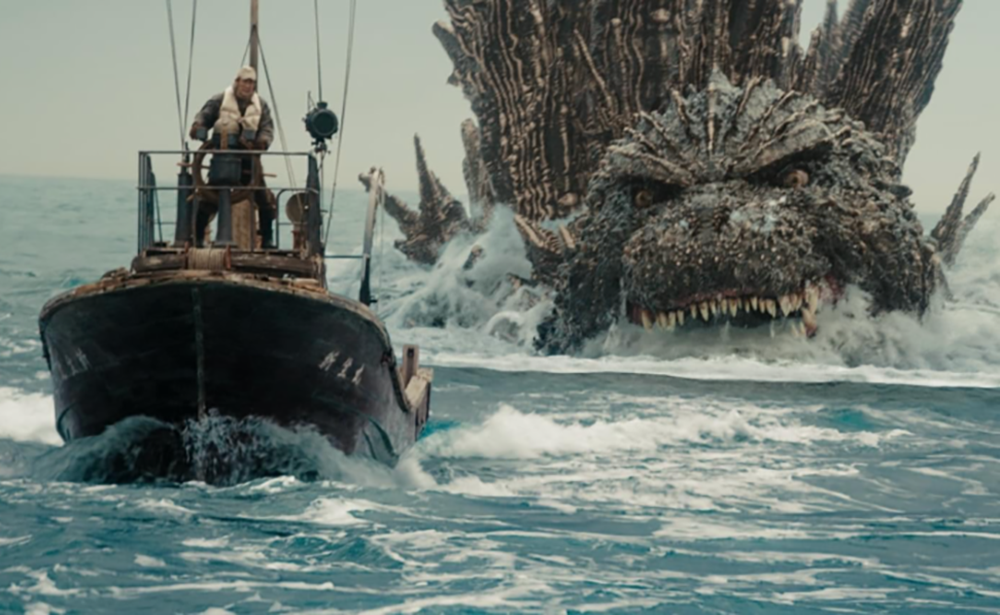
Godzilla in this iteration is quite terrifying, and a scene where he attacks Ginza is destructive and foreboding. There are callbacks to older “Godzilla” movies here, especially in the monster’s lumbering gait and iconic ‘thump’ as he walks. There’s also stage-setting with music by Naoki Satô, which utilizes homages to the 1954 opener with its power and scope. While the original Godzilla breathed fire, here the kaiju’s back plates light up blue with violent intention. It then breathes a horrible ray that finds its target and erupts with a mushroom cloud explosion, very much like those devastating bombs that found Hiroshima and Nagasaki.
Further, I appreciated this scene’s nods to the ’54 opener, complete with journalists on a roof chronicling the devastation as well as Godzilla picking up a multi-car train and attempting to eat it. But while the ’54 film drew Godzilla’s victims as but ants to step on, here we know some of the folks running. Noriko is on the train—she’s just gotten a desk job to raise money for her baby—and Godzilla’s destruction is painted as the horror it is.
While a lot of the rest of “Minus One” follows previous films (i.e. some group of citizen/military maneuver to kill the beast), here it explores its characters more, and their intentions. A former scientist and friend to Koici, Kenji Noda (Hidetaka Yoshioka) comes up with an idea to try and kill Godzilla with a sudden sinking and raising from a deep trench. The whole thing is kind of hinged on a pipe dream, unlike the ‘Oxygen Destroyer’ from the first film we wholly believed could work.
A Sober Post-war Effort
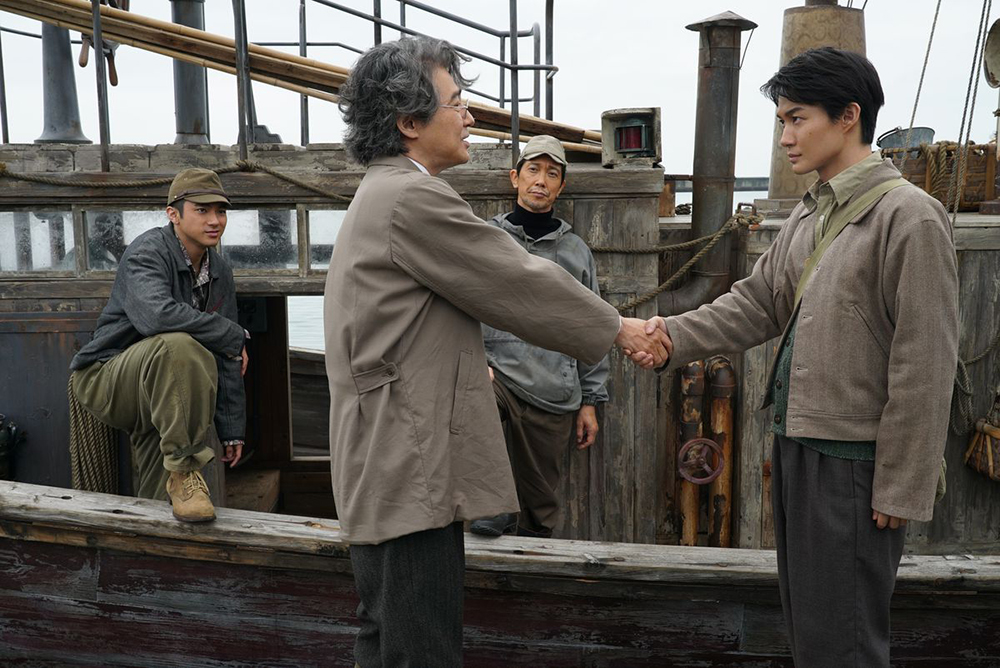
But under it all there’s a sense of Koici attempting to redeem himself, and the film’s winning argument is a Japan around him that seems to not want to see him kamikaze himself, despite a Koici that often sees no other way at redemption. This is because, at the movie’s heart, “Minus One” is not a film about the joy of surviving a war, but the guilt of living when so many others have died. And if Godzilla is that unavoidable fate haunting them, the film’s humans—discussing ways in which Japan’s government has let them down and martyred them—pave a path to military and nationalistic critiques sorely missing from American war films.
All-in-all, “Godzilla Minus One” is a good movie. “Godzilla” fans will likely find easy footing, and the online buzz seems to indicate a better, richer film than prior efforts. This is a serious film, not one to be taken as hyperbole, and feels doleful and somber throughout. But under it all it has a camaraderie and human spirt that vindicates it. It missteps occasionally with too much of a focus on the gargantuan monster and some thin treatment of characters I came to care for. But apart from its dying seconds—which indicate a sequel plug I found inappropriate—the film has the spirit of “Godzilla” films of old, complete with a humanity that makes us want to care. Yamazaki has made a good effort here, and I can only assume the movie will find its place among the ranks.

“Godzilla Minus One” is currently only available to watch in theaters.

