



I’ve never read Suzanne Collins’ “Sunrise on the Reaping,” expanding her world past the first three books in the “Hunger Games” series. As such, Haymitch Abertnathy’s transformation from young man to depressed and cynical alcoholic existed only in a small segment learned from her second novel, “Catching Fire,” as that series’ heroes, Katniss Everdeen and Peeta Mellark, watch a morbid recording of Haymitch’s Hunger Games victory. And from that we learn the necessary details. Haymitch had won the games through trickery and defiance, losing everyone he ever cared about in the process. His eternal punishment was to mentor two kids every year who usually—from his district at least—always died.
Francis Lawrence directs the “Sunrise on the Reaping” film adaptation. He has, in fact, directed all the film adaptations apart from the first installment. The films have always been successful and a draw. However, it wasn’t until “The Ballad of Songbids and Snakes” that I feel the films became full enough to spread Collins’ themes adequately. The first trilogy was overstuffed with star power (Jennifer Lawrence, Josh Hutcherson, Woody Harrelson, Donald Sutherland, and Phillip Seymour Hoffman, just to name a few) that sometimes overpowered the dystopian landscape. “Songbirds and Snakes” got it right. It cast a young, lesser-known President Snow (Tom Blyth), following his descent from questionable politician to wholly evil despot. “Sunrise on the Reaping” follows suit and mostly succeeds. There’s less a focus on the arena and more on the Capitol’s evil machinations, plus or minus a few issues.
District 12 Feels Desperate
The film improves upon several things that were irksome from previous iterations. First, the reaping ceremony itself (where the Capitol selects tributes from each district who will fight to the death on live TV) is scary and foreboding. In the first movie (dated now from 2012), we see the selected children wearily or numbly accept their fate. Here, we see not-so-willing tributes, often with dire consequences. The woman pulling the names (Glenn Close) is not as fun as the original’s Effie Trinket. She’s more a tool of the Capitol than a friend to District 12, and despises the denizens who live there. “Sunrise on the Reaping” follows Haymitch’s selection (played well by Joseph Zada) at the 50th Hunger Games, where double the participants are chosen. Zada plays the part with charm and humility. He’s not yet the cynical and broken Haymitch we see in Harrelson’s hands. He’s a boy in love with a girl (a charming Whitney Peak); he shows duty and fear in equal measure.
One of my complaints across the initial trilogy is its PG-13 rating and marketing for the young adult crowd. The books were also written for a YA audience, yet were filled with terror and heartbreak amidst their prose. Yet Gary Ross’ 2012 opener and Francis Lawrence’s following two films struggled. They were good. But something was missing. The arena designs seemed too fantastical and the Capitol renderings too fictitious. And while “Sunrise on the Reaping” is similar to its predecessor in making the televised event more “retro” (think ‘70s instead of 2000s), it improves upon important things. It focuses not so much on the games, but the Capitol’s twisting of them to fit their evil purpose.
Joseph Zada is Good as Haymitch

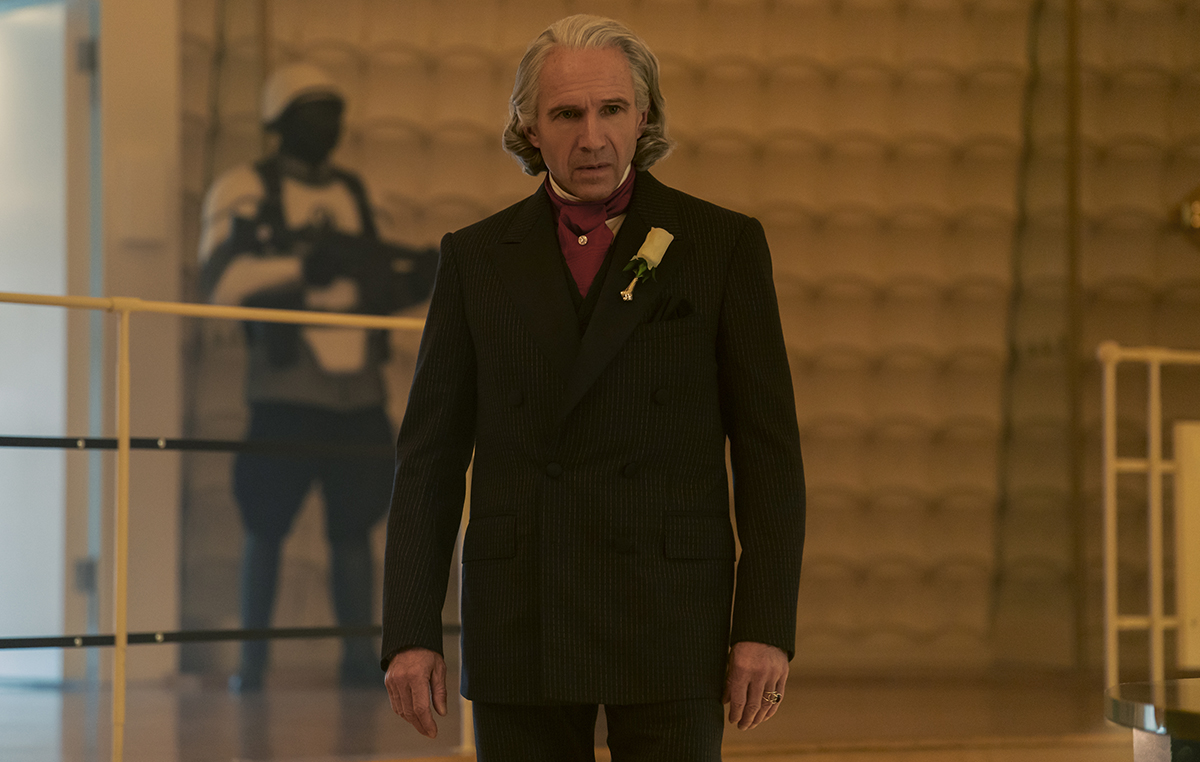
Ralph Fiennes plays President Snow. And while he’s not as unnerving as Sutherland, he shows a calculated man who wipes out anyone in his way. He’s middle-aged and cunning. He’s clearly taken his learned knowledge of poisons to heart, and this game’s arena is a) the most beautiful landscape you’ve ever seen and b) riddled with endless deadly poisons and traps. And this Snow is more forthright. He promises Haymtich he’ll kill him in the games after he crosses him. He’s rather blunt about it, not at all like Sutherland’s quiet, dead glances and subtle implications. Alongside him, Kieran Culkin plays Caesar Flickerman. Gone is the joviality and charm of Stanley Tucci’s portrayal. It’s replaced by menace, narcissism, and a man who rubs the tributes’ noses in their impending deaths.
The focus of “Sunrise on the Reaping” is Haymitch, and Zada does well with the heavy material he’s tasked with. He’s not cocky yet not timid; he’s scared yet driven. Haymitch hates the Hunger Games and wants them to end. Zada plays him as a man who wants this but also wants to see his family and girlfriend again. His expressions throughout the movie show his gamut of emotions, and I liked the forlorn way he fights his victory (he’s in the sequels and this is not really a spoiler). The way Haymithch’s dumped out by the victory train in a deserted factory in a blanket of darkness really captured his broken state. The cinematography by Jo Willems is good all throughout this. However, it really shines in highlighting the poverty and despair of District 12.
Plemons, Close, and Fiennes Represent the Capitol
Where “Sunrise on the Reaping” suffers somewhat in its pacing and progression, which attempts to cram too much into one film. Lawrence—with a script co-written by Billy Ray and Michael Lesslie—must show Haymitch’s family, his girlfriend, his reaping, his alliances and training, his time in the arena, his defiance, and his ultimate psychological destruction before the film ends. Even at 2 hours and 38 minutes, “Sunrise” doesn’t have enough time. It speeds through Haymitch’s training and time in the arena. It also skips some character development, with really only Haymitch, one tribute Maysilee (McKenna Grace), and Jesse Plemons’ Plutarch Heavensbee (a Capitol defector) given much depth. That said, Grace is very apt, and Plemons puts in a great performance in a role that would eventually be taken over (in the chronology of the films) by the late Phillip Seymour Hoffman.
“Sunrise” feels like the writers—and Collins—are banking on audience familiarity with Haymtich’s backstory, which I guess is reasonable. But it wouldn’t have hurt to attend to those not so aware. The training sections rushed and the Hunger Games themselves assumed deadly, the film—in a way—fails to make us very afraid. And some other continued fantasy elements—the most problematic the look of the Capitol and its populace—take the film out of reality. Collins wrote the Capitol very fantastical; but I feel that while it works in the books it doesn’t on-screen. Additionally, the Capitol’s ‘peacekeeper’ soldiers once again look more like “Star Wars” Stormtroopers and less like the kind of force that would belong in a resource-deprived dystopia.
Not Enough Time in the Arena

These criticisms aside, however, audiences should find a decent time at the latest “Hunger Games” outing. Haymitch is treated with care, and we get to see more of District 12’s heart this time around. The film watches easily, and Zada’s performance makes Haymitch easy to root for. Tighter writing (and my irrational wish for these films to be rated ‘R’ and give them the seriousness they deserve) would have centered the film better. But “Sunrise on the Reaping” is lush and beautiful in places, bleak and heartbreaking in others, and anchored by a breakout performance by Zada that will hopefully earn him recognition and future work. It’s a solid film. It falls only slightly below its previous entry and brings the long-awaited story of Haymitch finally to life.