There’s something almost radical in 2026 about a summer movie that knows exactly what you came to see and then just gives it to you.
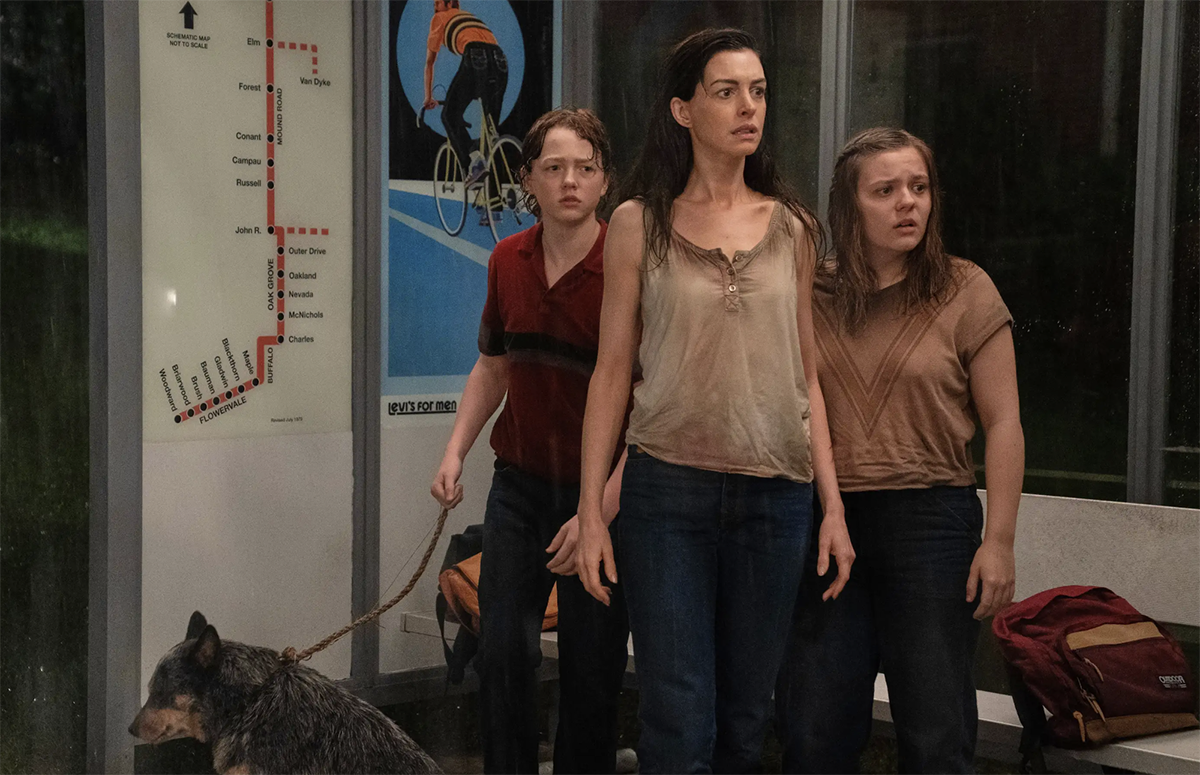
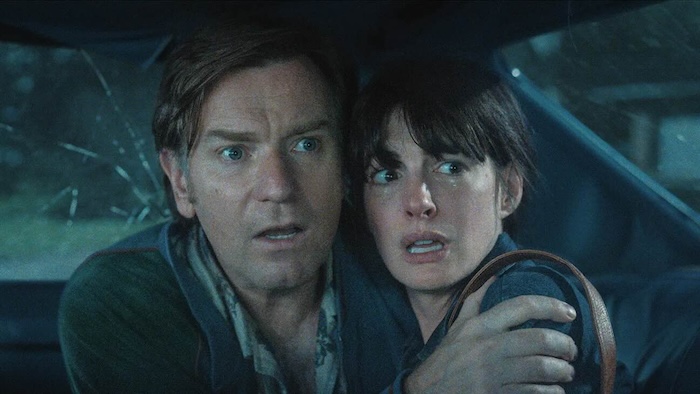
“The End of Oak Street” has the premise of a “Twilight Zone” episode. The Platt family—Anne Hathaway, Ewan McGregor and their two anxious kids—are already navigating the mundane tensions of suburban life when some unexplained cosmic event picks up their affluent Michigan cul-de-sac and deposits it someplace very, very wrong.
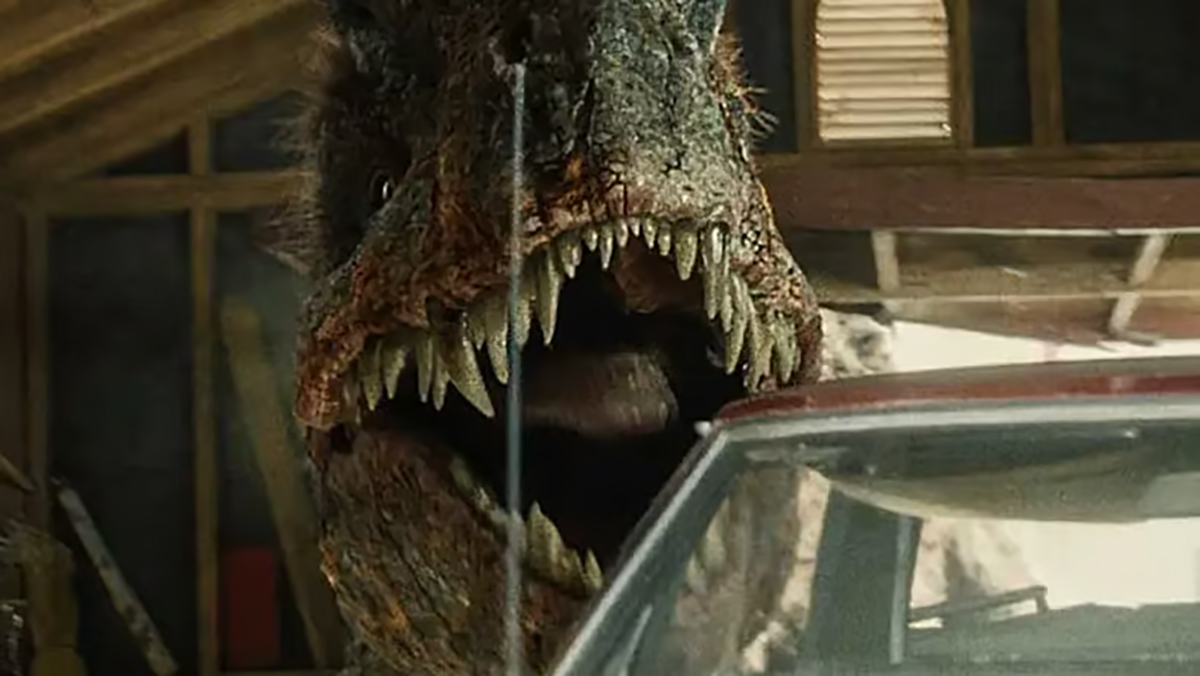
It’s the 1980s. One minute they’re dealing with marital problems, neighborhood gossip, and school bullies. The next, there are dinosaurs outside.
That’s it. That’s the movie. Let’s fucking go.
David Robert Mitchell in Control
Despite J.J. Abrams’ name sitting there among the producers, “The End of Oak Street” does not arrive wrapped inside a mystery box. There’s no scientist scribbling timelines on a chalkboard. Nobody starts theorizing about paradoxes or whether killing the wrong dinosaur will somehow prevent Ronald Reagan from becoming president. It has the setup of “The Twilight Zone,” only with considerably less talking and a lot more RUN!
Director David Robert Mitchell understands that once you’ve deposited Anne Hathaway, Ewan McGregor, and their kids in the Cretaceous period, the dramatic question is not how does time travel work? It’s how the hell are these people going to survive these fucking dinosaurs?
And “The End of Oak Street” is, first and foremost, an extremely good movie about people trying not to get eaten by dinosaurs.
I mean that as the highest possible compliment.
There’s an almost old-fashioned simplicity to the way Mitchell approaches the action. Put some people in a house. Put something horrible outside the house. Figure out increasingly inventive ways for the horrible thing to get inside.
Distrusting Empty Space
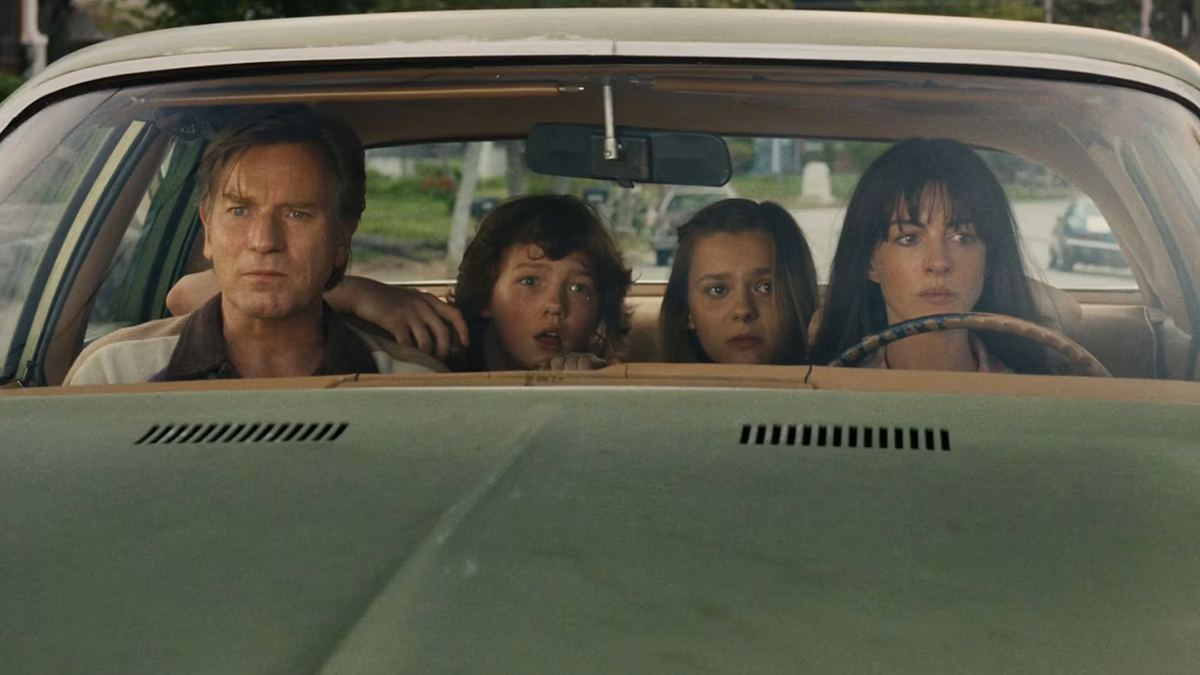
There are chases, close calls, severed limbs and a surprising amount of people getting chewed apart for a PG-13 movie. The effects occasionally look a little funky, but the movie has enough personality that I never really cared. If anything, the slight artificiality contributes to its pulpiness. These aren’t majestic creatures being unveiled for our awe and wonder. They are giant fucking animals that would very much like to eat Anne Hathaway.
And Mitchell knows how to make that scary.
He has always been unusually gifted at making you distrust empty space. It’s basically the governing principle of “It Follows:” the background of an image is never really the background because something could start moving toward you at any moment. Here he takes that same visual instinct and blows it up into a summer blockbuster.
Mitchell keeps arranging shots where your eyes wander away from the characters. You start checking the edge of the frame. The street behind them. The doorway nobody is watching. The dark patch between two houses.
Then something moves.
From ‘It Follows’ to Dinosaurs
There’s one sequence involving a pale, snakelike dinosaur where Mitchell barely seems to change his approach from “It Follows” at all. The creature doesn’t make some grand entrance. It just becomes part of the image. You notice it before the characters do, and suddenly a perfectly ordinary patch of background has become the only thing you can look at.
It turns out the guy who made an entire horror movie out of the terror of something slowly walking toward you is pretty fucking good at dinosaurs.
It’s also just enormously satisfying to see Mitchell working at this scale.
“The End of Oak Street” is his first feature since “Under the Silver Lake,” a movie I think is incredible and one whose divisive reception seemingly helped keep Mitchell away from feature filmmaking for far too long. Watching this, you’re reminded that underneath all the weirdness and shaggy conspiracy plotting of “Silver Lake” is an extremely classical filmmaker. Give Mitchell a street, a few houses, a bunch of actors and something chasing them, and he knows exactly where everything needs to be.
Now somebody has given him Anne Hathaway and dinosaurs.
Turns out that was a pretty damn good idea.
And Hathaway in particular is having a hell of a year.
Anne Hathaway is Having a Hell of a Year
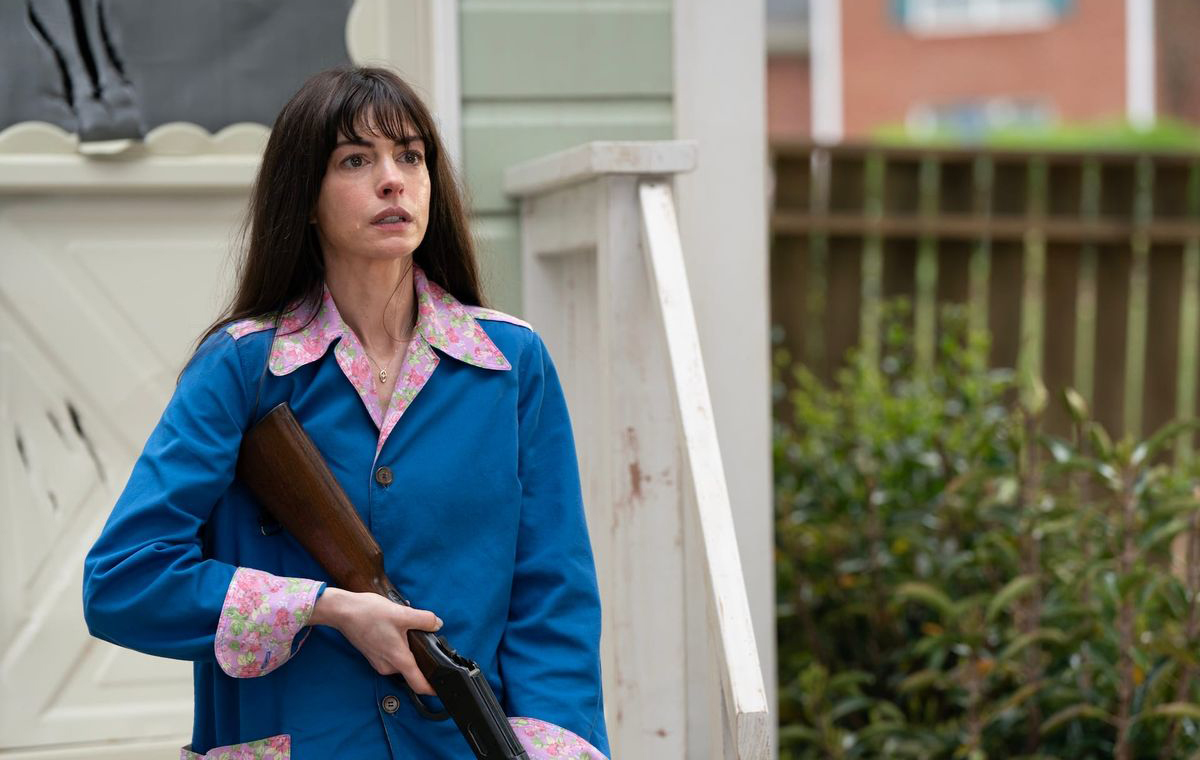
Between this, “The Devil Wears Prada 2,” Christopher Nolan’s “The Odyssey,” and David Lowery’s very under-sung ghost story/chamber drama “Mother Mary,” she’s having one of those great movie-star runs where you’re reminded just how many different frequencies Anne Hathaway can operate on. In the span of a year, she can return to the fashion-world comedy that helped make her a star, enter the Christopher Nolan IMAX machine, drift through David Lowery’s strange and intimate art-house world, and then show up here covered in blood trying to kill dinosaurs.
And I especially love this version: Anne Hathaway, blood-soaked genre heroine.
By the second half, she looks like she has been dropped into an entirely different movie from the suburban drama she started in. She’s covered in blood, wielding kitchen implements and fighting CGI monsters with the absolute conviction of someone doing Shakespeare.
She is great at this.
Hathaway has always understood how to play heightened material without winking at it. She doesn’t stand outside the ridiculousness and reassure us that she knows it’s ridiculous. If Denise has reached the point in her life where she needs to try to stab a dinosaur, then Anne Hathaway is going to try to stab the shit out of that dinosaur.
Anne Hathaway is a gift to Hollywood. Put her in more genre movies.
Things Aren’t as Permanent as they Feel
But what makes “The End of Oak Street” more interesting than its premise is that Mitchell gradually reveals a much sadder movie hiding inside the fun one.
Before the dinosaurs arrive, the Platt family already thinks its world is ending.
Denise is an aspiring novelist secretly writing about a frustrated housewife who wants to escape her marriage. Greg sneaks drinks in the garage. Their kids can tell something is wrong even when their parents try to hide it.
Before the dinosaurs arrive, divorce is the apocalypse.
Then the scale changes.
Suddenly the marriage doesn’t seem quite so important because there’s a dinosaur outside. Then the dinosaur doesn’t seem quite so important because the forest is on fire. Keep pulling the camera farther and farther back and eventually you arrive at the uncomfortable idea underneath the entire movie: maybe none of these things are as permanent as they feel while we’re living through them.
That’s where the 1980s setting really started to click for me.
The ’80s, Civilization, and Things that End
On the surface, Mitchell is playing with the same toy box as a million other pieces of Reagan-era nostalgia. There are bikes and cassette tapes and Polaroids and Froot Loops and Simon games. The kids feel descended from the adolescents of “E.T.” and “Stand by Me.” There’s “Poltergeist,” “Jaws,” and obviously “Jurassic Park” all over the place.
But the movie never struck me as particularly nostalgic.
The ’80s aren’t presented as some lost paradise we need to return to. They’re just another thing that ended.
That distinction matters because “The End of Oak Street” is constantly putting things that feel permanent next to evidence that they aren’t. A kid thinks childhood is the entire universe because it’s the only universe they’ve ever known. A couple assumes their marriage will define the rest of their lives until suddenly it might not. Americans build enormous houses and neighborhoods and convince ourselves that this is simply what civilization looks like.
Then Mitchell drops a dinosaur in the driveway.
The ’80s Setting Works
Early in the movie, Audrey quotes Carl Sagan: “We’re like butterflies who flutter for a day and think it’s forever.”
That line kept coming back to me.
The dinosaurs make the idea almost comically literal. Here are animals that once ruled the planet for an amount of time basically impossible for a human brain to comprehend. Now they’re pictures in Brian’s books.
Give it enough time and the 1980s aren’t fundamentally different.
Neither are we.
That’s also why the analog setting works as more than production design. When something impossible happens, these people can’t immediately ask the entire accumulated knowledge of humanity what they’re looking at. Denise photographs a strange plant with a Polaroid and has to physically go to the library to identify it. Audrey sits alone listening to Steve Winwood’s “Valerie” on cassette because she can’t disappear into an infinite library of music.
The Past is Isolation
The past is slower. Smaller. More isolated.
And then Mitchell strands it millions of years further in the past.
That’s the movie I kept glimpsing underneath all the dinosaur mayhem: this melancholy little idea about how bad human beings are at understanding the scale of our own existence.
Which makes it interesting that Mitchell ultimately doesn’t push that idea particularly far.
There’s a development around the middle of the movie that radically changes what we understand about the characters’ situation. For a stretch, “The End of Oak Street” suddenly feels like it might be willing to get genuinely bleak.
I started wondering whether Mitchell was actually going to follow the movie’s logic all the way down.
He doesn’t.
And initially I found that disappointing.
Conventional Pleasures
“It Follows” and “Under the Silver Lake” are movies that seem perfectly comfortable letting you leave the theater with something unresolved gnawing at you. “The End of Oak Street” ultimately has much more conventional pleasures in mind. The deeper you get into the final act, the more apparent it becomes that Mitchell is not trying to punish these characters—or the audience—for wanting to have a good time.
There’s another version of this movie that ends as an extinction parable. It takes the oppressive heat, the fire, the Sagan quote, and the image of modern Americans suddenly discovering that they are nowhere near the top of the food chain and turns the screws until something breaks.
I might even prefer that movie.
But that’s also not really the movie Mitchell made.
A Good Summer Movie
The movie Mitchell made has two impulses constantly rubbing against each other. One looks at human civilization from the perspective of geological time and sees something incredibly small and temporary.
The other looks at Anne Hathaway holding a weapon while a dinosaur runs toward her and thinks: Hell yes.
Eventually Mitchell has to choose.
He chooses Anne Hathaway fighting the dinosaur.
And you know what? Fair enough.
Because “The End of Oak Street” is so good at being a summer movie that I ultimately found it difficult to hold its lack of ruthlessness against it. It moves. It has movie stars. It has big, clean images. It has scares that actually depend on where the camera is placed rather than how loudly something can explode onto the soundtrack. It has jokes. It has blood. It has dinosaurs.
Most importantly, it feels like somebody actually directed the fucking thing.
Nothing Lasts Forever
That shouldn’t feel novel. But after enough gigantic movies assembled out of interchangeable coverage, weightless visual effects, and setups for the next installment, there’s a particular pleasure in watching a filmmaker use a blockbuster-sized canvas with this much control.
Maybe that’s why I kept thinking about the Sagan quote even as the movie itself seemed increasingly willing to leave it behind.
Nothing lasts forever. Not childhood. Not marriages. Not dinosaurs. Not the 1980s. Not whatever version of Hollywood we happen to be living through right now.
So while we’ve still got David Robert Mitchell making movies and Anne Hathaway fighting dinosaurs, maybe we should enjoy it.
“The End of Oak Street” certainly does.