



How do you prefer your Julia Ducournau cooked? Well, there is “Raw” (2016), Ducournau’s bold, grisly—and yes, raw—debut, an instant body-horror classic about a promising young female cannibal. And for a follow up, the French writer/director unleashed “Titane” (2021), an exhilarating, imaginative thriller that smuggled in affecting—and trenchant—commentary on family and, similar to “Raw,” the rigged game of trying to fit in. That “Titane” earned Ducournau the Palme d’Or at Cannes significantly raised her profile and expectations for what she’d do next. Enter “Alpha” (2025), which deploys familiar narrative and visual pyrotechnics as its predecessors. But it’s also the best of the three, offering an unrestrained and fair depiction of co-dependent love unhinged. Ducournau dials the white-hot temperature up and back again, and “Alpha” rounds out an unofficial, provocative trilogy with grace and gore.
Even the most original directors borrow and steal from key influences. The opening sequence of “Alpha” recalls Krzysztof Kieślowski’s “Three Colors: Red” (1994)—the third of three in that visionary trilogy—where the camera takes a “2001”-esque odyssey from the inside of a home through phone lines. In that chaotic, dizzying introduction, Kieślowski exposes and teases themes of connecting, retreating and an epidemic of loneliness. Replacing the wires, “Alpha” zigs and zags around the staggered lines on the forearm of an unconscious, rail-thin man. A toddler (Ambrine Trigo Ouaked) in purple glasses traces over his track marks using a sharpie, and when he comes to, Ducournau leaps forward, showing teenage Alpha (then played by Melissa Boros), all grown up and passed out at a party, unable to defend herself from a wicked and possibly deadly hazing ritual.
Ducournau’s Mind is Probing and Feverish
The letter A carved into her arm tags Alpha as an “other” and her vigilant physician mom (Golshifteh Farahani) is quick to respond, having had prior agonizing experience with an infectious, unnamed and terminal disease afflicting the community. Alpha is brought immediately to the hospital for a shot and tests, and through hazy, disorienting flashbacks, Ducouranu and Cinematographer Ruben Impens dutifully explain the root of Alpha’s mom’s (Farahani’s character is credited as Maman) medical specialty. Later, when Amin (Tahar Rahim) shows up at their apartment—which also doubles as Maman’s office—viewers recognize this gaunt, slackjawed figure before Alpha does. And after Alpha threatens him with a knife, Maman laughs it off, re-introducing her daughter to her brother, now a roommate.
Ducournau’s mind is probing and feverish, but her films rarely lose a sense of humor or pathos in simply observing how people behave. The frequent, nightmarish call backs to Maman’s past professional life are harrowing, but for me it was the domestic scenes—loud, sloppy and carnivorous—that revealed the genuine emotional core of “Alpha.” Composer Jim Williams (similar to the great Zbigniew Preisner’s work throughout “Three Colors”) matches the film’s anxious, heightened mood, opting for a melodic yet thunderous Beethoven piece during a fraught family meal. And while that scene’s sharp edges foretell chaos, when Alpha finds Maman rescuing Amin in the next room, it’s a fitting pitch that marks both a climax and a pivot in the film’s course to, through and past tragedy.
Embracing a Grim Fate
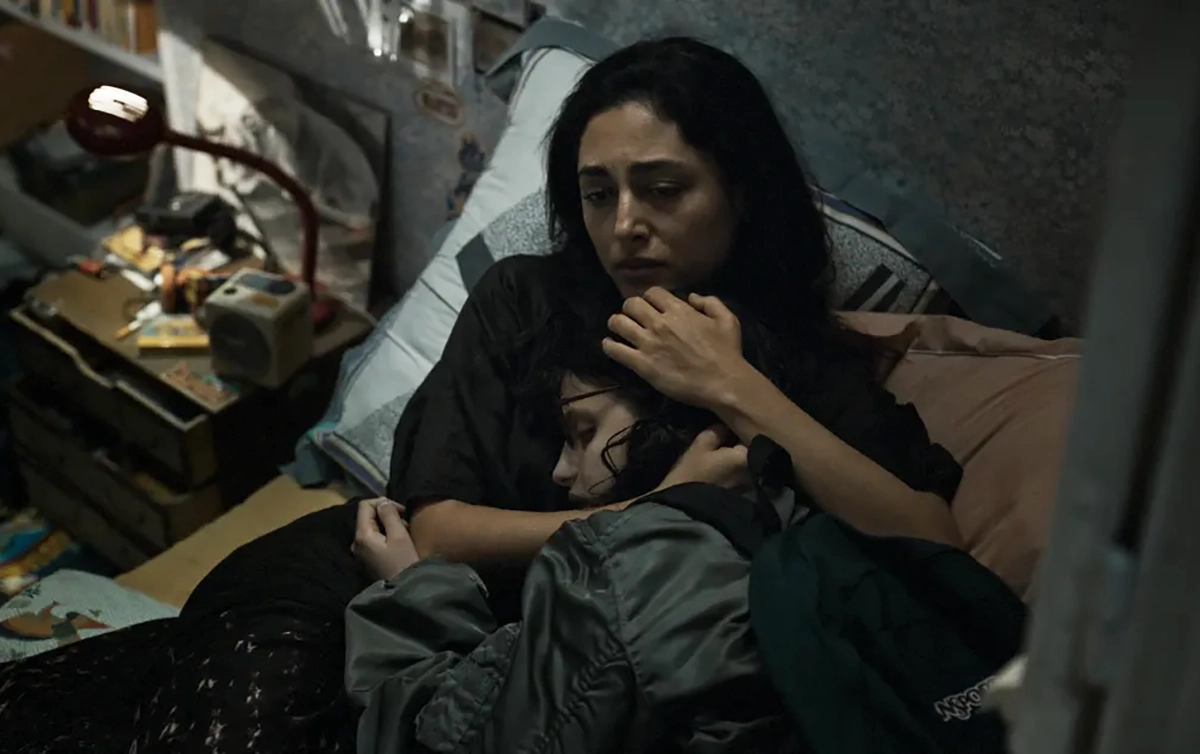
Following its world premiere at Cannes last year, “Alpha” took a critical drubbing. Call that a victim of Ducouranu’s early success and the highly pun-able title. Ducournau isn’t a minimalist, and certain symbols land heavy in “Alpha,” but in contrast to “Raw” and “Titane” the shocks on view are less jump-scary than emphatically upsetting. The appropriate pitch of despair stands out because “Alpha” smartly welcomes in some hard-earned joy—locker room make-out sessions, so many cigarettes—too. And for Ducournau’s harsh closing statement, “Alpha” permits its three-headed monster of Alpha, Amin and Maman to embrace a grim fate, which here transforms into a bizarro fade into a dust-caked sunset, the happy/sad ending that only a master chef such as Ducournau could plate (these puns, I don’t choose them, they choose me) so delicately and serve so mercilessly.
“Alpha” will screen on March 14th as part of Film at Lincoln Center’s Rendez-Vous with French Cinema festival. The film, a Neon release, has sneak preview screenings in New York on March 16th and 17th before its wider theatrical release starting on March 27th.

