It’s been eight long years since Gore Verbinski last graced us with a movie. His 2017 fever dream “A Cure for Wellness” was so deliriously unhinged—a gothic hallucination about capitalism, immortality, water, incest and eels—that it felt like a dare to every studio executive who ever wondered, “How weird can a big-budget film get?” Apparently, the answer was “too weird,” because Verbinski disappeared after that.
Among directors who’ve steered billion-dollar franchises, Verbinski remains one of Hollywood’s true eccentrics. Like Tim Burton, he’s a maximalist who filters populist stories through a deeply peculiar imagination. But where Burton trends toward the whimsical, Verbinski is gleefully grotesque—punk-rock Spielberg, with a fondness for water, skeletons, slapstick, and moral rot. He made “The Ring.” He made “Rango.” He made “Mousehunt.” He’s done it all, and somehow each film still feels distinctly his.
Classic Verbinski Idiosyncrasy
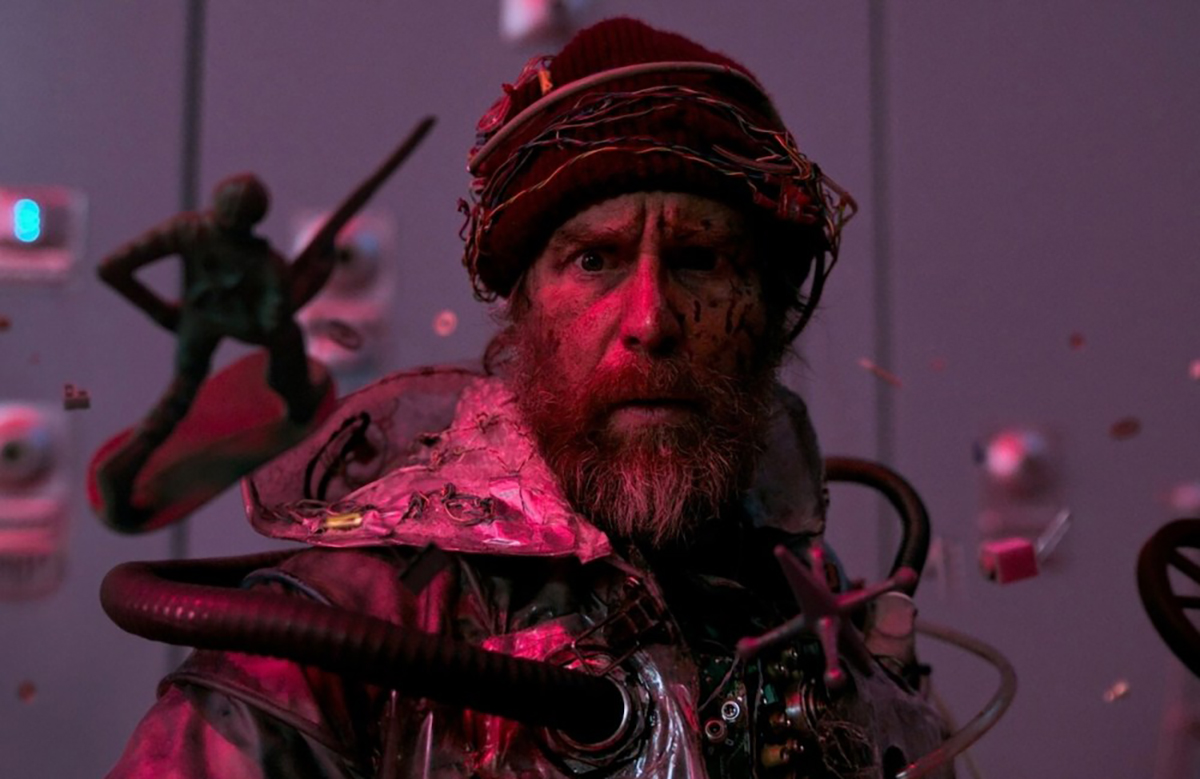
That sense of idiosyncrasy is alive—if not always well—in his new sci-fi dark comedy “Good Luck, Have Fun, Don’t Die,” which premiered here at Fantastic Fest. The premise is pure high-concept lunacy: a ragged man from the future (Sam Rockwell) appears in a Los Angeles diner to recruit its late-night patrons (Haley Lu Richardson, Michael Peña, Zazie Beetz, and Juno Temple) for a mission to stop a rogue artificial intelligence from ending the world. What follows is an anthology of apocalyptic sketches that double as cultural autopsies: one about AI overreach, one about cellphone addiction, one about the normalization of school shootings, one about VR escapism. Each vignette taps into a distinctly 2020s dread—that creeping sense that the future is already here, and it kind of sucks.
I have to admit, for the first hour I worried Verbinski had lost the magic. The early segments feel oddly generic, their satire blunt and their tone weirdly off. The humor lands flat, the music sounds like temp cues, and the visual polish of his earlier films is replaced with the plasticky sheen of a streaming original. For a director once synonymous with lush, tactile world-building, that’s a jarring comedown.
Then, somewhere in the final act, the old Gore comes roaring back. The film blossoms into something strange and striking—a delirious blend of “The Ring’s” technophobic dread and “Mousehunt’s” cartoon chaos, filtered through a retro 1950s sci-fi lens. Suddenly the images have weight again, the compositions a painterly wit. You can feel Verbinski slipping back into his natural rhythm as a grand visual prankster.
“Good Luck, Have Fun, Don’t Die” isn’t top-tier Verbinski, but it’s unmistakably his…”
An Apocalypse Tale that Dares to be Personal
At the Fantastic Fest afterparty, I had the chance to tell Verbinski how much I loved “A Cure for Wellness.” He smirked and said, “Oh, you’re one of the three.” That’s the kind of self-deprecating absurdity that defines his best work—a man who knows exactly how niche his particular brand of madness is, but keeps chasing it anyway.
The ensemble is a mixed bag. Peña and Beetz are unremarkable; Rockwell does his usual twitchy charm bit; Juno Temple commits so hard she sometimes feels beamed in from another movie. But Haley Lu Richardson, who starts off as a quirky supporting type and gradually becomes the film’s emotional anchor, gives the movie its pulse. She’s the one who makes the finale’s chaos feel strangely hopeful.
“Good Luck, Have Fun, Don’t Die” isn’t top-tier Verbinski, but it’s unmistakably his—a messy, morbid, often hilarious reminder of how few directors working today can make something this bizarre on any scale. It’s a mid-budget apocalypse fable that still dares to be personal. And in a festival full of calculated weirdness, there’s something refreshing about a filmmaker who’s just naturally wired that way.
Fantastic Fest ran from Sep 18, 2025 – Sep 25, 2025. Follow us for more coverage.