
Horor studios often don’t know how to market their better films. Year after year, genuinely bold, and unnerving films slip by under the radar while audiences pile into reheated sequels or self-serious “traumacore” exercises that mistake miserabilism for meaning. The post-“Hereditary” wave has turned grief into a marketing hook, sanding down horror’s rough edges in favor of polite symbolism and hand-holding allegories. On paper, “The Woman in the Yard” might sound like it falls squarely into that camp—it’s a story about grief, trauma, depression, and the unraveling of a family. But in practice, it’s something far more daring and thematically focused than assembly-line trauma horror. Jaume Collet-Serra doesn’t use despair as a gimmick; he builds the entire film around its texture, its atmosphere, and its terrifying intimacy. The result is one of the most quietly ambitious studio horror films of the year.
I’ll be honest: I have an overwhelming affinity for Collet-Serra. I think he’s one of the most gifted directors working inside the studio system today, even if he spent too many years stuck in the wilderness on forgettable films like “Jungle Cruise” and “Black Adam.” With the tidy yuletide throwback thriller “Carry-On,” he seemed back in his groove: crafting B movies with A+ level craft. His thrillers (“The Commuter,” “Non-Stop”) and horror outings (“House of Wax,” “Orphan”) usually carry a kind of junky pleasure—pulpy setups executed with a formal precision that elevates the material without pretending it’s more than it is. But “The Woman in the Yard” is refreshingly not one of those films. It’s Collet-Serra working at a different level, less concerned with genre thrills and more invested in building a sustained atmosphere of dread and psychic unease.
Profoundly Destabilizing
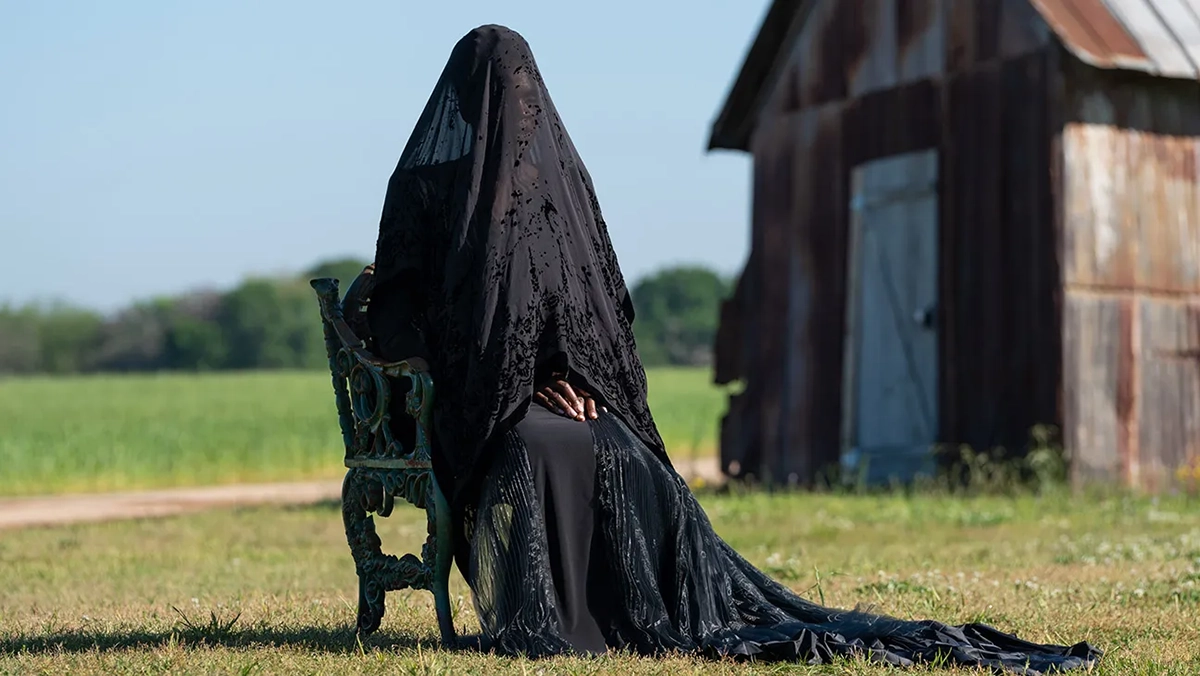
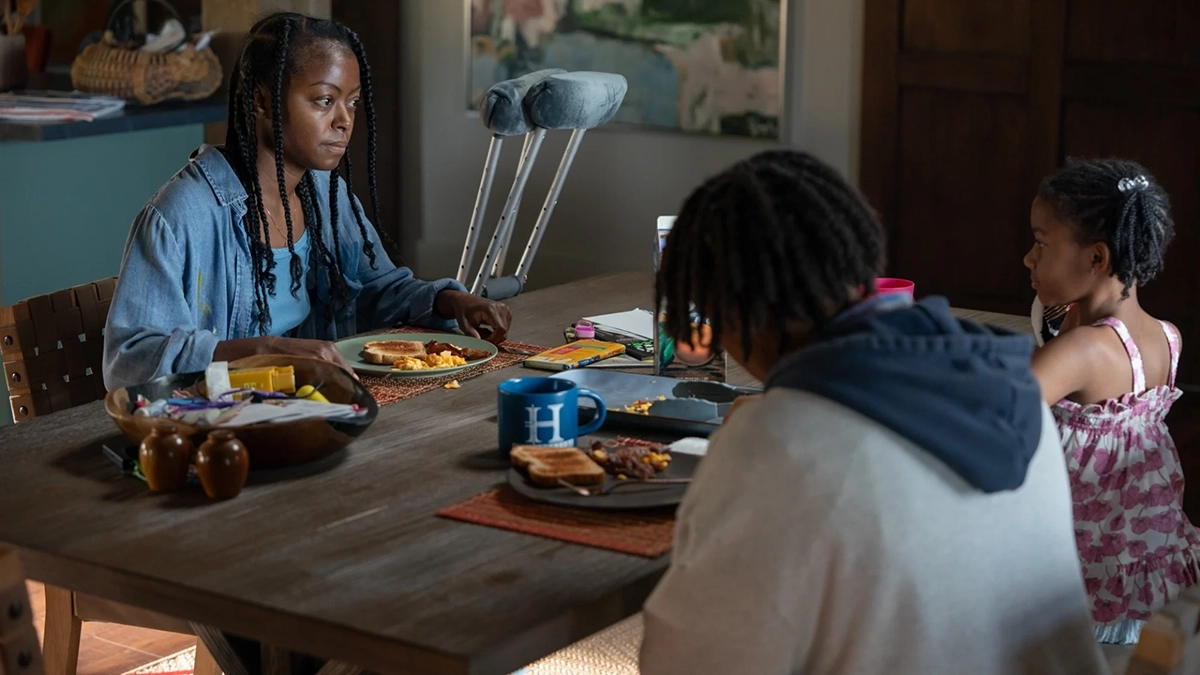
The setup is deceptively simple: Ramona (Danielle Deadwyler), a widow still reeling from the sudden death of her husband, tries to hold together her fragile family in a half-renovated farmhouse when a strange figure in a long black veil appears in their yard. She doesn’t move, doesn’t explain herself, just lingers—a Gothic intruder rendered in broad daylight. But what seems like a classic haunting soon reveals itself as something far more insidious: the woman in black is less an external threat than a manifestation of Ramona’s despair, her grief, and her suicidal impulses.
The figure in the yard, played by Okwui Okpokwasili, is one of the most striking horror presences in recent memory. She does almost nothing in the conventional sense—and yet she’s impossible to ignore. Shrouded in a thin black veil, she radiates menace and magnetism in equal measure. Her performance reminded me of Tony Todd in “Candyman:” a striking seducer who unsettles not through aggression but through sheer presence. But where Todd’s Candyman carries a sensual, mythic menace directed outward, Okpokwasili works inward, tethered by a cerebral link to Danielle Deadwyler’s Ramona. She isn’t just a haunting figure—she is the haunting thought, the whisper that refuses to leave the room, the physical incarnation of despair. That cerebral intimacy makes her not just scary, but profoundly destabilizing.
What makes the film so unsettling isn’t a twist—it’s the way Collet-Serra, working with Ari Aster’s frequent cinematographer Pawel Pogorzelski, turns ordinary domestic space into a kaleidoscope of dread. Sunlit kitchens and cracked drywall become canvases for shadowplay, distorted reflections, and unnerving sightlines that recall Val Lewton’s golden age of suggestion and the fractured emotional surrealism of “Fire Walk With Me.” The Woman herself becomes part of that design—sometimes framed as if she were simply another piece of furniture, other times bursting into view like a hole in reality itself.
Deadwyler Offers a Raw, Physical Performance
At the center is Deadwyler, delivering one of the most physically and emotionally raw performances of the year. She’s not just playing grief; she’s inhabiting it, bending her body language into something fragile and fierce. The film even incorporates her own artwork—layered self-portraits that mirror Ramona’s fractured psyche—blurring the line between performance and excavation.
Yes, “The Woman in the Yard” is technically “about trauma,” but unlike so many hollow exercises in post-“Hereditary” grief horror, this one earns its weight. Where others posture in metaphor, Collet-Serra makes despair tactile, present, and inescapable. He stages suicidal ideation not as a plot twist or a third-act rug pull, but as the film’s very foundation. His images teeter on the brink of incoherence, dissolving into silhouettes and dream-logic fragments that carry a raw emotional charge. It’s “traumacore” by definition, but stripped of gimmicks and sermonizing—what’s left is the real thing. Like M. Night Shyamalan at his sharpest, Collet-Serra balances blunt, sometimes awkward dialogue with an earnest emotional exploration that cuts deeper than polish ever could.
A Tour of Grief and Motherhood
At under 90 minutes, it’s tight, bruising, and never lets go. And while it isn’t flawless—the dialogue sometimes hammers its points a little too bluntly—the film’s visual and emotional logic is so strong that it scarcely matters. By the time the credits roll, “The Woman in the Yard” has pulled you through a guided tour of grief, motherhood, and self-destruction, and emerged with something startlingly graceful.
And here’s the sharpest irony: critics weren’t even given a proper screening of this movie. Blumhouse and the studio seemed to treat it like just another forgettable March dump, when in truth it’s one of the most expressive, thematically focused, and emotionally raw films they’ve released in years. It’s the rare Blumhouse picture that doesn’t just trade in scares but digs for something deeper—something that stings. The fact that it was shoved out without critical support says less about the film than it does about how little faith studios sometimes have in horror audiences.
Bracing and Disturbingly Beautiful
If you’re looking for horror that rattles instead of reassures, that lingers instead of entertains, this is the one to catch before it’s tossed on the pile with the rest. “The Woman in the Yard” isn’t just another horror film to put on for October scares—it’s proof that even within the lines of studio filmmaking, Jaume Collet-Serra can deliver something bracingly, disturbingly beautiful. Don’t make the same mistake the industry did: this one deserves to be seen, talked about, and remembered.