


Even though I am not his biggest fan, one thing I admire about Richard Linklater is that he never stays the same. Linklater evolves over time and consistently seeks to craft a distinct project from the one before, each featuring a new style and often crossing genres and lines he hasn’t explored before. This decade alone, we have seen him trying many new things and techniques. From the rom-con spy games in “Hitman” to the French New Wave tricks in “Nouvelle Vague,” he is not done mixing and matching. However, in his latest film, “Blue Moon” (screening at the 2025 New York Film Festival in the Spotlight section), Linklater has not only sought a new rhythm but also outdone himself in comparison to his offerings over the past couple of years.
Richard Linklater’s Portraits of Renowned Artists
At times, it is a biopic, and in others, a portrait of a man, his art, and what lies between them. Linklater has legacy on his mind, a theme that ties with the aforementioned “Nouvelle Vague” (also playing at the festival, in the Main Slate), and smeared across the frame as he dissects a diffusing day in the life of Lorenz Hart, to which Linklater’s long-time collaborator Ethan Hawke brings to life in a fascinating performance. Who is Lorenz Hart? An American lyricist and one-half of the Broadway songwriting team Rodgers and Hart. You may not know the songs by name in particular. But the tunes of “Blue Moon,” “The Lady is a Tramp,” and “My Funny Valentine” you will undoubtedly recognize.
This is not the first time Linklater has created portraits of renowned artists. “Me and Orson Welles,” one of his most underrated features, covers the life of a teenager who is hired to star in Orson Welles’ production of Julius Caesar. The film is less concerned with historical accuracy and more interested in the textures of personality and performance. It is capturing the genius behind flawed men and how art outlives them. And the same thing occurs with “Blue Moon.” Yet it sings its song with a more sorrowful tune than the 2008 film. Linklater’s latest takes place during the premiere of the now classic musical “Oklahoma!,” written by Richard Rodgers and Oscar Hammerstein.
By this point, the Rodgers and Hart duo had fallen apart. The latter’s escalating alcoholism caused unreliability during the early 1940s. This caused a shift in their dynamic because Hart became a burden, challenging to work with and endure in a professional setting. His demons consumed the man who was seen as the vessel of joy through music. By 1943, just months later, after the events depicted in this film, Hart would pass away. And that passing creates a looming cloud that covers “Blue Moon.” The charm fades, and melancholy gives way. Ultimately, there is love and care for Hart, Rodgers, and their work, whether they work together or apart.
Lorenz Hart and His Lyrical Dissertations
On a cold November night, lyricist Lorenz Hart (Hawke) leaves the production of the stage play “Oklahoma!,” from his former collaborator Richard Rodgers (Andrew Scott), early. He heads for a drink in Sadi’s Bar, owned by his old pal Eddie (Bobby Cannavale). Upon entry, the two recreate a scene from “Casablanca.” It immediately presents the viewer with how strong their bond is, as well as the delightfulness of Hawke’s performance–best in years, one might say. Their discussion begins as the drinks are poured. It quenches Lorenz’s thirst for lyrical poetry, which, in his view, “Oklahoma!” lacks in spades. He would rather leave early and drown his troubles in whisky and gin than stay for the overture. Hart does not have a disdain or hate towards the playwright Rodgers.
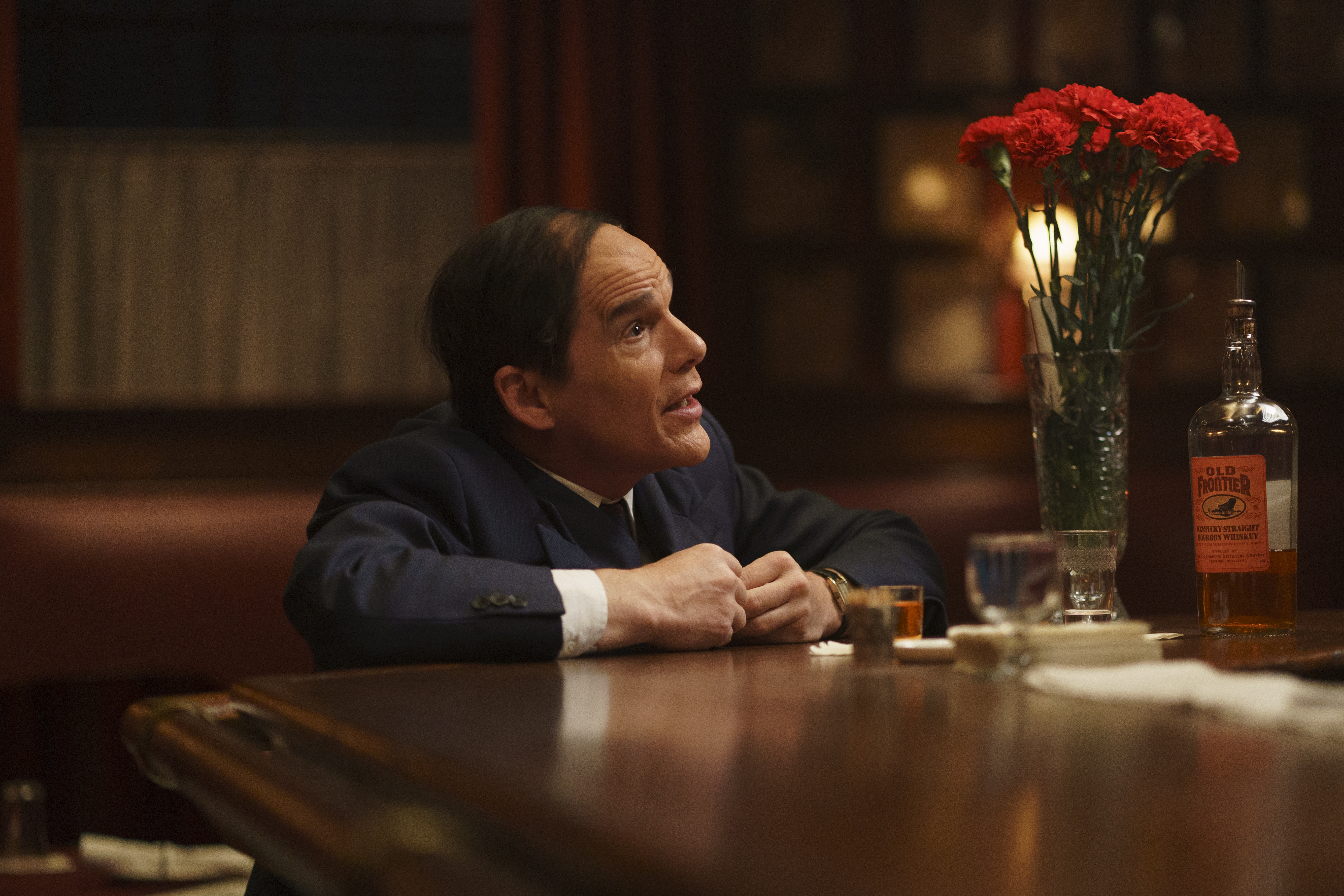
There is love and care for his former writing partner. However, the separation has left Hart quite cold, even if he doesn’t express it. Rodgers has moved on with a new collaborator, Oscar Hammerstein (Simon Delaney). We hear recollections, deep thoughts, and honest remarks from Hart. He converses with the other actors, producers, lyricists, and businessmen who come by the bar. Monologues upon monologues, affirmations upon dissertations, all with lyrical responses to the most basic or complex questions asked to Hart. Of course, these remarks have him at the center of it all. He enjoys discussing himself and sharing his thoughts on a wide range of topics. However, Linklater does not portray Hart as a contentious or overly narcissistic man.
There is too much respect for him for the “Dazed and Confused” director to do so. These conversations unfold through reflective and comedic dialogue, reminiscent of Woody Allen’s work in the 1970s and 1980s, where melancholy seeps slowly into a savvy cocktail. It has the effect of making you laugh to the same degree as it makes you question a specific part of life’s uncertainties. Linklater homages Lorenz Hart in all his extraordinary talents and downsides, with Hawke portraying him with a vivacious enthusiasm and somber mind. “Blue Moon” isn’t just an homage or a tip of the hat.
A Portrait of Brilliance and Fragility
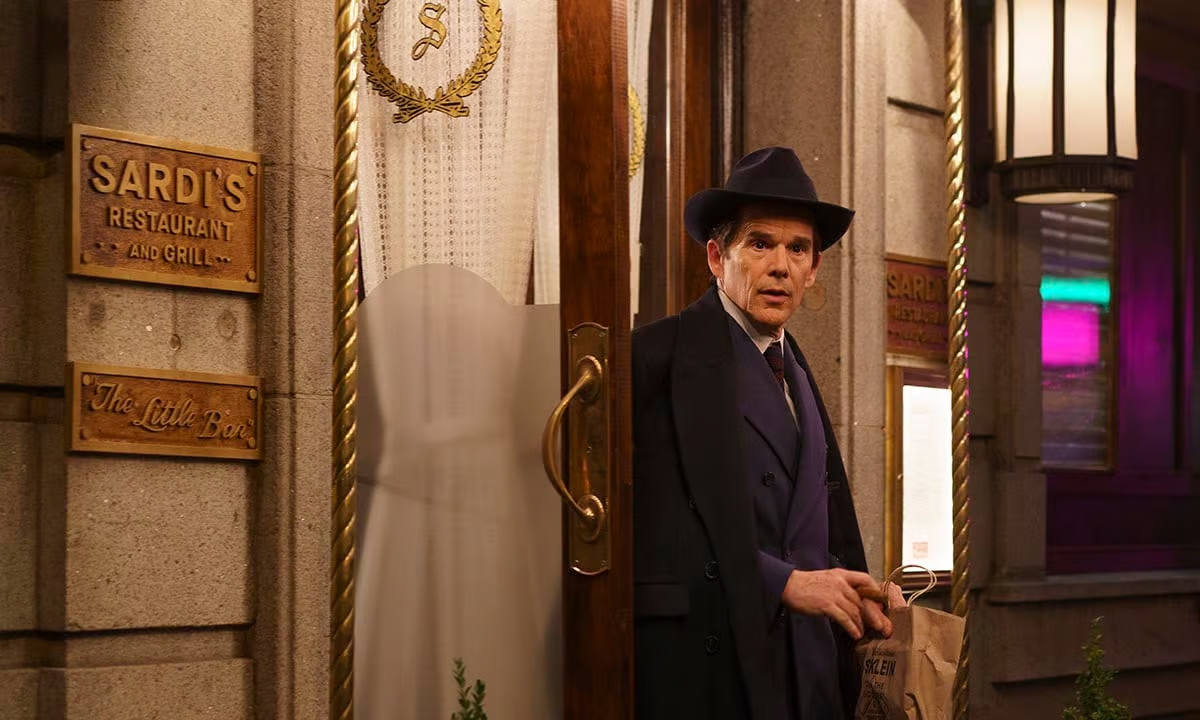
Linklater wants to discuss the ability to say goodbye to a life that has long gone, whether it’s a relationship, aging, a change in scenery, or one’s inability to let go. We see this in a scene where Hart begins to play the tune of one of his acclaimed songs as Rodgers tries to exit the bar. He hesitates to leave, yet can’t because of what Rodgers felt at the time is still dear to him. Lorenz Hart can’t let go of the life he had with Rodgers on his side. Rodgers can and has done such. The many years spent trying to help his writing partner get out of his alcohol abuse caused him to make the definitive move after there was nothing else he could do.
This inability to let go gives “Blue Moon” its melancholic tinge, where we feel for Hart, even though his sparks of narcissism are evident, thanks to Linklater’s sincere and respectful approach. There is a fear that, without Rodgers, he will become just another man in the desolate world. Irrelevancy stings more as fame dissipates and death comes near. Linklater leaves us with a portrait of brilliance shadowed by fragility—a man, and perhaps an era, struggling to live once the music fades.
“Blue Moon” screened at the 2025 New York Film Festival in the Spotlight section of the festival.

