


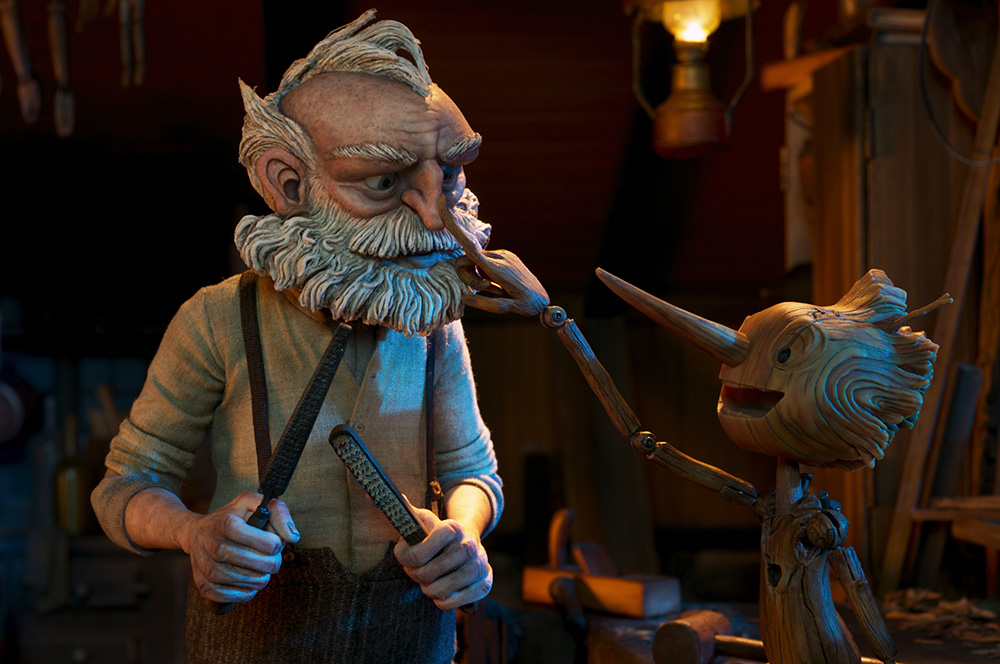
With only a few seconds in, you can feel the love and care put in Mark Gustafson and Guillermo del Toro’s “Pinocchio.” Filled with touching songs and embracing both the darkness and light within the story we all know, this reimagining is a beautifully crafted and whimsical film that dwells in the melancholic beauty of the mournful times, the transiency of mortality, and the everlasting pains of the past.
The story of Pinocchio, the wooden puppet who wants to be a real boy, has been told hundreds of times in various forms and genres. Carlo Collodi’s 1881 novel has inspired many filmmakers to create their own rendition of the classic tale because of its balance between light and darkness. Of course, not all of them embrace both sides of the coin, but they try to implement their own twist to justify their existence among the many. The one that everyone knows the most is the classic animated Disney picture from 1940. It is one of the best films from the popularist company. Earlier this year, we got Robert Zemeckis’ version, which was indeed an awful experience to endure due to its cringy dialogue, extremely poor direction, and poor visual effects. Basically, to resume it all, every facet felt lacking. After that film, I think everyone felt another version wasn’t necessary until Guillermo del Toro announced he would make one. And if a director were fit to tell the tale, it would be him.
Sharing Similarities with Mary Shelley’s “Frankenstein”
Birthed similarly to Mary Shelley’s “Frankenstein” (the titular character is raised from the dead and elevated by sequences of tension and tenderness—scares and charm), “Guillermo del Toro’s Pinocchio” is a stop-motion reimagining of Carlo Collodi’s story by the Mexican filmmaker and co-director Mark Gustafson, one of the animation directors on Wes Anderson’s “Fantastic Mr. Fox.” Del Toro’s knack for creating memorable creatures and monsters blends well with the story of the puppet brought to life. “Pinnochio” embraces the playful light of his innocence and the shattering darkness of his immortality. At the same time, it masks scenes of bliss with an atmosphere filled with dread and despair. From the initial moments, the viewer can sense the love and care put into the movie and its beautiful craft. It indeed feels like del Toro’s lifelong passion project. This richly layered and whimsical fantasy adopts what makes dreams and nightmares come true in the best way possible.
He doesn’t want to repeat what’s come before, and sets his version during the rise of fascism in Mussolini’s Italy. This rendition of Pinocchio’s story begins with a glimpse from the past, as Geppetto (David Bradley), a woodcarver in a quaint Italian village, recalls the life he had before his son, Carlo (Gregory Mann, who also voices Pinocchio), passed away due to a church bombing. The tragedy has broken Geppetto’s heart into a million pieces. It leaves him a grief-stricken drunk. He drowns his sorrows in multiple bottles of liquid courage to try and hold his head high. He leaves his persona of being a charismatic and joyful man behind. The longing has reached a new high. The sadness is eating him alive to the point where he decides to build a wooden version of his son. This is where the first element of “Frankenstein,” a story that Guillermo del Toro is very fond of and used in some of his other features, arrives.
A Testament to Grief and Acceptance
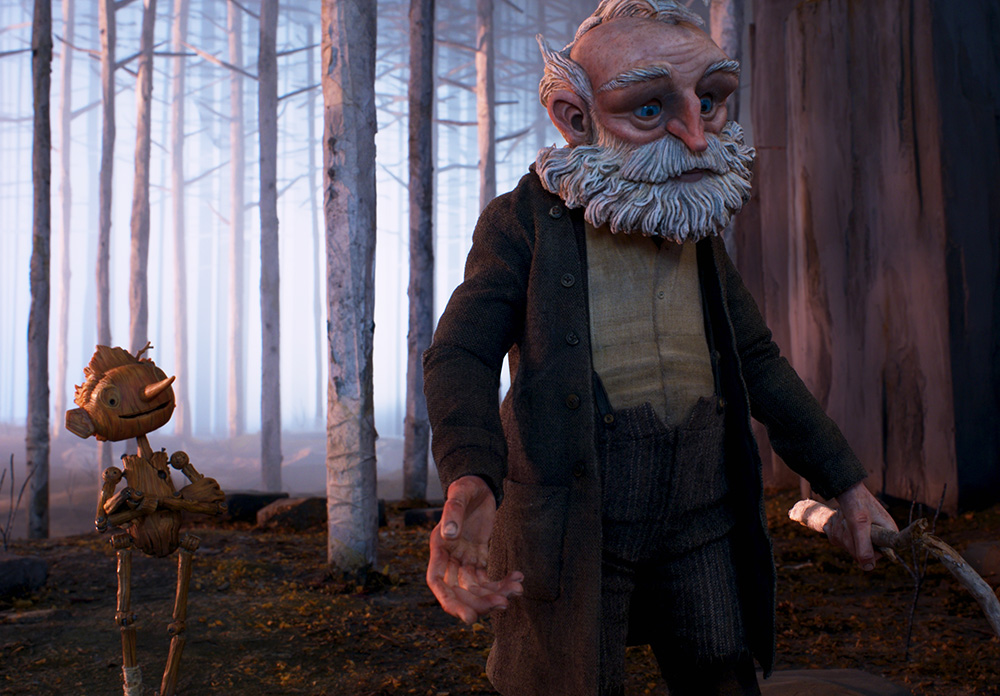
Geppetto throws the bottle to the ground and raises the hammer and saw to carve the boy to life. Of course, he knows that won’t bring him back, but Geppetto only does that to try and cover the wounds caused by loss. These first few minutes show a significant departure from the source material. They showcase how Guillermo del Toro can play with the viewer’s emotions through his filmography. Happiness transitions into sadness, which later culminates into utter drunken despair. The film highlights the guilt-ridden heart of a man who lost his entire world and his will to live. However, there’s tons of beauty latched onto this tragic introduction, a melancholic one, to be specific. This chapter in the narrative revolves around the first four stages of grief; the rest of the film is about how Geppetto copes with acceptance. Because the woodcarving elder has deteriorated emotionally, a Wood Sprite (Tilda Swinton) provides him with a gift. She gives life to the puppet so that he could be his son.
What name would it be given? You guessed it… Pinocchio. Geppetto would need to care for him, and a cricket, Sebastian (Ewan McGregor), needs to guide him out of trouble. As expected, mischief arrives in the hands of two troublemakers, The Podesta (Ron Pearlman) and Count Volpe (Christoph Waltz), who his “pet” monkey accompanies, Spazzatura (voiced incredibly by Cate Blanchett, who spent a lot of time searching for the right sound for her character). Many moments are taken from the source material, its grand finale involving Monstro, the gigantic whale, and its core elements. However, the best parts of the film revolve around the distinctiveness— scenes detached from Carlo Collodi’s story (the addition of fascism and war, more experimentation with the aspect of death, drenching the atmosphere in the utter darkness and light of bereavement, amongst other expansions). In my opinion, the addition I loved the most was the presence of death and the conversations that Pinocchio had with the creature meant to represent that aspect of life.
Awe-Inspiring Animation Coupled with Remarkable Emotion
Although I wanted more of those scenes where Pinocchio keeps asking questions to the sprite and learning more about the world, the ones we see in the film are remarkable. Since the boy can’t die, that’s just a pit stop for him. It is a place where he contemplates life and the decisions he has made so far. He examines what life means to him and how love is felt differently. It’s bardo (or limbo), a place that is between life and death. And those moments arrive with deep emotional sensibilities that viewers of all audiences can enjoy. Adults can embrace the cessation factors and reflect on their lives so far, while kids slowly learn about what it means to lose someone or where people go after they pass. That’s the best form of children’s entertainment. These pieces of work showcase tough topics to young ones in a way that’s easy for them to explore.
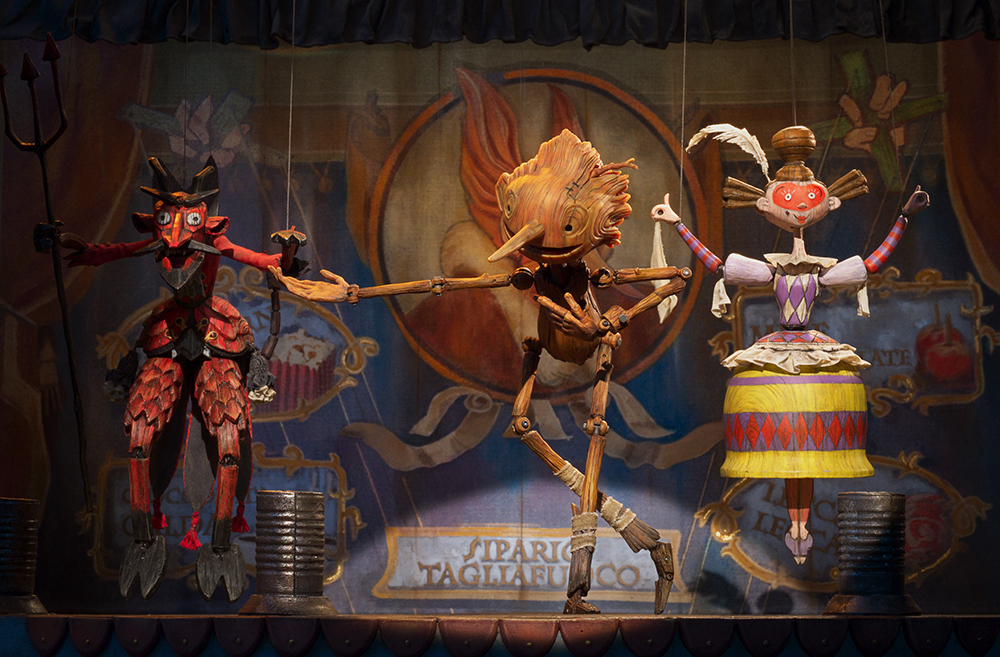
It doesn’t have to be a film drenched in the harshest form of melancholia because that would be thoroughly depressing and break their souls in half. Yet, it is always fascinating when a filmmaker provides stories that embrace the hardships of life in a medium that’s approachable for all audiences, including the younglings. That’s one of the reasons why “Guillermo del Toro’s Pinocchio” strives. It does all of that and more. The animation is awe-inspiring and truly a gift just seeing it in action. The hand-crafted puppets feel vivid and life-like, even though they’re caught in a blend of fantasy and realism. And this is not only because of the excellent voice acting by the cast but the movement these puppets do (shoutout to the cast and crew who worked extremely hard to make this project work). If we were to compare “Pinocchio” with one in del Toro’s filmography, it should be his magnum opus, “Pan’s Labyrinth.”
A Beautiful Contemplation on Life and Death
These two gems are dark fairytales that use mystical and magical elements as escapism to keep the main character out of harm’s way, mainly caused by true-to-life situations that happened decades ago. However, both end in dream-like tragedy, where hope is meant for some, but sadness lingers for others. In what space does Pinocchio land? Just like his meetings with death, right in the middle, looking within the astral plane of yearning and dismay. Just like the quote in Don DeLillo’s novel, “White Noise,” “All plots tend to move deathward.” The world passes him by; he loses his close ones and remains the same—immortality strikes the young wooden boy just like a vampiric tale. Would he pass onto the other realm? That’s the ending question that Sebastian leaves to the audience. We don’t know if Pinocchio will ever die. But when the time comes (if it ever arrives), he already knows how to handle things.
This ending pierces the viewers’ hearts, causing a minor fracture that remains unwounded for days after seeing the film. The existentialist procedure in the narrative’s latter half makes up for the issues one might have about the film. Some may be less impacted by Pinocchio’s story because they have seen or heard about it hundreds of times. Still, Guillermo del Toro and Mark Gustafson’s spin on it makes sure that it impacts you and, most importantly, makes you contemplate the beauty of life and what may come next.

“Guillermo del Toro’s Pinocchio” is currently available to watch in select theaters and stream exclusively on Netflix.
Support the Site: Consider becoming a sponsor to unlock exclusive, member-only content and help support The Movie Buff!
