

Close Menu
    Facebook X (Twitter) Instagram
    Friday, March 6
    Facebook X (Twitter) Instagram Bluesky
    The Movie Buff
    • Home
    • About
      • Critics
      • Press & Testimonials
      • Friends of the Buff
      • Terms of Use
      • Thank You!
    • Film Reviews & Coverage
      • Movie Reviews
      • TV/Streaming Reviews
      • Film Festival Coverage
      • Interviews
    • Podcasts
    • Indie Film
      • Reviews & Articles
    • Advertise
    • Contact
      • Write for us
    The Movie Buff
    31 Days of Halloween

    Review: Forming the Basis for Film Noir, the Excellent ‘The Cabinet of Dr. Caligari’

    Rita AmerBy Rita AmerOctober 11, 20201 Comment4 Mins Read
    Facebook Twitter Pinterest LinkedIn Tumblr Email Copy Link
    Share
    Facebook Twitter Email Copy Link

    Watching “The Cabinet of Dr. Caligari” is like being imprisoned in Edvard Munch’s painting “The Scream,” forever suspended in the silence of unending anguish. This silent German Expressionist masterpiece is a brilliantly realized nightmare whose antique acting style and visually arresting sets and costumes are as exciting and moving as a great 19th Century opera or ballet.

    “The Cabinet of Dr. Caligari” is a seminal work of what in German is called helldunkel. It is German Romanticism warped by the soulless devastation and incalculable loss caused by the First World War. Where WWI suffocated the light of the German soul, psychoanalysis and nihilism filled the void. Beauty is abandoned as an artistic end and the monsters of the subconscious creep and slither freely across the face of German art.

    In cinematic Expressionism, the actors do not project their inner lives, emotions, and thoughts outward for the viewer to catch and interpret from their performances. The actors inhabit a concrete, external construction of their dreams, desires, and demons. The subconscious realms so recently described by Freud, Jung, and other psychoanalysts were depicted during the inter-war period for us to see in the skewed perspective of the sets, the abandonment of the rules of perspective, the dramatic chiaroscuro lighting, and the outlandish costumes. And we watch the characters negotiate the shifting sands of this dream-reality. 

    The actors themselves move in a strictly stylized way based on the ubiquitous Delsartre System of Bodily Expression. This system of gesture, created by a French singing coach, penetrated into training for actors, orators, singers, and the new “modern” dancers such as Isadora Duncan. It was a new kind of movement system intended to free the performer from stiffly mannered expression and, instead, teach them how to appear more gracefully “natural.” It is not what we would call natural today because acting has changed greatly. But when the system is used by talented actors like the cast here, it is exciting, expressive, and dynamic.
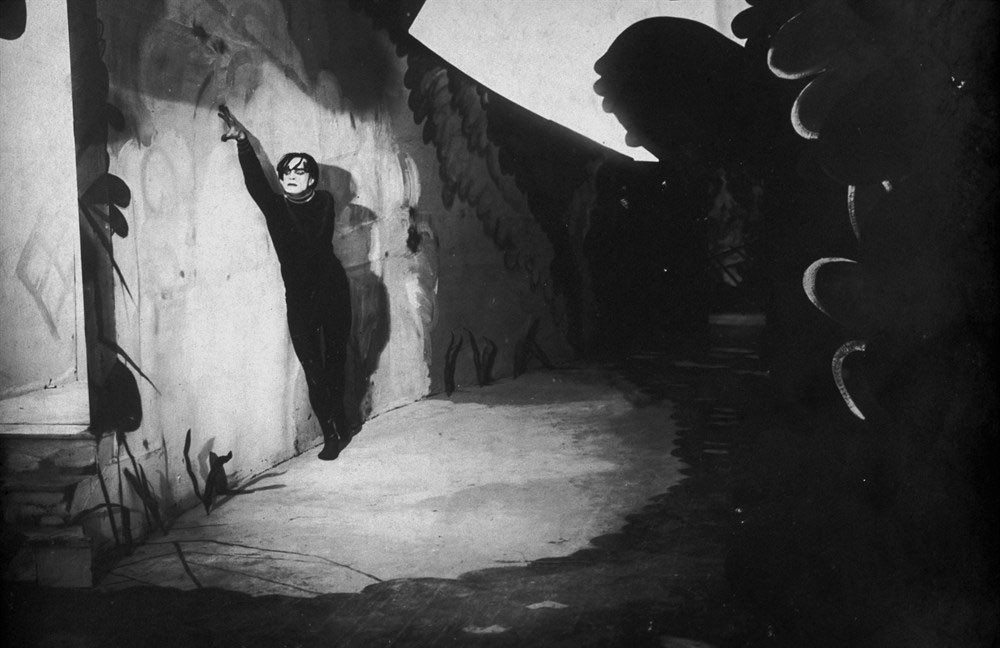
    A scene from “The Cabinet of Dr. Caligari” (Decla Film-Gesellschaft-Berlin, 1920).

    But “The Cabinet of Dr. Caligari” is more than a period piece; it is a thriller. The protagonist Francis (Friedrich Feher) races through streets tilted at impossible angles desperately trying to discover the identity of a serial killer and unravel the mysteries of Dr. Caligari. He spirals like a character in a Kafka novel through nightmarish absurdity.   

    In order to tell the story of the serial killer, Cesar the Somnambulist, who lives in a waking dream, Conrad Veidt employs his Delsarte training to allow us to see into the mind of the sleepwalker. The shell that Cesar has become walks, speaks, and kills only at the behest of Dr. Caligari. He has no inner life and no will. That is the wonder of Veidt’s performance; he is able to embody a compelling blankness, looming violence, and poignant beauty all in one being. Cesar is perhaps the emblem of the post-war shellshocked remnants of Germany’s young manhood. He may even be the archetype of what Germany’s soul became after its defeat and humiliation in 1918. Veidt’s performance is supported by every other aspect of the film. There is nothing lovely, safe, or rational about the landscape. The sets are pointed, skewed, and sharply shadowed, denuding the world of comfort.

    All of the techniques deployed here so brilliantly will form the basis of film noir when the great German filmmakers and actors begin to emigrate to Hollywood as the Nazis rise. These filmmakers and their new American colleagues will take the brutalist components of Expressionism, mold, round, and recycle them to convey American disillusionment following the Second World War in a more refined, palatable way. The beautiful chiaroscuro of “Out of the Past” (1947) and the vertiginous camerawork of “The Big Clock” (1948) are owed to these early German Expressionists.

    For more viewing, “Metropolis” (1927) is the most famous of the German Expressionist films. To see a Hollywood adaptation of the style, I suggest watching (or re-watching) “Casablanca” (1942). The special link here is that Conrad Veidt who played the Somnambulist in “The Cabinet of Dr. Caligari” plays the Nazi Major Strasser in Casablanca.



    Cabinet of Dr. Caligari classic horror murder somnambulist Werner Krauss
    Share. Facebook Twitter Pinterest LinkedIn Tumblr Email
    Previous ArticleReview: ’Spring’ an Indie Horror/Romance that Almost Pulls it Off

    Next Article Review: a Trip Down ’80s Memory Lane, ‘Scanners’ So Good it Will Blow Your Mind
    Rita Amer
    • Website

    Rita has been a cinephile since birth. Though she works a day job, her evenings and heart belong to celluloid (and video). Rita has a Masters in Dance and a Juris Doctor; but those accomplishments pale in comparison to sharing the best and worst of cinema with our readers. You can also follow Rita on her podcast, ‘Foibles,’ where she talks about film and literature.

    Related Posts

    Drama March 4, 2026

    ‘Rosemead’ Review: A Mother and Son Stare Down the Barrel in a Tragic Eye-Opener

    Independent March 2, 2026

    The Short Film ‘Jam Boy’ by Sriram Emani is Rich with Culture and Social Commentary

    Horror March 2, 2026

    ‘Scream 7’ Review: A New Chapter as the Franchise Rewrites the Rules

    Drama March 1, 2026

    “Wuthering Heights” (2026) Review: A Preposterous Retelling, Rich in Aesthetic Yet Weightless in Text

    Horror February 28, 2026

    Why Do We Keep Returning to the ‘Scream’ Films?

    Action February 26, 2026

    ‘Man on Fire:’ Violent and Unforgiving, but Features Both Denzel and Fanning at their Best

    1 Comment

    1. Chava Bahle on January 14, 2024 6:05 AM

      Hello and thank you for this lovely post. I am writing a new biography of Conrad Veidt. You write, “Conrad Veidt employs his Delsarte training.” I am hoping you can help me find original source material that substantiates substantiates that this was his acting training.

      Reply
    Leave A Reply Cancel Reply

    Latest Posts

    ‘Rosemead’ Review: A Mother and Son Stare Down the Barrel in a Tragic Eye-Opener

    By Vidal DcostaMarch 4, 20260

    The Short Film ‘Jam Boy’ by Sriram Emani is Rich with Culture and Social Commentary

    By Mark ZiobroMarch 2, 20260

    ‘Scream 7’ Review: A New Chapter as the Franchise Rewrites the Rules

    By Holly MarieMarch 2, 20260

    “Wuthering Heights” (2026) Review: A Preposterous Retelling, Rich in Aesthetic Yet Weightless in Text

    By Hector GonzalezMarch 1, 20260
    • Facebook
    • Twitter
    • Instagram
    • YouTube
    Indie Film Highlights

    ‘Rosemead’ Review: A Mother and Son Stare Down the Barrel in a Tragic Eye-Opener

    By Vidal DcostaMarch 4, 20260

    “Rosemead” is based on “A dying mother’s plan: Buy a gun. Rent a hotel room.…

    The Short Film ‘Jam Boy’ by Sriram Emani is Rich with Culture and Social Commentary

    By Mark ZiobroMarch 2, 20260

    Review: Rough Sex and Rougher Relationship Dynamics Intertwine in the Risqué ‘Pillion’

    By Vidal DcostaFebruary 24, 20260

    Interview: Filmmaker Sriram Emani on Exploring Self-Erasure and Breaking Patterns in his Debut Short ‘Jam Boy’

    By Vidal DcostaFebruary 20, 20260

    Acclaimed Violinist Lara St. John Talks About ‘Dear Lara’ Doc in Post SBIFF Interview

    By Mark ZiobroFebruary 16, 20260
    Spotlight on Classic Film

    ‘The Innocents’ Review: One of the First Haunted House Films of the Modern Horror Era

    ‘Gone With the Wind’ Review: Epic Film from the Golden Age of Hollywood

    ‘The Count of Monte Cristo’ QCinema 2024 Review: A Thoughtful, If Rushed, Study of Revenge and Redemption

    ‘Thirteen Women’ Review: A Precursor of the Slasher Genre, with a Devilishly Divine Femme Fatale at its Helm

    The Movie Buff is a multimedia platform devoted to covering all forms of entertainment. From Hollywood Blockbusters to Classic Comfort faves. Broadcast Television, on-demand streaming, bingeworthy series'; We're the most versatile source.

    The Movie Buff is also the leading supporter of Indie film, covering all genres and budgets from around the globe.

    Facebook X (Twitter) Instagram YouTube LinkedIn TikTok
    Copyright @2011-2025 by The Movie Buff | Stock Photos provided by our partner Depositphotos

    Type above and press Enter to search. Press Esc to cancel.