


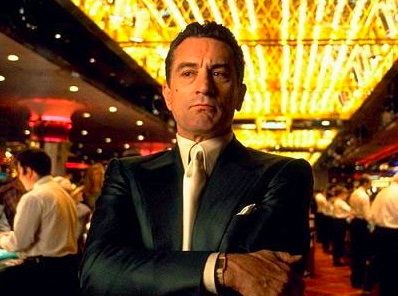
Like Martin Scorsese’s renowned “Goodfellas,” his 1995 effort “Casino” would again concern mobsters, the reach of their empire, and would reunite Robert De Niro and Joe Pesci. De Niro, who played a thieving hitman in “Goodfellas” would play a different role here, filling the shoes of a quasi legitimate casino president who prefers to look the other way, while Pesci is up to his old bag of being an intimidating thug. Throw Sharon Stone into the mix as a love interest for De Niro’s “Ace” Rothstein, and you’ve got the makings of another successful mob picture.
While “Goodfellas” was more concerned about mobsters, “Casino” has a wider scope, which is both its greatest asset and its biggest liability. The film spends some time toward the beginning detailing the history of Rothstein and Nicky Santoro (Pesci). Ace is the best handicapper in town, and is an easy choice for mob bosses (led by a man named Remo Gaggi) to send him to Las Vegas for their burgeoning casino enterprise. But it’s not casino operations they wish to run, but casino skimming – how much they can take from the back room without getting caught.
Alongside this, Nicky is sent as protection – for Ace and for the mob bosses’ interests. But we quickly see what kind of man Nicky is: he’s a hot head who doesn’t mind roughing up goons (with a couple of gruesome intimidations that will not be spoiled here), extorting innocent civilians, and robbing places blind – all while he is supposed to be keeping an eye on Ace and keeping things quiet. “Hey, I gotta earn, don’t I?” is all he can answer in retort.
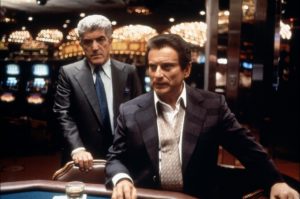
As a picture, “Casino” does several things right. The first is to immerse us fully in Las Vegas culture, guiding us through glamorous casinos when that meant something; and before Vegas was turned into a watered down tourist trap. We see rich businessmen comped for expensive hotel rooms, bookies making a fortune, and the lavish dress of 1970s’ era fashion.
Scorsese also takes us through the less glamorous aspects of casino management, such as how cards are counted, how dealers are scrutinized by security cameras, and how thieves are dealt with. In one protracted scene, a pair of cheaters is punished: one, shocked with a cattle prod and having his fingers smashed with a hammer. Scorsese wants us to know Las Vegas means business. And we take his message literally.
A mafia picture, “Casino” also takes us through some hushed conversations between Remo and his gang as they skim money, complaining about things like not making enough money and the effrontery of having to pay the people that steal the money for them for stealing the money.
Acting wise, “Casino” is stacked with a breadth of capable actors, and all turn in impressive performances. De Niro – with appearances in “Goodfellas” and “The Godfather Part II,” has cemented himself as able to play mafia types with ease. Though he’s more or less taken on comedic roles of late (such as the funny “Last Vegas”), here he plays a man who is a criminal but spends most of the film pretending not to be one. It’s a credit to Scorsese that Ace thinks himself a serious casino operator all while backed by a legion of mafioso types.
Alongside him, Pesci excels as the mobster Nicky Santoro – and, despite his pure menace – the chemistry (and arc) he and Ace have throughout the film’s run makes the picture that much more toned down and believable. It’s not when they get along, but when they come to heads, that makes “Casino” both engaging and thrilling.
Other actors, such as James Woods, Kevin Pollack, Don Rickles, Frank Vincent, and Dick Smothers round out the cast.
 If criticisms do come, they come in several forms, such as its length (the film clocks in at arduous two hours and 58 minutes) and some side-plotting that becomes more than distracting. The length is just too much. Rise and fall pictures (of which “Casino” is a sterling example of the genre) take time, but at almost three hours here feels more like work than enjoyment. “Goodfellas” accomplished the feat in less than two and a half hours, and the editing in that movie was tight and effective. In “Casino” it feels as if Scorsese wanted to fit in every nook and cranny that could possibly be used to tell his story, where much of it could have been truncated and still had the powerful impact it did.
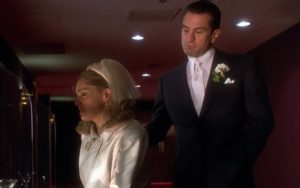
The worst offender of this is the tense relationship between Ace and Ginger McKenna (Sharon Stone), a Vegas working girl whom he falls in love with. While the film devotes little time to their love affair, [spoilers] it drags viewers down an inordinately long path detailing the struggle and ultimate demise of their relationship. [end spoilers]. In fact this portion of the film takes so long you forget all about the casino, the mafia, or Nicky and Ace’s relationship. It reminded me of the ludicrous plot in James Cameron’s “True Lies,” where an arc involving the hero’s wife takes up almost a full 30 minutes, subtracting from the action of the overall picture. In “Casino,” viewers will wish this part to be over far sooner than it eventually is, and it really subtracts from the picture as a whole.
At the end of the day, however, it’s hard to find too much fault with “Casino.” It’s an engaging mob picture, immerses viewers completely in 1970s Las Vegas, and feels as exciting and authentic as the cinematography is pleasing and warm. Some scenes are over the top and will make you cringe, while others will make you wish you were there. If you haven’t seen “Casino,” do give it a try. Just be prepared for some pacing issues and sections of drawn out over-exposition.
– by Mark Ziobro

