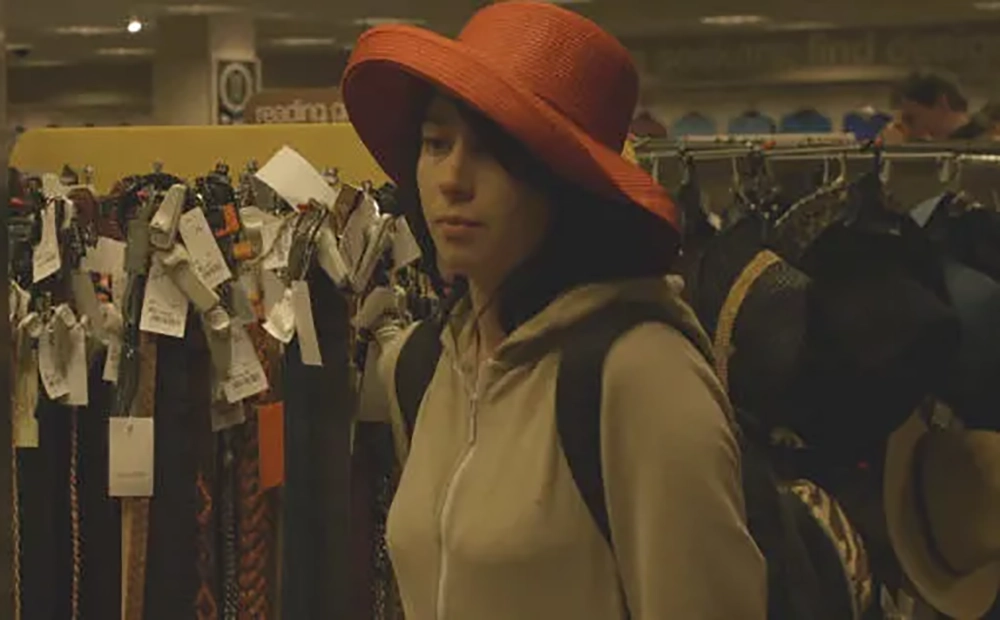
“Nola and the Clones” is an independent feature written and directed by Graham Jones, and offers food for thought on life, perception, and more. Press releases describe the film as “unabashedly feminist;” and while the film has a feminist footprint, it is more about personal discovery than social message. It’s main character is homeless, but the film is also not about homelessness. What we find is a wonderful portrayal by the film’s main actress (Caoimhe Cassidy), and a pensive film that is slow to build.
Independent films are used to waxing philosophical over plot, and “Nola and the Clones” is no exception. We are introduced early to the homeless girl played by Cassidy, who in turn runs into a series of men who seem to be similar in ways.
An early one she meets outside a shop indicates an attraction to her, which she acknowledges while also dissecting. Another man who inserts himself into her breakfast table at a café is also seemingly attracted to her, but less honest and more demeaning. She could make something of herself, he indicates, a certain amount of resentment cloaked as benevolence that she picks up right away. And she meets another man in one of the most chauvinistic scenes in the film: a man who picks her up for a stint of prostitution after urinating in the river, drunk, right in front of her as she sleeps on a park bench.
“Nola” is not a moral tale, or one of redemption. Its protagonist does things (accepting money from strangers, prostitution, passing days away in malls pretending to shop) that are not evidence of anything, but offer a sense of exploration into her psyche. She revered her dad, while he was alive. Her mom was a drunk.
She learned early on her job as a woman was to look pretty, and, as her mother put it,’ “make men happy, get them off.” Doing these things, she finds, causes her to lose herself. The men she makes happy also think less of her for doing so. An exploration of this double standard runs deep through this film.

The film is shot wonderfully, and I think my favorite thing about the whole film is the gritty, ‘70s feel that Jones injects into the work. Grainy cameras are used here in lieu of the bright, high def images of many of the films of today. In an interview, Nicholas Cage once stated he preferred the look of these older films, because it left more to the imagination. “Nola” is filmed entirely in Dublin, and the streets are presented in a dreary overcast, not the bright, crisp treatment moviegoers are used to.
Additionally, Jones has mastered the long shot in this film. Several scenes show steady cams fixed on the protagonist and her paramour, sometimes dialogue-heavy, sometimes not. In the most impressive scene of the film, Cassidy narrates to an offscreen man about her past with her family, other men, and experiences, shot in a single take in a car, devoid of any distractions.
The most beautiful scene of the movie comes soon after, near its end, as Cassidy ponders the Virgin Mary — and is one of the most interesting interpretations of the religious myth I have seen on film. In fact it might be the first time I’ve seen it addressed on film at all.
 I have to say that I found the men in this film lacking. They are all played by the same actor, a man named Joseph Lydon. And while I get the film is about Cassidy’s exploration, and is supposed to show us her view of a legion of men who are all the same, I found the guys to be simply caricatures of themselves. They all look down on her, demean her (either overtly or subtly), and then more or less fade from the film.
Incidentally, the film combines two dynamics: a powerful female lead that also happens to be homeless, and the dynamics are mixed in ways hard to unentangle. An personal exploration film, “Nola” doesn’t wish to comment on homelessness, but I wish it had. It makes some subtle gestures towards the film’s end, as Cassidy walks through stores, nightclubs, etc., and seems to close just as it was getting truly interesting.
There are also many shots focused on silent portrayals of Cassidy, of sights in Dublin, etc. And while scored beautifully, some of them carry on for a bit too long, slowing the pace of the film to tedious in places.
All in all, “Nola and the Clones” is an engaging film. It’s dialogue-heavy in places, introspective throughout, and despite some lagging, offers escapism and filmmaking in an old-soul sort of way. Jones (behind the camera and script), and Cassidy, turn in an impressive showing for a YouTube-released indie.