Released in 2002, “28 Days Later” proved to be a revitalising shot in the arm for director Danny Boyle, (Oscar successes with “Slumdog Millionaire” and “127 Hours” followed soon after) launched the Hollywood careers of then unknown Cillian Murphy and Naomi Harris, and lead to a resurgence in zombie movies. Films like “I Am Legend,” “The Dawn of the Dead,” remake and “World War Z” owe Boyle’s film a huge debt, in particular its super fast zombies. However, Boyle’s film stands tall above them all thanks to energetic direction, intelligent writing, and a beating heart that many horror films lack.
Bicycle courier Jim (Cillian Murphy) wakes from a 28-day coma to find London is completely deserted. After being attacked by zombies infected with “Rage” (a prologue depicts its accidental release from a lab by animal rights activists) he is rescued by fellow survivor Selena (Naomi Harris). Jim and Selena team up with taxi driver Frank (Brendan Gleeson) and his daughter Hannah (Megan Burns) and travel to the North of England following an emergency broadcast from an Army base lead by Major Henry West (Christopher Eccleston). However, they soon discover that the base is not the safe haven they hoped for.
“28 Days Later” was a comeback of sorts for director Danny Boyle. The UK filmmaker burst on to the scene with “Shallow Grave” and “Trainspotting,” but his move to Hollywood with “A Life Less Ordinary” and “The Beach” proved less successful. Returning to England with a low budget and making use of small digital video cameras, Boyle created a gritty, powerful horror film which intelligently played into modern fears of viral outbreaks and the collapse of society.
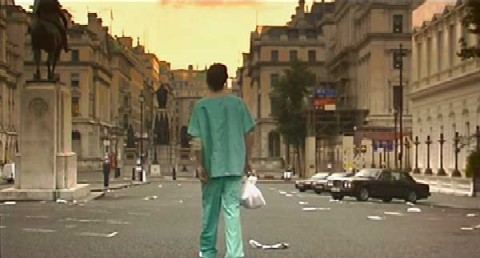
The “Rage” that infects the zombies (although the Z word is never used in the film) can be taken as a metaphor for the rage that we see throughout modern society e.g. road rage. Boyle and screenwriter Alex Garland create some powerful images of societal collapse. In one shot, we see Jim collecting abandoned cash, unaware that money has no value in this new world. In a funny scene where the four survivors take joy in raiding the shelves in an abandoned supermarket, Frank leaves his credit card at the checkout; the card is now just a meaningless piece of plastic in the apocalyptic environment. In the final act of the film Boyle and Garland take swipes at the cruelty of the military and make some disturbing points about how women would be particularly vulnerable in this kind of crisis. Acts of sexual violence could be “justified” by the perpetrators in the name of “repopulating the Earth.”
 There are some chilling moments of human horror in the film. For instance, Jim finding the bodies of his parents in their bed, clutching sleeping pills and shots of fields of executed men and women at the Army base. It is these themes of ‘real’ horror, as in the kind of horrors that existed outside the cinema screen, which separates great horror from the standard fare.
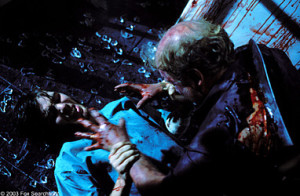
At the time of the film’s release, much was made of Boyle’s use of digital video cameras. Digital cameras have come a long way since 2002 and now many blockbusters are filmed digitally. “28 Days Later” does look cheap in comparison to modern films shot this way, but that adds to the gritty feel of the film. It almost gives the film a “found footage” style before that trend took hold of the horror genre. Boyle and genius cinematographer Anthony Dod Mantle separate their film from a straight to DVD horror thanks to some dynamic framing and camera movement. Boyle’s trademark firecracker directing style is particularly electrifying in the final act, as Jim and Selena face attacks from not just the film’s zombies, but perhaps some of the film’s humans as well. Boyle’s scare tactics are not subtle, aside from odd scenes of suspense as when Hannah hides behind a mirror from an infected soldier. For most of “28 Days” relies on blunt force trauma, with shock jump scares and sudden bursts of graphic violence.
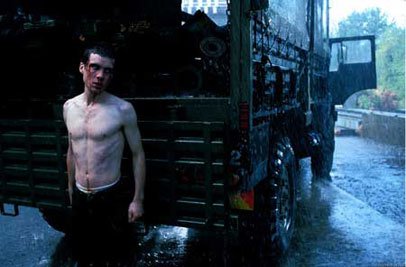
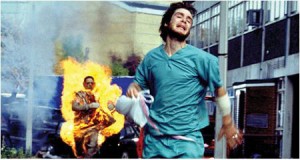 The performances in the film are for the most part very strong, with the exception of Megan Burns, who is incredibly wooden. Murphy was an unknown theatre actor when he was cast and his intense performance launched his career in Hollywood. Jim has a real emotional journey in this film, from the cowardly everyman at the beginning to his transformation into action hero in the third act. From the scenes of him weeping over his parents’ bodies to him stripped to the waist kicking zombie ass, he is thoroughly convincing throughout. Harris is also brilliant, her Selena seems initially hard and aloof but gradually reveals that she is just as damaged and humane as Jim. Gleeson has some nice comic moments as the working class hero and has one scene of heart-breaking tragedy. Eccleston’s villain is more broadly drawn than the other characters, but the actor’s presence and charisma means that we understand the reasons for his cruelty.
With “28 Days Later” Boyle not only righted his faltering career but (along with Edgar Wright’s “Shaun of the Dead“) also reinvigorated the moribund zombie genre. None of the films that followed, despite their bigger budgets and slicker visual style, matched the intensity or emotion of this film. The sequel “28 Weeks Later,” directed by Juan Carlos Fresnadillo, was larger in scope and budget but lacked the emotion and wit of Boyle’s film. Going against the grain of unremitting bleakness found in many horror movies, Boyle’s film ends on a note of hope and redemption. Boyle finds a power in the film, and a theme that even in the darkest of moments, humanity will shine through.
– by Craig Adgie