


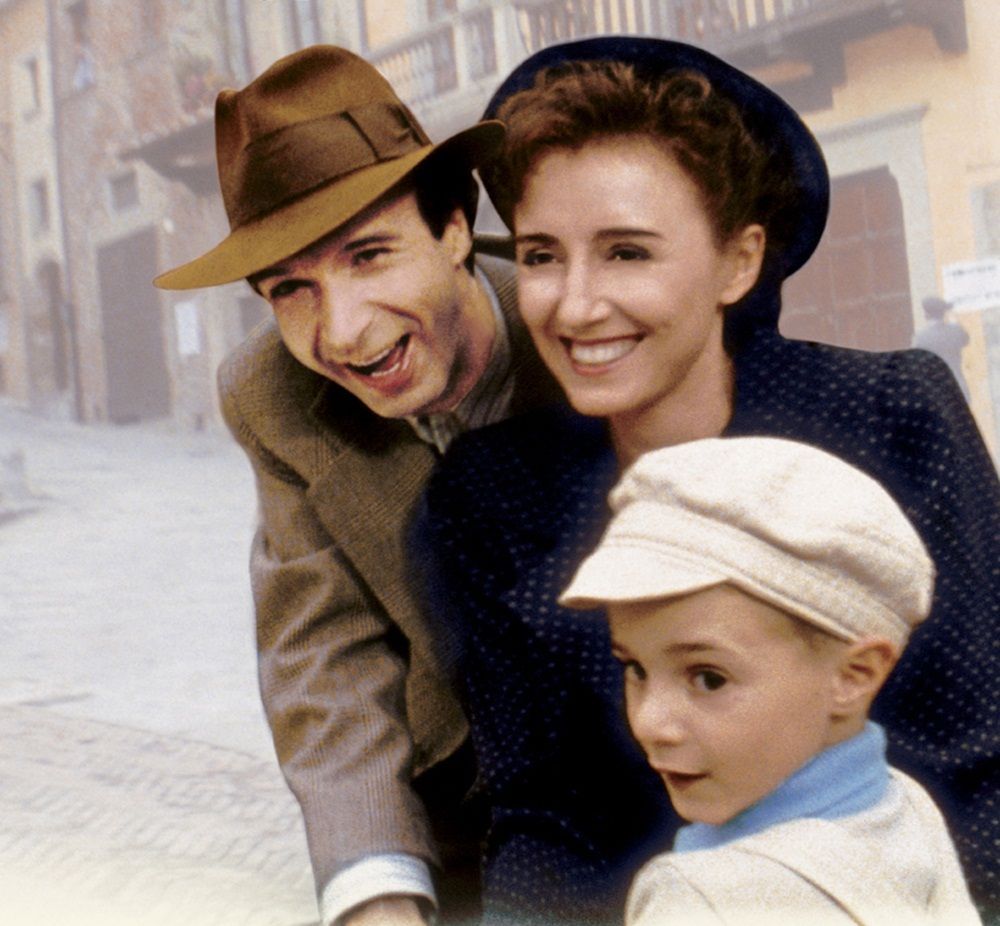
“Life is Beautiful” (La vita è bella) is an unlikely look at the horrors of the Holocaust, seen through the eyes of a young boy and his father, the latter ever bit as innocent as the former. And while Holocaust films are plenty, what is unique about this film is that it uses humor as its main vehicle instead of pain, and hope as its overriding principle. Directed by Roberto Benigni, who also plays the film’s lead, “Life is Beautiful” won a slew of Oscars at the 1999 Academy Awards, all well deserved. It’s more than a war chronicle. It’s a story of triumph, hope, and the splendor of the human spirit.
Avoiding the war-torn openings of most Holocaust films, “Life is Beautiful” centers on two friends, Ferruccio (Sergio Bini Bustric) and Guido (Benigni), carousing through the idyllic Italian village that is their home. Along the way, Guido makes the acquaintance of a girl he absolutely must have, the beautiful Dora (whom Guido calls ‘Princess’), as well as multiple run-ins with Dora’s antagonistic boyfriend. The blossoming romance between Guido and Dora is one of the most enjoyable parts of the film, and to give away too much is to ruin the charm of this movie. However, as the trailer portrays this much and more, the two fall in love, and have a child, Joshua, who grows up amidst the ever-escalating anti-Jewish campaign spreading through the world during the late 1930s.
The film’s effectiveness lies in its characters, not its progression, and Benigni, along with co-writer Vincenzo Cerami, pen a beautiful script that allows Guido, Dora, and Joshua to blossom into near perfection. Benigni’s humor is captivating as he woos the reserved Dora, shying away from her wayward boyfriend, and otherwise takes Ferruccio on a tour of simple pleasures as the two make their way through town. Guido is quick on his feet, using happenstance to his great advantage. While this is used in an almost cutesy way during Guido’s courtship of Dora, the foreshadowing of the film is excellent given how this same skill will come into play in the film’s more foreboding third act. This is a testament to Benigni’s screenplay and his acting – Guido captures our hearts immediately, right from the film’s start.
The film’s other characters are great as well, and the film imparts the feeling of a real moment in time, and not merely anecdotes strung together to tell a story. As Dora, Nicholetta Braschi gives an apt performance, even if her character isn’t as developed as Guido’s. Beautiful and kind, she looks through Guido’s humor and hijinks and finds a husband. It’s a testament to her skill that the effort comes off as seamless as it does.
Benigni also knows how to weave a story, not dragging Guido and Dora’s fledgling relationship on for more than necessary. And their son Joshua (played with an enthusiasm that flies in the face of his young age by Giorgio Cantarini) is a delight, smiling with wide eyes and a sense of wonder. Reading a sign that says ‘No Jews and Dogs Allowed’ on a restaurant, he buys into his father’s seemingly-foolish answer that different neighborhood stores disallow different races of people and animals (such as other shops not allowing Kangaroos or spiders) despite its incredulity. Benigni wants the audience to buy into Guido’s innocence and takes pains to show the hopeful joy of unquestioning faith.
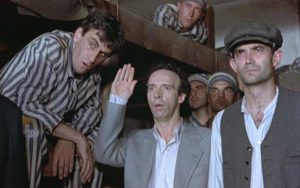
The film does become more foreboding, however, during a turn of events that leads Jewish Guido and his family to a concentration camp. And while the film takes pains to spare its audience full-on horror, history tells us much of the souls lost in the Holocaust, a history that silently underlines Guido’s attempts to convince his son their imprisonment is an elaborate game. Hatred has no part in Guido’s life, nor Benigni’s film; while “Schindler’s List” and “The Pianist” focused on Nazi atrocities, “Life is Beautiful” focuses on its character’s love, and not their pain. However, amidst it all, the film becomes just as poignant a tale as these two giants. By undercutting the Holocaust’s horror with humor, Benigni makes the proceedings that much more monstrous. It’s more than Joshua’s life Guido is trying to protect, but his innocence. Who’s to say what’s more important?
 “Life is Beautiful” took home several Oscars, but the film’s real testament is that it was nominated for “Best Picture,” even as a foreign film. The film’s cinematography is a marvel – gorgeous when it needs to be, bleak when it must, and tells the story every bit as much as its actors. Using brightness and cheer, the film allows audiences to wade alongside its protagonists in clinging to fleeting hope. There are many Holocaust tragedies, showing many lives lost, in many similar films. For all our sakes, let’s hope there was at least one Guido.
– by Mark Ziobro

