


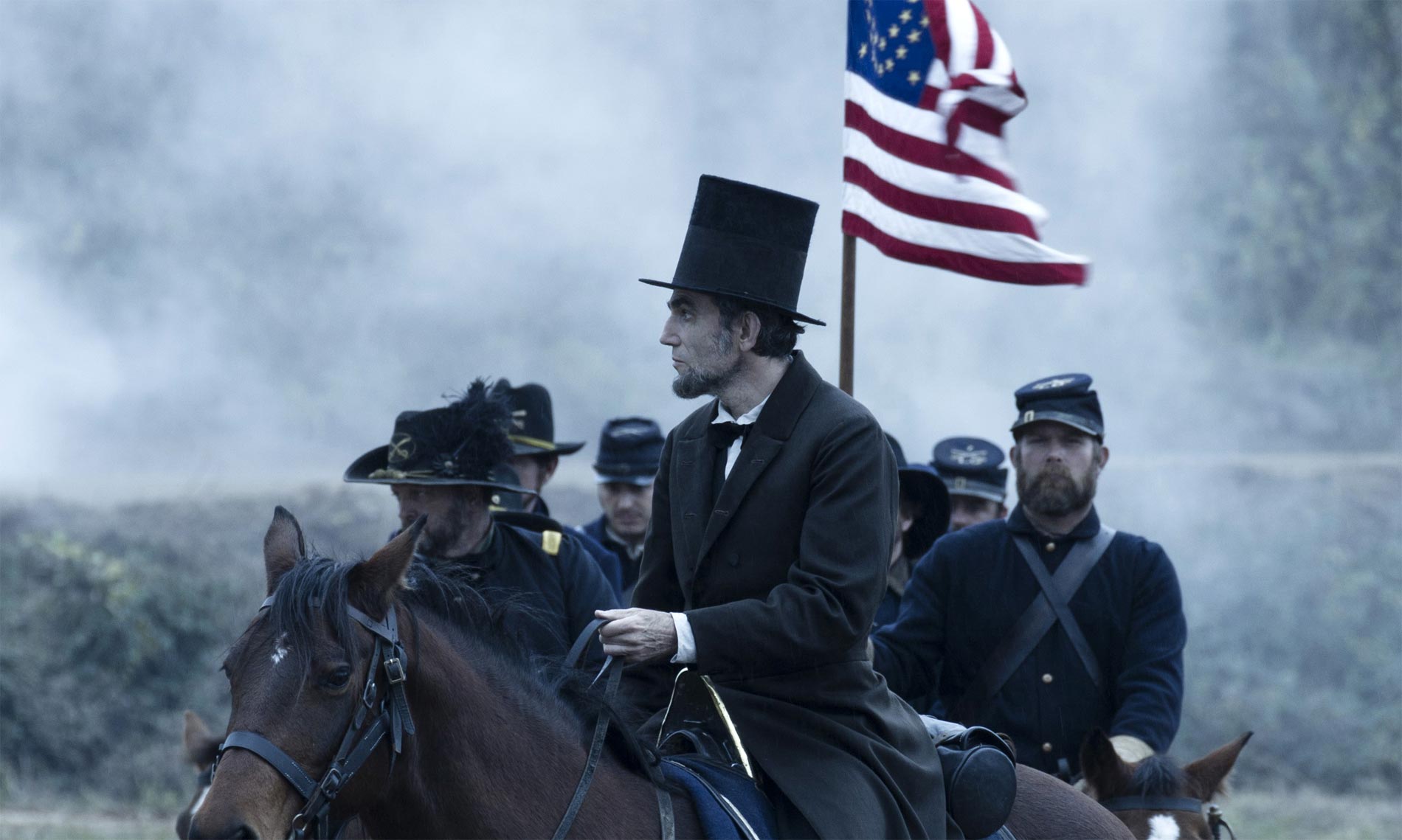
Highly touted movies carry with them an enormous burden. There’s of course the phenomenon of peer pressure, the desire to like them because so many others have. And then there’s the desire to experience it fresh, as one who hadn’t been privy to results of award ceremonies and accolades. You most often find these movies land just short of perfection but certainly well short of failure. It was while watching “Lincoln” which walked away with two academy awards, that I became astutely aware of this fact. A film about history should be expected to be poignant and reminiscent, yet encumbered with the sluggishness that often accompanies such exposition. “Lincoln” is all three, yet leaves one with the emotional footprint only possible by efforts that draw audiences back in time. And the result is decidedly worth the effort.
The most surprising discovery about “Lincoln,” which is evident in the first twenty minutes, is that the movie is about so much more than Daniel Day-Lewis’ performance. Not to impugn Lewis’ work, a method actor who pours his heart and soul into his roles possibly greater than any other, but to credit the script, scope, and breadth of a film that attempts to encapsulate not the accomplishments of the our 16th president, but his motivations, which, it turns out, carry with them far greater implication. At the film’s opening, we are privy to Lincoln conversing with two blacks on the battlefield; one wears anger on his sleeve in regards to his lot in life, while the other recites back Lincoln’s now-famous Emancipation Proclamation. The scene is powerful, and sets the stage for the rest of the film – Lincoln’s markedly uphill battle to pass the 13th Amendment to the Constitution that would forever abolish slavery.
In fairness, the first sixty minutes of “Lincoln” are slow-paced and devoid of much action or intrigue. We see meetings in the White House, in public meeting halls, and other venues of Democrats and Republicans arguing over the validity of passing the 13th Amendment. We are introduced, in almost painstaking slowness, to the president’s right hand man, William Seward (David Strathairn), his sometimes-reluctant wife, played empathically by Sally Field, as well as those who would be his supporters and those who would be his opposition. The opening hour of the movie moves too slowly for all but the most patient viewers, and takes a large degree of commitment to muddle through at times.
“Lincoln’s” base strength, of course, lies in the hands of Day-Lewis, who brings to life not just the man, but his emotions, motivations, and stalwartness. Day-Lewis, who won “Best Actor in a Lead Role” Oscars for “There Will Be Blood,” and “My Left Foot: The Story of Christy Brown” does something with Honest Abe that no history book or historian has hitherto been able to – he gives us a reason why.
There is a speech by Lincoln early in the film where he spells out the reasons for seeking passage of the 13th Amendment, and the hoops and rule bending that might need to take place to get there. There’s no amount of politicking involved, but a great deal of emotion that Lincoln seemed to harbor for human equality. Why did he want it passed? To set things right and accomplish what he calls “the fate of human dignity.” Slavery was a pestilence to Lincoln. He believed the 13th Amendment was the cure. In the most powerful scene in the film, draped in shadows and basking in the glow of a single lamp, Lincoln explains why both the war and slavery must end. Perhaps the most poignant take-a-way is that his audience is comprised of not naysayers and opposers, but men who wanted to do the right thing but felt they lacked the courage.
The acting in “Lincoln” is solid all-around, with special note to Day-Lewis, Strathairn, Field, and Tommy Lee-Jones (who plays Thaddeus Stevens in a wonderful performance). They all have their must-see scenes. For Strathairn it’s his facial reaction during Lincoln’s above-mentioned speech and his gentle yet decisive control of Cabinet meetings. For Field it’s an impassioned and gut-wrenching argument between she and Lincoln over their son’s (Joseph Gordon-Levitt) ambition to enter the war. And for Lee-Jones it’s numerous hearings before the House floor as he initially defends his position that all men are created equal, only to later defend a seemingly soul-crushing recant that they are only equal “before the law.” Lee-Jone’s Thaddeus is passionate but practical. He sat on his laurels and helped to end slavery. For Lee-Jones, whose once dynamism has waned of late, it’s a powerful performance that shows us once again how good he really is.
 The set pieces of “Lincoln” are also extremely well done, with most of the story told between muddy town squares and the stately interior of the White House. The exterior of the White House, so prominent in many a modern political production, is hidden, shown only toward the film’s end as the vote for the 13th Amendment passes. The result is captivating, as if the message Director Steven Spielberg and company wish to impart is that this is the beginning of America. It’s impossible to say that “Lincoln” is unbiased; the man was not, and the movie means to make that statement. And the specific attention to detail that the film gives to its visuals and its emotions are more than sufficient to hammer this point home.
“Lincoln” surprised me. It is powerful, moving, and authentic. It’s not so much about the accomplishments of a man but about their intentions. Its acting is spot-on and purposive, its emotions are real and palpable, and it features a depth and clarity often missing from political dramas. It’s more about a movement than a man, though one cannot exist without the other. While emotional dramas may come second nature for Spielberg, who has tugged at our heartstrings while educating us before, “Lincoln” is not as heartbreaking as “Schindler’s List.” Accomplishment should be heralded and not mourned. “Lincoln” ends shortly after the man’s assassination; it’s the accomplishments the film wishes us to remember. And it does a pretty good job at that.
– by Mark Ziobro


1 Comment
The first hour is painstaking but I also feel the rest of the movie is also.