


At the start of his career, actor Tom Hanks was an unlikely leading man if ever there was one. Appearing in television series such as “Taxi” and “Family Ties,” he struck an almost immediate likability in early films such as “Dragnet” and “The Money Pit.” Since that time his breadth of film has become so vast, it’s almost impossible to single out any one performance. A slew of excellent performances such as Andrew Beckett in “Philadelphia,” Capt. Miller in “Saving Private Ryan,” and Chuck Noland in “Cast Away” – intermingled with several acting/directorial pieces such as “That Thing You Do!,” “A League of Their Own,” and TV’s “Band of Brothers” – rightly earned Hanks an ‘AFI Lifetime Achievement Award‘ in 2002, placing him as one of the most sought after actors in Hollywood.
Released in 1988, “Big” was one of Hanks’ early works, released only a year before the buddy-cop drama “Turner and Hooch.” The premise of the movie – which one can only assume was geared toward kids, but is entertaining for adults as well – involves a boy who makes a wish at a carnival on a ‘Zoltar’ machine to be ‘big.’ The surprise comes the next morning when twelve-year-old Josh Baskin awakes to find out he has the body of a thirty-something, yet still has the mind of a boy. Terrified, he runs from his house so that his mother won’t see, enlisting the help of his childhood friend Billy (Jared Rushton) to track down Zoltar so he can go back to normal.
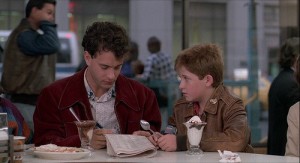
Any child who’s ever been told, ‘when you’re older’ by an adult will certainly sympathize and find pleasure in the premise of this film. However, as Josh realizes, growing up too quickly carries with it enormous responsibility. First, he needs to land a job to pay for the mounting bills for his apartment, which leads him to FAO Schwartz, New York City’s massive toy conglomerate. His job: data entry. However, it’s only a matter of time before Baskin – with his youthful eye and wonder – woes the boss (a man named MacMillian), ending up in toy manufacturing among big wigs who have worked for the company their entire careers.
“Big” has something about it, an inherent charm that somehow holds up in the 25 years since its release. The movie is fun, and escapism in the old school, but requires a hefty suspension of disbelief to navigate. Early scenes – such as when Baskin rents an apartment in Manhattan (the apartment, a cesspool inhabited by criminals, and scored by gun shots and domestic abuse) – are comical, as if drawn from a child’s view of the ‘big city.’ Likewise, scenes at the office, where Baskin immediately becomes an asset, force questions like: where did a twelve-year-old learn to type 100 words a minute?
The movie also has a further complication, a plot involving a lie told to his mother (Mercedes Reuhl), insinuating his own kidnapping to answer the question of his continued absence for nearly a months’ time.
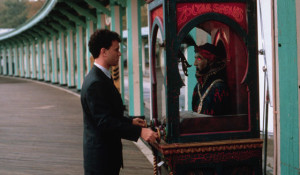 Disbelief aside, “Big” makes some poignant observations while being entertaining throughout. There’s Baskin, whose ‘child’s perspective’ allows the company to make toys that children will actually play with, not to mention the youthful spirit Baskin seems to garner from MacMillian, played enthusiastically by Robert Loggia, in a 180-degree departure from “Scarface’s” conniving Frank Lopez. Baskin’s interactions with a jealous co-worker (the venerable John Heard of “Home Alone” fame) also points out how adults, in their day-to-day operations, may have long forgotten what it’s like to be a kid, much to their detriment.
Acting along the way sells “Big” both convincingly and lovingly. Hanks is terrific, and seems to practically exude the twelve-year-old spirit his character embodies. Even looking the part of an adult, Hanks is believable and awkward as a young boy, coming off spontaneous, energized, and scared in equal measure. Loggia is great as MacMillian, and easily becomes the hero of an office filled with both under and overachievers. Co-workers land on both sides of the fence, such as skittish Scotty Brenan (John Lovitz in a toned-down performance), and as Paul, John Heard plays his part well, making you hate his character while still understanding his position.
Rounding out the cast is Elizabeth Perkins, whose portrayal of Baskin’s love interest Susan is both lovely and enchanting, the kind of beautiful woman you could only find in the ’80s. Her interest in Josh is both genuine and frustrated; genuine, for her character is probably the nicest exec to ever work in a Manhattan office, and frustrated as only the audience knows why she has such a hard time connecting to Josh during their relationship.
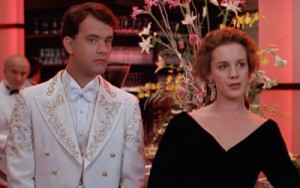
“Big” is an iconic movie, a relic from the 1980s, which, surprisingly, holds up all this time after its release. Considering the scope of Hanks’ work since, it may be considered pedestrian, or a throw-a-way, but with its unique premise and classic scenes, it continues to be a crowd pleaser, just recently surfacing on the American Movie Channel. While you probably won’t be blown away, you will be entertained, and, especially if you haven’t seen the film in a while (or have never), you’ll be in for a thoroughly escapist treat that might just remind you what it was like to be a kid all those years ago.
– by Mark Ziobro

4 Comments
Is it just this site you guys sure like average comedys
“Big” is not an average comedy. Average comedies have no interesting plots and bad acting. Good comedies have great acting and make commentaries on life. “Big” is the latter.
bad comedies just suck
Pingback: » Dragnet (PG-13)