Horror movies don’t usually pose moral dilemmas. Run…hide…scream…be killed. The options, while numerous, aren’t inventive. A killer stalks an unwitting victim, and he or she, while required to make hard choices to survive, knows the rules of the game. However, some movies try to educate the horror genre. “Saw,” and a legion of sequels presented a moral dilemma each character faced – the choice to cause themselves bodily harm or die at the hands of vicious traps. Patrick Melton and Marcus Dunstan’s 2009 effort, “The Collector,” posed an interesting moral dilemma to its protagonist when he is required to save the very family he came to rob from a masked psychopath. However, in the unusual horror-thriller “Frailty,” a much different moral dilemma is posed: viewers are asked to suspend not only their disbelief but their notion of right and wrong in order to get to the end. And it’s not an easy task to undertake.
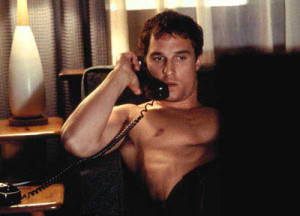
In its execution, “Frailty” (starring and directed by Bill Paxton) uses a common cinematic exposition tool, but, for some reason, it comes off without a hitch. The opening introduces us to Fenton Meiks (Matthew McConaughey), who has arrived at FBI Headquarters in Dallas with a story to tell. The brunt of that story is reserved for the FBI Director, Wesley Doyle (Powers Booth, “Sin City”), – Meiks confesses in quick succession that he a) knows the identity of a notorious local serial killer and b) that it is his brother.
Doyle is of course skeptical. But the confession leads the way to a much longer story, a story that takes place in Meiks’ youth in a town called ‘Thurman.’ It’s the ’70s, and Thurman is your run-of-the-mill small town. And the Meiks’ are your average family – sons Fenton and Adam watch television, struggle with homework, etc, and Dad (Paxton) works all day to put food on the table. We learn that the boys’ mother is deceased, but the family is no less strong for it. They are very close, and, we learn, loving.
However, that changes one night when the boys’ father bursts into their room with (according to the look on his face) exciting news: he has been visited by an angel, and God has charged their family with helping to rid the world of ‘demons’ before Judgment Day. Admittedly, the family is shocked, more so Fenton than Adam. Younger Adam is ready to believe whatever Dad says; Fenton is rightly skeptical, especially when Dad talks about ‘destroying demons with magical weapons from God.’ If you’ve ever doubted the acting potential of Paxton, however, this is the scene to prove you wrong. Straight-faced and sober as ever, he answers Adam’s adolescent question: “That’s right son, we’re a family of superheroes that are gonna help save the world.” The effect should be comical, and in a way it is. The only one who’s not laughing is Fenton.
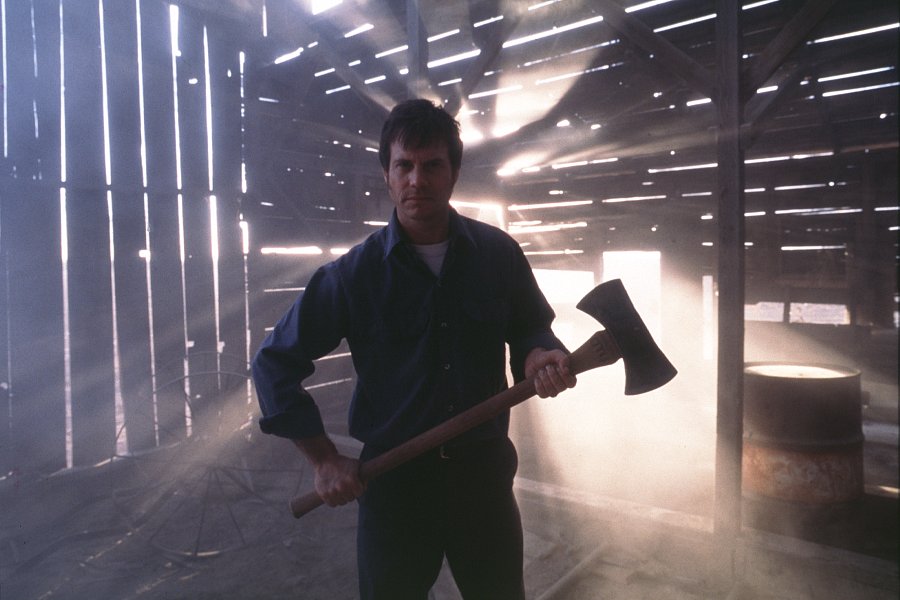
Thus “Frailty” begins a nightmare decent into a horror that’s as real as its effect on the life of Fenton as he struggles to understand it. First he thinks his dad dreamed it, and later that he is ‘not right in the head.’ Whatever he thinks of his dad, however, can’t prepare him for when his father begins to bring home the ‘magical weapons’: a lead pipe, a pair of gloves, and a glistening silver axe. The tension in the film rightly escalates the closer Dad gets to actualizing his ‘mission;’ he is given a ‘magical list’ by the Angel, a list of demons he needs to eliminate as part of God’s plan.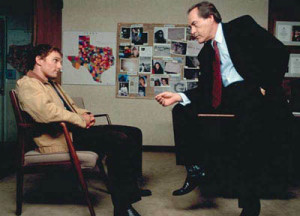 “Frailty” is a disturbing movie. It takes viewers on a rollercoaster ride of emotions. First you’ll doubt Father Meiks’ intentions, and later, as he brings home his first ‘demon,’ which looks nothing but a flesh and blood person, you’ll doubt he will actually commit his crime. However, when he does, “Frailty” shatters that trust, aligning us with Fenton as unwilling prisoners to Meiks’ irrational pathos. The movie also escalates as Fenton is faced with an increasing moral dilemma – to continue to suffer this nightmare, as Dad brings home demon after demon, or to tell the authorities, which the Angel had already mentioned will have disastrous results. “Someone will die,” Meiks states. That someone is never named: is it Fenton, Dad, an innocent? Answers aren’t immediately forthcoming – and the uncertainty only works to fuel Fenton’s growing desperation, and his rage against his father.
The story pulls in and out of the past, as adult Fenton narrates a long chronicle of murders/demon-killings at this hands of his father, who truly believes that what he does is right. After one murder, as Fenton weeps for a victim, he states “Don’t cry for her Fenton. She was a demon.” Again, one of the strong points of the movie lies with Paxton, both for his direction and his acting. Do we believe that he is actually killing demons? No, we think he’s a killer. But do we believe that he believes it? And that he thinks that what he is doing is right? Absolutely.
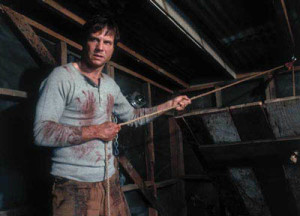
“Frailty” is not a movie that can, or should be, talked about in terms of plot. The progression, and ending of the movie, is especially well-done, but is something that has to be experienced from start to finish. And, on a whole, it’s rather hard to find fault with the film. Acting is good all around, but none so poignant as the maligned chemistry between Paxton and Matt O’Leary, who plays young Fenton. And rightly so – a majority of the film takes place with no other characters save the three Meiks’. If the actors hadn’t sold the family to us, the movie wouldn’t have worked. But they do sell the family, often a little too well, and the result is chilling, spine-tingling, and downright terrifying.
Another reason the movie works so well in delivering genuine frights is it makes you disbelieve it the entire way. The idea of siding with the Dad is so preposterous, yet often he makes us second guess even ourselves. The supposed ‘sins’ he gleans from his victims are shown in vibrant and horrific colors, involving such crimes as domestic abuse, murder, and child rape. Paxton makes us believe these people should be made to bear ‘God’s wrath.’ But at the same time you’ll damn him, think him a murderer and psychotic lunatic who has irreversibly destroyed the innocence of his two young sons.
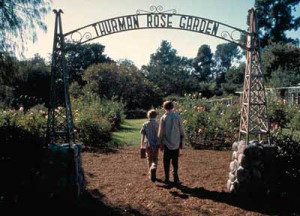 There is, of course, a closing exposition that attempts to explain why Fenton has confessed all this to the FBI, as well as what becomes of Fenton, Adam, and their father. But it’s not something you can read and understand from a review, no matter how thorough. What “Frailty” does is to get inside your head, twisting your thoughts and emotions for its 100-minute run-time until you don’t know what to believe except that you have to know how it ends. Do yourself a favor and rent this film – to call “Frailty” psychological is an understatement and to call it horror is a gross overstatement. “Frailty,” in its execution and presentation, is a mind trip of biblical proportions.
– by Mark Ziobro