


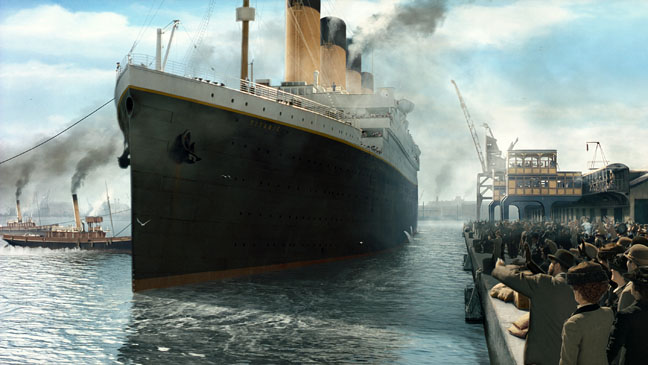
James Cameron’s “Titanic” is just as popular in 2012 (100 years after the sinking of the actual Titanic) as it was the day it was released. The movie, which grossed $28 million its opening weekend in 1997 followed up that feat with a $17 million opening weekend in 3D. The movie has made more than $647 million in its lifetime, and continues to captivate audiences for its story, special effects, and chronicle of the tragic ship and its passengers.
“Titanic 3D” is a way to go back to the movie in the same way that “Titanic” brought audiences to the story for the first time in 1997. The 3D rendering, which was retrofitted over the original 2D picture, isn’t perfect, but manages to bring to life some of the movie’s most captivating scees. However, what is most brilliant about the movie’s return to the big screen, 3D or not, is that, even after 15 years, the story – part cautionary tale, part documentary, and part romantic drama – is still as captivating as ever.
The beginning of the movie, which shows the scale and marvel of Titanic in its’ harbor at Southampton uses 3D remarkably well. The ship looks massive, and we get an even better idea of its sheer size than in the original screening. And while the 3D seems to have dimmed the film a bit, the realism of certain objects is enhanced. Luggage seems real enough to touch; the entire opening, as well as scenes on the boat deck once the vessel is underway, give audiences the distinct impression they are on the open sea, and not at all a movie theatre.
The elements of the film get a revamp by the effects, but nonetheless remain poignant. The magnificent technological advancements Titanic brought to the era, as well as the riches and high society of the times are hammered home. Well-to-do titans such as Colonel Archibald Gracie, John Jacob Astor, and fictional Caledon Hockley (Billy Zane) waltz carelessly through the ship’s ballrooms, promenade decks, and cigar rooms. This is pitted against 3rd class, or ‘steerage’ passengers, who must undergo lice checks to board the ship, and then room in cramped, three-passenger quarters in the belly of the ship.
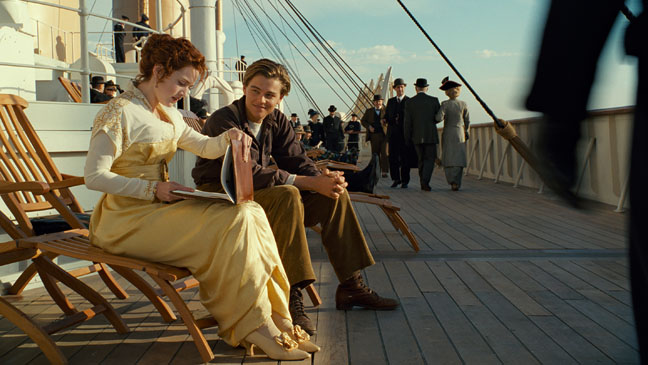
These scenes, the divide between the 1st and 3rd class passengers, are vital throughout. While most of our attention is diverted to the romance between Jack Dawson (Leonardo DiCaprio) and Rose DeWitt Bukater (Kate Winslet), the irreverent way these passengers are treated is especially significant as the Titanic’s sinking is assured. Scenes of immigrants who can’t read signs pointing them top side, as well as locked gates barring access from steerage to 1st Class, shows whom Titanic was really built for.
The large crux of the story revolves, however, upon the romance between Jack and Rose, and Rose’s struggle against her desires and the life that has been set out for her. Her arranged marriage to cruel Caledon Hockley imminent, (emotionally and physically abusive to her during the film) she views the voyage as an imprisonment. She meets Jack when he stops her from jumping from the ship’s massive deck in an attempt to end her life.
To touch on their story briefly, it is refreshing that Cameron decided to write their romance the way he did. There is an element of melodrama – Rose, the rich girl falling for Jack, the lonely, poor drifter – but he manages to center it in a way that keeps our attention. Part of this is due to the fact that Rose is actually given a fair amount of back-story and realness of character. We actually believe, watching it, that she is a good-hearted person trapped by circumstance. But another part of the story’s believability lies in the fact that we believe in the progression of their relationship during the film. While rushed (Titanic leaves Southampton on April 10, 1912 and sinks the morning of April 15), we actually believe the transition the two make from acquaintances to friends, and, by the end of the movie, believe that the two are actually in love.
The elements of their story are interspersed tragically with Titanic’s fateful collision with the iceberg. I say tragic, because we are to believe that were it not for the sinking of the ship that Rose actually would have gotten off the boat with Jack, as she so proposed, and not abide by her mother and Hockley’s wishes. More than likely, however, this isn’t reality. Would Rose be able to break free from her upper-class chains? Would she and Jack remain together if the boat docked in New York? It’s not as interesting as the story of Titanic Cameron decided to tell. We only see this brief glimpse into their lives, this brief glimpse of unspoiled potential; and it works because it makes it real. Rose herself chastises research vessel crewmate Lewis Bodine (Lewis Abernathy) at the beginning of the film for the same fault: A hunk of iron sinking to the bottom of the ocean is not the story of Titanic. Cameron, Winslet, DiCaprio and others bring the ship to life in a way only made possible by human beings. We care about the fate of the ship because we feel connected to, and care about, its passengers.
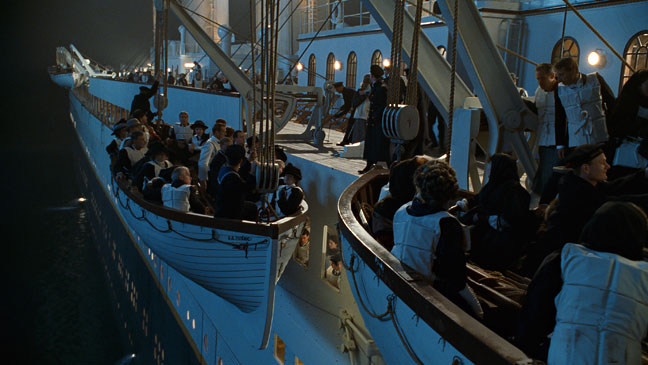 The actual sinking of the ship is of course brought to life by its new 3D treatment, but is heart- wrenching just the same. A massive ship sinking intact into the sea (which many of us think when we think of Titanic) is not the reality. In reality dishes smash on the floor, wooden paneling rips off the walls, magnificent staircases collapse, and the once grand ship rips in half in a completely irreverent fashion. The lives lost in this process bring this act to life. A ship is sinking; but it is the way it sinks, and the violent way it does so, that makes the images from the movie stay with us.
There are two scenes in the movie that show this tragedy remarkably well. One involves the launching of a distress flare, which shows the flares striking the water next to a clearly submerged bow- the first image shown by Cameron that the ship is taking on water, fast. The second is eerie rendered in 3D or not – 1,500 freezing passengers are seen splashing in the water over the space that used to be Titanic’s decks. This, coupled with lifeboats now hanging back for fear of being overcome with panicked passengers, still manages to send a shiver up our spines.
3D or not, “Titanic” still manages to stay with us. The closure the film’s developments provide Rose (she was able to live life on her own terms, in part because of the events of the sinking, but part because of her love for Jack) effectively mirror the closure treasure-hunter Brock Lovett finds in her story. “All this time chasing Titanic – I never got it. I never let it in,” he remarks. He has lost his hunt for the diamond. But, by the time he utters this line, we’ve long-forgotten that the diamond was what brought us back to Titanic in the first place. Another lifetime has come and gone in the space between the opening of the movie and its conclusion, and one that is far more unforgettable than a priceless gem.
The Buff’s advice: see “Titanic 3D”- not to be blown away by special effects but for the rare chance to see this masterpiece alive on the big screen once again.
Trivia: Only one alteration was made to the film during its transition to 3D. James Cameron, coming under fire in a “snarky” e-mail from American astronomer Neil deGrasse Tyson, changed the night sky patterns Rose sees as she is lying on the wooden plank to correctly match what the sky would have looked like in the North Atlantic on that night in 1912.
– by Mark Ziobro


1 Comment
Pingback: » The Perfect Storm (PG-13)