


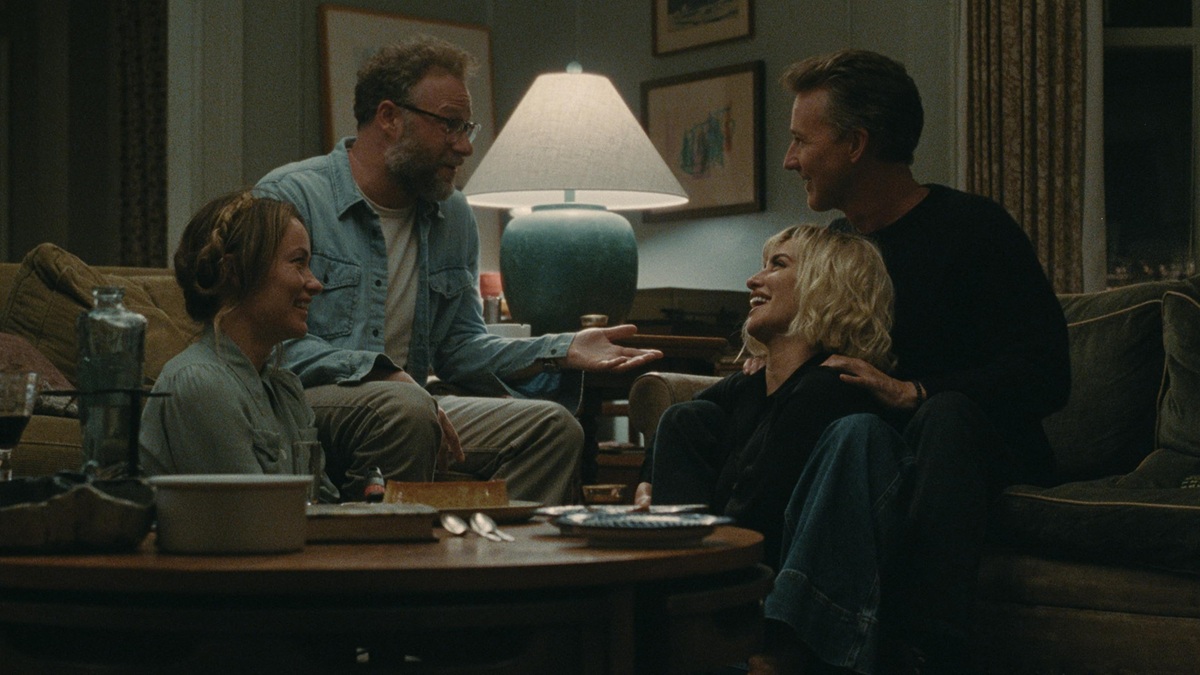
Four people at the dinner table. Devonté Hynes brought a fifth.
Olivia Wilde‘s “The Invite” gathers Seth Rogen, Wilde, Penélope Cruz, and Edward Norton inside a San Francisco apartment for a dinner party that quickly unravels into arguments about sex, marriage, and the things couples would rather not admit to each other. There’s plenty of talking, bickering, and uncomfortable silence, but Hynes’s cello has a voice of its own. Sometimes anxious and often quite funny, the score becomes another presence in the room, turning this four-person chamber comedy into something of a five-piece ensemble.
Hynes might be more familiar to music listeners as Blood Orange, the name under which he’s released critically acclaimed albums such as Cupid Deluxe and Negro Swan. But beyond his work as a singer, songwriter, and producer, he’s also carved out a career composing for film. He made his film-scoring debut with Gia Coppola‘s “Palo Alto” (2013) and has since lent his musical talents to several other projects, including Melina Matsoukas‘ “Queen & Slim” (2019) and Rebecca Hall‘s “Passing” (2021). “The Invite” marks his latest venture into film scoring, and one that makes particularly inventive use of his talents as a cellist.
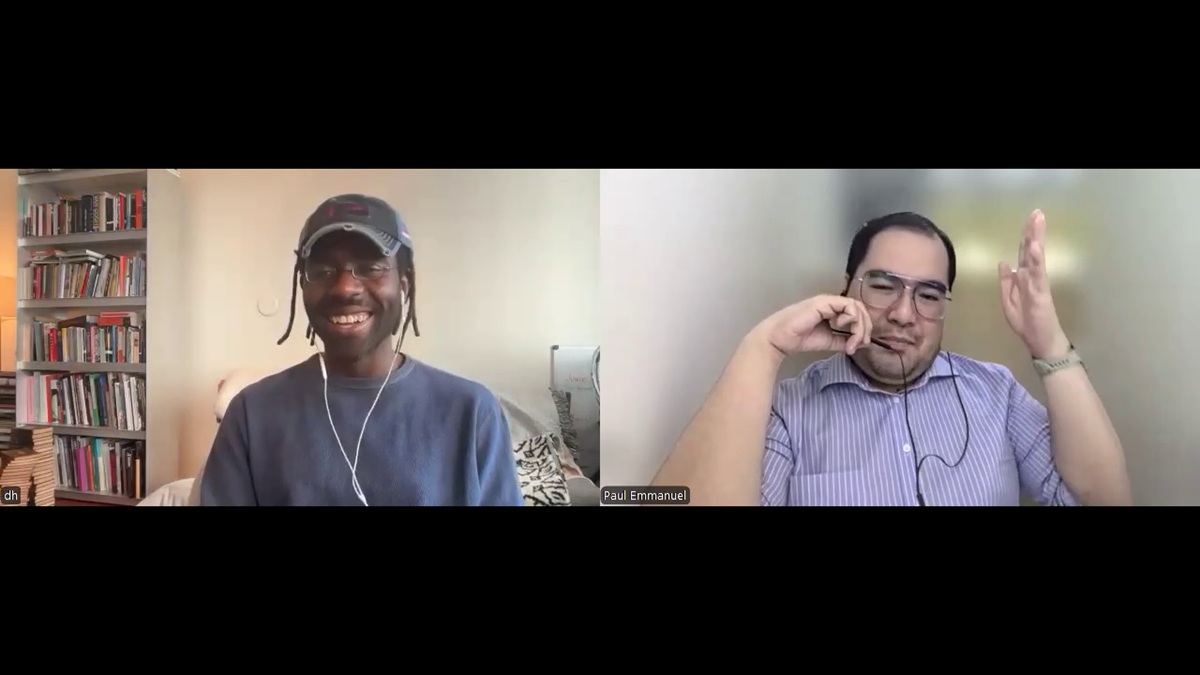
As “The Invite” prepares to make its exclusive U.S. streaming debut on HBO Max on October 23, I caught up with Hynes over Zoom to discuss his work on the film. Our conversation touched on his collaboration with Wilde, how his understanding of theater and experience as a cellist informed his approach to the score, and the challenge of knowing when the music should intervene or simply let the actors do the talking.
We also shared a laugh over some of the music itself. I brought up one particular track, “You Do Have Sex, Right?,” which runs for just nine seconds. With barely a handful of notes, Hynes somehow manages to communicate the sheer awkwardness of that question. It’s a small but amusing example of how much personality he can squeeze into a few seconds of music.
This interview has been edited for brevity and clarity.
The Movie Buff: Before we start, Dev, I’d just like to say congratulations on your work on the film. I greatly enjoyed listening to the whole score.
Devonté Hynes: Thanks so much.
I wanted to talk about the collaborative process. So much of the film takes place in one apartment. How did your conversations with Olivia Wilde shape the way the music moves between the characters and their different emotional states?
The initial conversations were really exciting to me and got me very excited about the project in general. Knowing that the whole thing took place in this house and it’s just four characters made me think, “This is a play. This is theater, essentially.” We’re almost out of the film world in this sense, and that opened up a lot of possibilities of where the score could go.
Once I started looking at it like that, I could think to myself, if this were a piece of theater and people were going to watch it, the music would be kind of alive. It would be playing throughout the film in a way that it’s in conversation with these real actors who are having these real dialogues with each other. It’s such a dialogue-heavy film.
That was really the opening moment. I started thinking, “I’m a cellist, and the cello, to me, is an instrument that actually can be in dialogue.” It can do so many different things: It can be so harsh, it can be super lush, it can be very flowery when it wants to be. Once I started talking to Olivia about that, and I mentioned the cello and the whole theater aspect of it, it’s funny, the restraint of that created a world of possibility. I felt like I had infinite choices I could make.
It’s interesting that you talked about being a cellist. Here, the cello feels almost like another guest at the dinner table. Listening to the score, it sounds anxious, sometimes argumentative, and a lot of times quite funny. In your process, did you imagine it taking anyone’s side, or was it there to just stir things up?
Yeah. For me, it was observing. I always felt it was almost like a ghost or something, a ghostly figure that’s just looking at what’s happening.
Something I really love about this film is that there is no protagonist. They’re all going through their own different emotions all the way throughout the film. And I think that’s the beauty and the power of the film: Different people can watch it and relate to different characters. So it was kind of tricky, actually. That was a tough part, trying to create something that is almost like an extra guest at the table but doesn’t really have a point of view.
Within that, we feel when a moment is tense. We know this is a tense moment. Whether we are siding with Seth’s character or Penelope’s character, it’s neither here nor there. Right now, we know that things are tense. I tried to lean into those emotions and moments throughout the score.
The film being largely a comedy, I want to ask about knowing when to step back as a film scorer. Comedy depends so much on timing, especially in a film with this much dialogue. How did you decide when the music should sharpen a joke or an emotional moment, or when to just let the actors do the work?
That’s actually super interesting because it varies. There are moments, say at the beginning of the film, when they’re fighting and bickering, but the dialogue isn’t as important. It’s the feeling of what they’re doing.
There, I can be more frantic with the cello and just build this unease that’s happening. Then there are other moments where the beats of what they’re saying actually do need to hit. You need to pull back and let it happen, then enter in again.
A lot of those I could do myself, but Olivia really helped with a lot of those other moments, too, especially toward the end. She had an amazing sense, an amazing ear, and an understanding of her film, of which moments needed the emphasis and which moments it was time to pull back. To me, that was the biggest challenge of the film, just when to insert and when to pull back in these moments.
One interesting thing I noticed in the film is Joe’s relationship with music. I want to ask you this as a musician yourself. Joe used to be a musician, but he’s now teaching music, and he seems to have lost some of the fire that he once had for it. Did that part of his character influence you in any way in how you approached the score or understood his emotional world?
You know, I think it’s twofold because I was able to understand, in a sense, what was going on with him. But at the same time, it’s not his story as a whole. [pauses] It was interesting. Almost like a viewer of the film, I could understand the underlying emotion within him.
Within the score, I didn’t stay away from it, but I had to not make it almost like a focal point. But I still did want it to feel quite musical, essentially, when parts of the story would lean toward him. I did want it to flirt with more franticness. If you watch the film, there is a score theme that has more to do with his tension before he explodes at some point in the film.
Talking about the actors as a whole, was there any particular moment or performance in the film that made you rethink something you had originally composed when you watched the film?
That’s a really good question. [pauses] I feel like Ed Norton’s character is an interesting character in the film because there’s a preconceived notion of who he is when you’re watching the film, especially in the beginning, the first half of it. I think it’s incredible how he plays it. It’s so funny. But then you start to peel back the layers and you get to the core of it. I do think, especially watching it back, I have a bigger sense of that.
Obviously, I scored it and tried to work on that a lot more. But it’s funny, the difference between scoring and then watching it afterward. There is a difference there, which I find quite interesting. Because when you’re in the making of the film, you’re so inside it, and you’re working on these different moments.
But when I looked back, I think I was quite proud of that moment of the unveiling of his character throughout the film.
What’s next for Devonté Hynes? Have you thought about it?
I’m not sure. I would love to score more films. I love doing it. And I love working with directors and working in film. Hopefully, more film scores. [laughs] That would be great.
More Interviews: Isabel Lamers • Carl Joseph Papa • Karla Murthy

