


It’s one of the hottest days of the summer, the power goes out across Toronto, and suddenly the kids in Serville Poblete’s “Sunburn” have nowhere better to be than outside.
For Shay (Joshua Obra), that means killing time with his best friend Vince (Dashawn Blackwood), worrying about whether he should finally make a move on Nia (Ericka Leobrera), and occasionally tolerating his younger sister Cee Cee (Arianna Shannon). Nia, meanwhile, has something she hasn’t told her best friend Britney (Trinity Lloyd): her family is moving. Cee Cee, too young to be included but old enough to resent being left behind, ends up spending time with Allie (Milan Deng), another girl who understands the indignity of having an older brother treat you like a kid.
Nothing about this sounds particularly momentous. And that’s pretty much the point.
It’s All Fun and Games, Until Someone Wants Out
“Sunburn” takes place in St. James Town, and Poblete treats the neighborhood with the respect of someone who knows ordinary places don’t need to be made extraordinary before they deserve a movie. Kids wander between apartment towers, sit on concrete, lie around in the grass, complain about the heat, chase whatever relief they can find. The blackout gives the day a little shape, but there’s no great race against time once the electricity dies. Mostly, everybody hangs out.
Shay and Vince have clearly been doing that for years. Their friendship has reached the point where personal space seems almost theoretical, but the day keeps exposing small differences between them. Vince talks about leaving. Shay seems more attached to what they already have. Nia and Britney face another version of the same problem: friendship can feel permanent right up until somebody has to tell the other person she’s moving away.
Serville Poblete’s warm coming-of-age film watches friendships shift during one sweltering day in St. James Town.
I recently wrote about “Forgotten Island,” another film interested in what growing apart costs, and “Sunburn” approaches that feeling from a much warmer place. These kids haven’t necessarily lost one another yet. They’re just beginning to understand that proximity has been doing some of the work for them. You live in the same buildings, walk the same streets, waste the same afternoons together, and it’s easy to imagine the arrangement continuing forever.
And then somebody leaves.
More TIFF 2026: ‘Nosotros’ Finds Tenderness in a City Built to Wear People Down

Looking Up From St. James Town
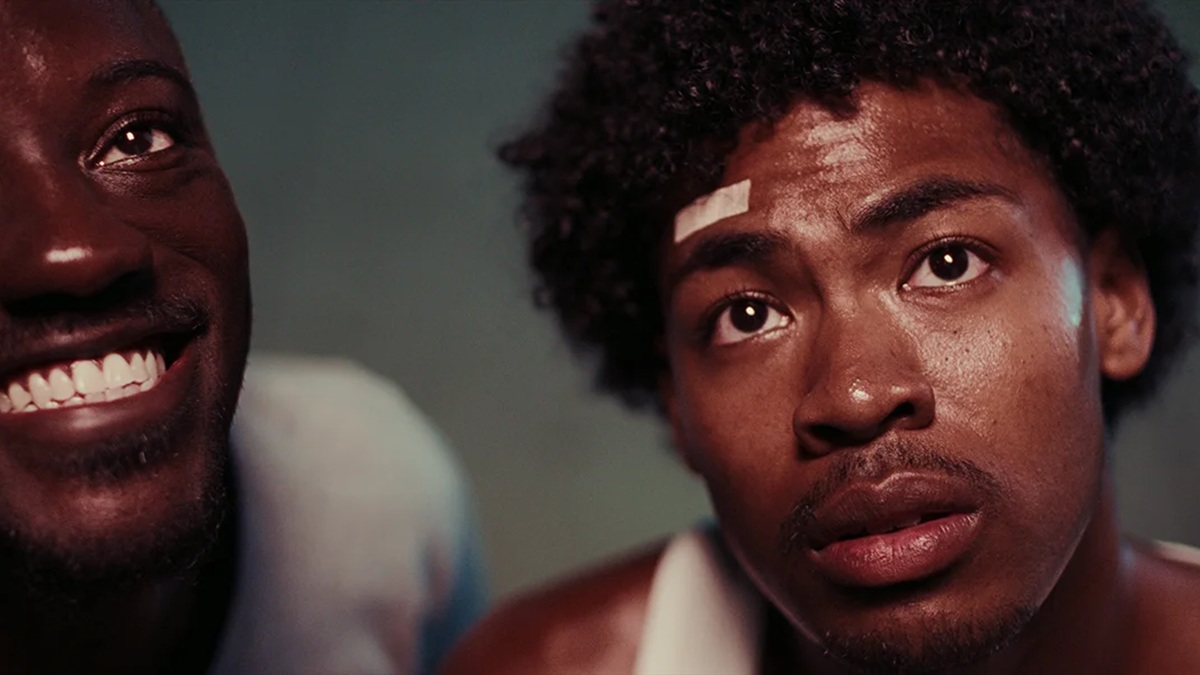
Christian Bielz’s cinematography makes the neighborhood part of that realization. Some of my favorite compositions place one character low in the frame while another occupies the opposite side from above. It’s a simple arrangement that makes an ordinary conversation suddenly feel like two people inhabiting different levels of the same space. Elsewhere, the camera gets almost uncomfortably close. Faces fill the screen; sweat gathers on skin with enough detail that you can practically smell the heat coming off it.
Poblete and Bielz, however, keep returning to the apartment towers. They loom behind the characters, sometimes so large that the kids look almost incidental against them. In other shots, the buildings are what the characters themselves are looking toward. Shay and the others keep tilting their heads upward: toward balconies, toward the horizon, eventually toward the night sky. The architecture can look protective one moment and impossible to escape the next. One of the film’s loveliest images simply lets the two girls stretch out on the grass, bodies resting alongside one another while the afternoon carries on. There’s no need to push the symbolism. Soon enough, one of them won’t be around in quite the same way.
And that relationship between people and place gives “Sunburn” more character than its modest plotting might suggest. While the film doesn’t romanticize St. James Town into some magical urban playground, it nonetheless shows why somebody could both love a neighborhood and wonder what exists beyond it. Vince’s desire to get out doesn’t make the place a prison. Shay’s attachment to it doesn’t make him unimaginative. They’re just starting to want different things.
Elsewhere, Nia and Britney experience the same latent tension. On the other hand, Cee Cee and Allie provide the younger version. Their scenes have a different tentative energy because whatever the older kids are beginning to lose, these two are only starting to discover. Riding a bike, finding somebody you want to spend time with, realizing that affection makes you vulnerable to somebody eventually going away: childhood doesn’t end through one giant event here. It gives way in increments.
More TIFF 2026: ‘The Smell of Apples’ Watches a Boy Slowly Learn What Privilege Protects

Nothing Happens, Except Everything Does
All these make “Sunburn” an easy film to call slight, and I don’t entirely disagree. Its 85 minutes don’t build toward some revelation that suddenly reframes the day. A water-balloon fight is allowed to be a water-balloon fight. People sit around. Conversations trail off. Some of the supporting characters remain sketches, and the film occasionally leans so heavily into the pleasure of hanging out that I wanted a little more emotional pressure underneath it. Even so, I’d hesitate to call it slow. The looseness suits a coming-of-age film about a day that nobody realizes is important until it’s almost over. Poblete doesn’t make the kids announce that their childhood is slipping away. They wouldn’t. They’re busy sweating through it.
The young cast helps enormously. Obra and Blackwood have the easy rhythm of friends who know exactly how to annoy each other, while Lloyd and Leobrera give Nia and Britney’s impending separation enough weight without turning it into melodrama. Shannon and Deng are especially good at that younger kind of awkwardness where curiosity and embarrassment keep arriving at the same time.
By night, the kids are looking up again, now at fireworks. The image is obvious enough, but after an entire film spent placing these young bodies beneath concrete towers, it gets to me anyway. For once, what fills the space above them isn’t another building.
“Sunburn” knows that a summer doesn’t have to contain the best or worst day of your life to stick with you. Sometimes all that happened was the power went out, you spent the afternoon with your friends, somebody told you they were leaving, and eventually the lights came back on. Only later do you realize things didn’t come back exactly the way they were.

Serville Poblete’s “Sunburn” had its world premiere at the 51st Toronto International Film Festival under the Centrepiece program. The festival ran from September 10 to 20, 2026. Follow us for more coverage.

