


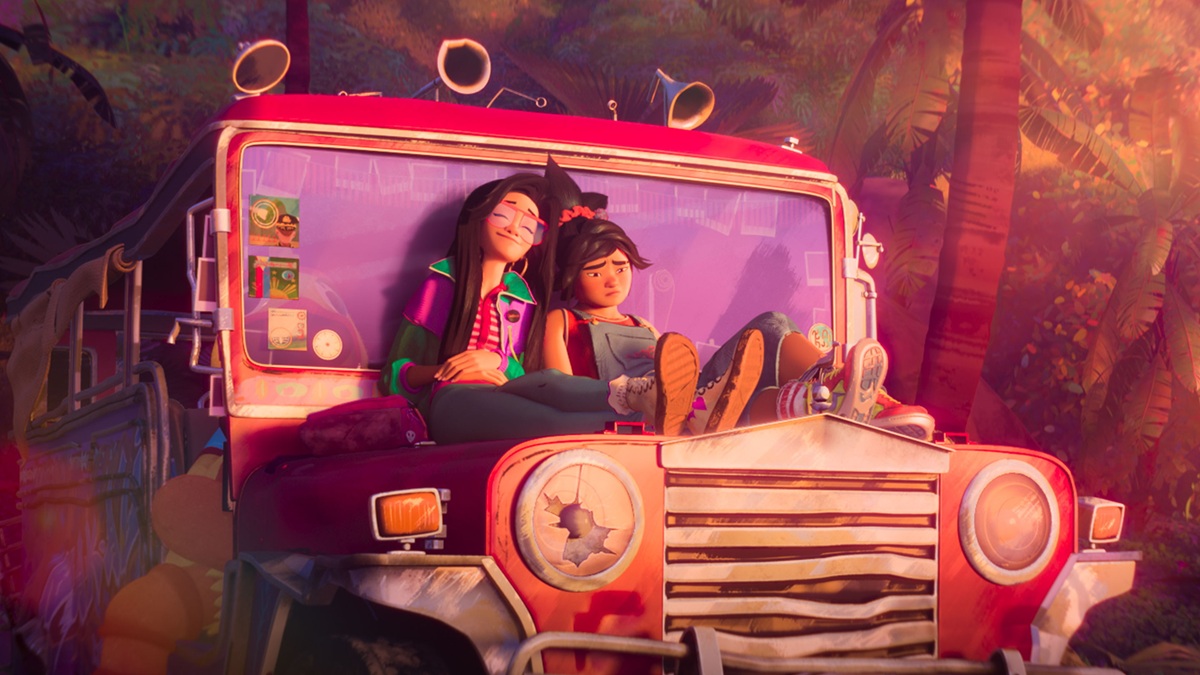
“Forgotten Island” sits somewhere between the rambunctious diasporic energy of “Joy Ride” and the quieter friendship heartbreak of “Frances Ha.” Strip the former of the sex and raunch, inject the latter’s fear of watching a best friend move into a life that may no longer have the same space for you, then send both through a DreamWorks adventure filled with manananggals, jeepneys, karaoke, Filipino food, household iconography, and enough familiar objects to turn parts of the movie into an Easter egg hunt.
It sounds like a lot, mainly because it is. Joel Crawford and Januel Mercado’s film rarely passes up an opportunity to remind us where its characters come from, sometimes to the point of excess. Yet the clutter serves a movie whose emotional language depends heavily on remembering: the things two people remember about each other, the stories families pass down, the images a culture carries around without needing them explained every time.
At the center are Jo (H.E.R.) and Raissa (Liza Soberano), best friends since childhood. Their friendship begins after Jo gets into trouble at school while using a manananggal to frighten her classmates during a slideshow presentation assignment about family. Raissa catches up with her outside the guidance office, and from there the film skips through the years they spend growing up together. Jo’s grandmother, Lola Fatima (Dolly de Leon), becomes part of that shared history through her stories about Nakali (short for nakalimutan, the Tagalog term for ‘forgotten’), the Forgotten Island, a place populated by creatures pulled from Filipino folklore.
Those stories remain stories until adulthood starts changing the shape of Jo and Raissa’s friendship. Raissa, the more academically driven of the two, is leaving for Caltech. Jo, meanwhile, hasn’t figured out what comes next. Their final night together goes badly, a tampuhan escalating around everything neither of them quite knows how to say. Eventually they wind up near an old jeepney by the shore, encounter a mysterious object, and wake up inside the very island Lola Fatima used to describe.
Nakali contains Lea Salonga’s dreaded manananggal (whom the characters refer to as Manang), Manny Jacinto’s Bungi, Jenny Slate’s Batiba, and Raww, a lovably dim weredog voiced by Dave Franco, among several other creatures and personalities. For a cast this stacked, though, “Forgotten Island” can be surprisingly stingy with some of its biggest names. Salonga’s Manang is such an inspired bit of casting that I kept wishing the film had found more for her to do (I recognize the irony of bemoaning the underuse of a Disney Legend in a DreamWorks picture, yet here we are). De Leon gets even less room, though the story at least has a reason for Lola Fatima’s limited presence. Still, when you have Lea Salonga and Dolly de Leon in your recording booth, wanting more of them hardly feels unreasonable.
Getting back home soon becomes tied to Jo and Raissa’s memories. From there, “Forgotten Island” follows a fairly recognizable animated-adventure route. The plotting is simple, the emotional destination visible well before the characters reach it, and very little about its eventual lesson should surprise anyone who has spent time with this kind of studio storytelling.
I didn’t mind much. The movie has other things on its mind.
Growing Apart Without Falling Out
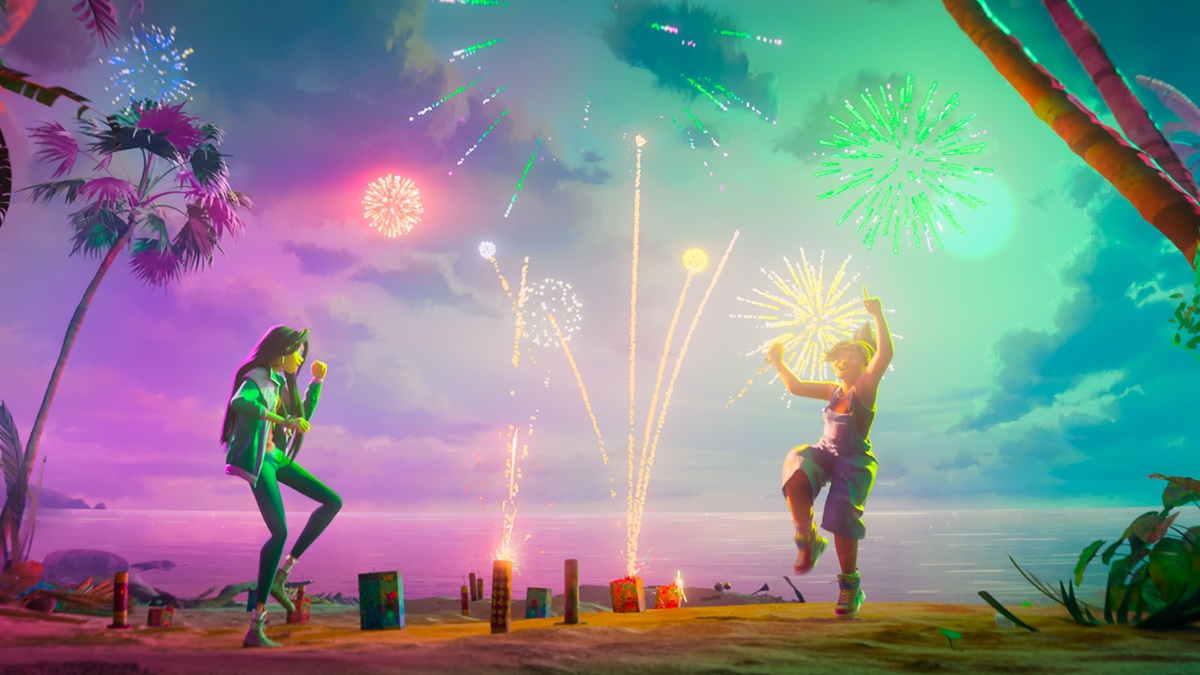
“Frances Ha” kept nudging its way into my thoughts because Jo and Raissa aren’t dealing with betrayal. Nobody has slept with somebody’s boyfriend, stolen an opportunity, or committed an offense large enough to justify ending a friendship. Raissa is simply moving forward faster. One of them already has an answer when people ask what comes next; the other is beginning to realize that “we” may soon become two separate lives.
Friendships rarely receive the same dramatic language movies reserve for romances, even though they can fracture with just as much confusion. Sometimes nobody does anything wrong. Someone moves abroad. Someone gets married, or they find a job that eats up their evenings. The friend who once knew the useless details of your day becomes a person you have to schedule. There may not even be a fight worth remembering, just the gradual realization that proximity had been doing more work than either person noticed.
Jo experiences Raissa’s departure as abandonment partly because she hasn’t imagined herself outside their shared routine. Raissa, meanwhile, cannot freeze her life simply to protect Jo from the discomfort of change. “Forgotten Island” never turns either woman into the villain of that disagreement. Their problem is one of timing. Raissa is ready for the next chapter before Jo is ready to accept what her leaving really means.
The fantasy mechanics externalize that fear in broad strokes. Nakali makes memories collectible, exchangeable, vulnerable to being lost. The metaphor isn’t subtle, nor does it need to be. Jo and Raissa have spent so long building a sense of themselves around a shared past that the prospect of losing those memories becomes indistinguishable from losing part of who they are.
H.E.R. and Soberano give the friendship an easy familiarity that keeps the sentiment from becoming entirely schematic. Jo and Raissa can be loving and annoyed with each other almost simultaneously, which is often what long friendships actually look like once politeness has burned away. You know where the story is heading, but the route remains pleasant because the relationship itself has enough warmth to carry the obviousness.
The film also subscribes to the idea that preserving a friendship doesn’t mean embalming it. Jo and Raissa can’t remain the children who once sat spellbound listening to Lola Fatima. Even if neither woman left home, something else would eventually force the relationship to change. Adulthood has a way of making nostalgia look like loyalty when sometimes it’s merely fear wearing nicer clothes.
That’s where the movie’s fixation on memory becomes more interesting than its plot.
Recognition as Part of the Experience
For Filipino viewers, “Forgotten Island” offers another form of remembering at almost every turn. The references arrive so frequently that cataloguing them could become its own viewing game. Filipino food, jeepneys, household decorations, religious imagery, pop culture, folklore, music, slang, familiar behavioral quirks: hardly a corner of the frame seems content to remain culturally neutral. At times the movie overdoes it. There are moments when another piece of iconography enters the frame and you can almost hear the film nudging you in the ribs.
“Recognize that?”
Yes. We do.
I laughed at myself more than once for responding exactly as intended.
Fan service carries a pejorative smell these days, but I don’t think all fan service is automatically cheap. Sometimes recognition is pleasurable precisely because the thing being recognized rarely occupies this much space in a Hollywood production. A Filipino audience doesn’t need a jeepney explained before feeling something when it rolls into view. A creature your grandparents or parents once used to scare you behaves differently in the imagination than a monster encountered for the first time through subtitles.
Western audiences can still follow “Forgotten Island” without knowing every reference, and that’s what I liked about the film. Many of those details will simply register as production design, fantasy world-building, or visual comedy. The film rarely stops to translate itself culturally, which is one of its better instincts. A joke can pass. A word remains unexplained. Not every image needs to file paperwork proving why it belongs there.
DreamWorks’ Filipino fantasy turns folklore, pop culture, and a rough-edged visual style into a warm story about friendship, memory, and learning to move forward.
Even “tayo na,” the phrase Jo and Raissa keep returning to, has become its own point of contention. “Tara na” would certainly sound more casual to many Filipino ears, and probably more like something two teenage friends would say without thinking. But by the end of the film, I understood why “tayo” carries more weight here.
“Tara” is an invitation: come on, let’s go. “Tayo” makes the togetherness harder to miss. You and me. Us. Spoken between Jo and Raissa throughout the film, “tayo na” starts sounding less like a catchphrase than a small pact. Wherever life takes us, we go together.
Which is precisely why their impending separation hurts. Raissa leaving for America doesn’t simply interrupt their routine; it threatens the assumption built into those two words. For years, movement has meant movement as a pair. The film eventually asks them to accept that growing up may require going somewhere the other person can’t follow. A phrase that initially sounds slightly formal, even odd to contemporary Filipino ears, acquires an emotional logic through repetition. By then, changing it to the more colloquial “tara na” might actually lose something.
That small linguistic argument dovetails into the more complicated question of authenticity, particularly when the characters mostly speak English. I can already understand why some Filipino viewers might bristle. Maybe an accent sounds too American. Maybe a pronunciation lands differently from the way someone grew up hearing it. Or maybe the abundance of Filipino imagery creates an expectation that the language should follow. These responses aren’t frivolous; after all, familiarity gives local audiences an ear for details international viewers wouldn’t notice.
But the demand for one correct version of “Filipino” runs into trouble quickly. The Philippines isn’t linguistically or culturally monolithic. If the entire movie were spoken in Tagalog, would that settle the question, or merely move it somewhere else? A Cebuano viewer could ask why Tagalog gets to stand in for everybody. The same could be said by Ilocano, Hiligaynon, Waray, Kapampangan, and other audiences whose relationship to “Filipino identity” doesn’t begin and end with Manila speech. There’s no way for a single DreamWorks movie to contain all of us, and the attempt would probably make for terrible drama anyway.
What “Forgotten Island” can do is establish a particular Filipino and diasporic experience and trust that specificity without pretending it is universal. Jo and Raissa speak the way these characters speak. Lola Fatima tells the stories she tells. The objects around them belong to homes that resemble some Filipino homes and not others. A viewer may recognize pieces of their own life while also noticing the distance. That tension is more productive than a checklist of correctness.
It reminded me, in a sideways manner, of the conversations surrounding Rafael Manuel’s “Filipiñana.” That film was also conceived very consciously with Filipino audiences in mind, yet its formal severity and slow pacing made it alienating to some of the very viewers it addressed. “Forgotten Island” operates at almost the opposite commercial frequency. It wants the Filipino audience to recognize itself immediately and repeatedly. It courts pleasure, familiarity, music, movement, jokes, spectacle.
Even then, recognition doesn’t guarantee agreement. If anything, being represented invites more scrutiny because now everybody has an opinion on which version of “us” made it onscreen. I find that healthy up to a point. The trouble begins when specificity gets mistaken for exclusion.
Animation With Some Dirt Under Its Nails
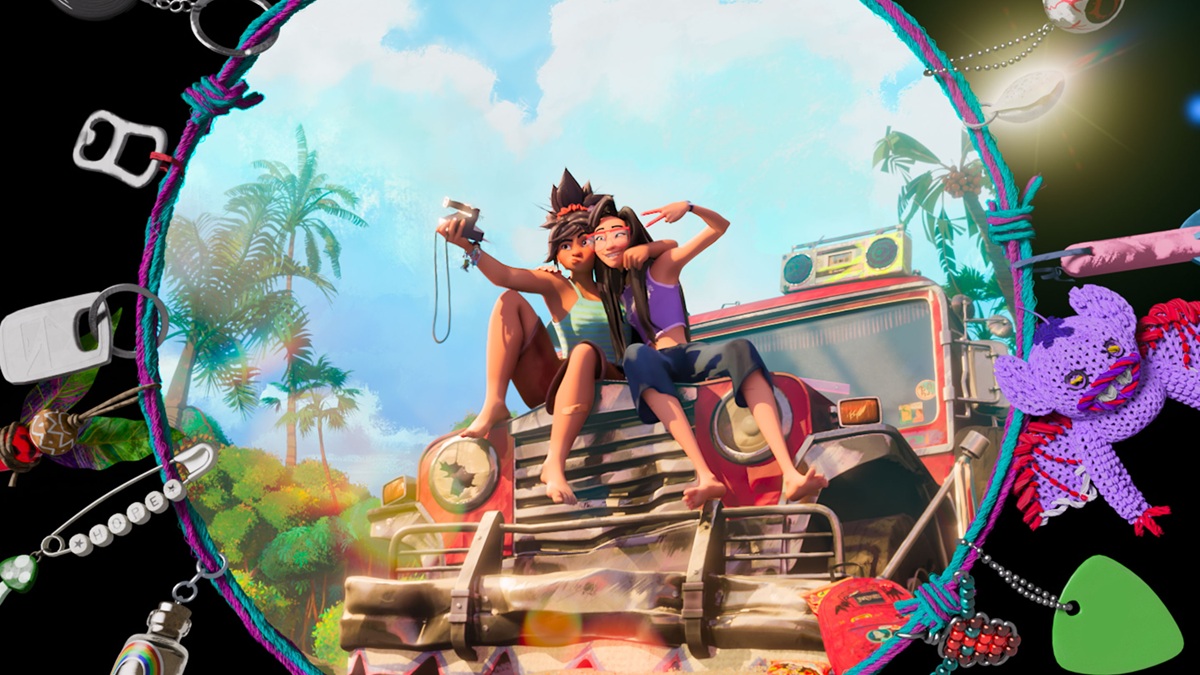
Visually, “Forgotten Island” works because it doesn’t chase immaculate surfaces. Parts of it look almost crude by current studio standards, and I mean that as praise. Characters stretch, snap, tumble, and occasionally move with the rude physicality of slapstick cartoons. The film shifts between three-dimensional animation and passages that lean more openly into two-dimensional imagery, and the seams aren’t always hidden.
Good.
I’ve grown a little tired of animated films whose technical achievement becomes inseparable from how effectively they mimic photography. Hair moves correctly. Water behaves correctly. Skin catches light correctly. Fabric folds correctly. Millions of dollars are visible in every pore. “Forgotten Island” often seems more interested in movement than perfection.
I kept thinking of it as anti-Pixar, not in the sense that Pixar represents everything wrong with animation, but as a rejection of the idea that polish should be the medium’s highest aspiration. Nakali can stretch because memory stretches. A creature may become grotesque, funny, cute, or frightening within a few seconds. A gag can briefly wreck the proportions of a body. Images shift texture because there’s no obligation to pretend a camera was ever present.
That looseness fits a story built around childhood and recollection. Nobody remembers childhood with 4K accuracy. Certain rooms become enormous. Certain people shrink. A frightening story told by your lola acquires details she may never actually have said. Years later, you remember the feeling more clearly than the facts. The animation behaves a little like that.
This is also why the film’s sweetness rarely tipped into synthetic sentimentality for me. You can sense people behind the work. Plenty of animated movies look gorgeous and somehow arrive onscreen hermetically sealed, every surface finished but nothing breathing underneath. “Forgotten Island” has bumps. It also has fingerprints.
Crawford and Mercado seem to see pieces of themselves in Jo and Raissa, and the movie gains something from that affection even when the screenplay is playing with familiar parts. The people making it appear to care not only about what these characters represent culturally, but about their dumb jokes, petty fights, childhood attachments, and fear of losing each other. That affection travels surprisingly far.
The soundtrack helps whenever the adventure needs another push. Alongside BINI’s “A Parallel World” and SB19’s take on Francis M.’s “Mga Kababayan,” H.E.R. and Soberano perform an original song, “BRB.” These songs arrive with enough force to wake up sequences that might otherwise coast on visual energy alone. Their presence also fits the movie’s larger cultural collage. Contemporary Filipino pop sits beside folklore, old family stories, familiar objects, and childhood superstition without the film treating any one of them as a more legitimate expression of identity.
There are times when “Forgotten Island” could stand to trust all of this a little more. The Easter eggs pile up. The emotional mechanics occasionally state themselves too clearly. Batiba and the rules surrounding memory lead the story toward a conclusion that isn’t difficult to anticipate.
Even so, predictability doesn’t erase feeling, and simplicity isn’t the same thing as shallowness. Jo and Raissa eventually have to confront something most friendships encounter without the benefit of a magical island: the past can’t be preserved by refusing to move. The person who knew you at twelve may still know you at thirty, but differently. Distance changes the vocabulary. Memory fills in some gaps and distorts others. Sometimes the friendship survives because both people stop asking it to remain exactly what it was.
“Forgotten Island” wraps that realization in monsters, slapstick, P-pop, Filipino clutter, and enough cultural references to keep audiences arguing over them after the credits. The mess is part of its charm. It knows that remembering where you came from and figuring out where you’re going aren’t opposing impulses. Growing up asks you to do both at once.

Joel Crawford and Januel Mercado’s “Forgotten Island” is scheduled to be released by Universal Pictures on September 25, 2026. Follow us for more coverage.

