


Marriage is a difficult thing. I wouldn’t know from my own experience. But as I’ve seen it through others who have decided to tie the knot and live their lives together, or who get tired of each other, the love they once had evaporates. The concept of marriage itself is a difficult one to comprehend. It is more than a union of two souls. And everyone who partakes in it has a different experience, with both good and bad (sometimes ugly) consequences throughout the union’s lifespan. Many artists have tried to encapsulate the ups and downs of married life, particularly the times when things get dour and complicated. The inability to talk with one another and to have intimacy grows into an ulcer that doesn’t seem to heal until it consumes one.
There is still some love and devotion in that fractured relationship, but frustration and anger have the largest share. Filmmakers like Noah Baumbach (with both “The Squid and the Whale” and his far better divorce drama “Marriage Story”), Stanley Kubrick (“Eyes Wide Shut”), and Derek Cianfrance (“Blue Valentine”) have done features that talk about that sensation of a relationship falling to the brink whilst withholding an amount of care. Although not up to par with the aforementioned directors’ works, Olivia Wilde wants to put her stamp and personal take on marriage and the disconnection that occurs through time with her third feature film, and best so far, “The Invite,” adapted from the 2020 Spanish play “The People Upstairs”/“Sentimental” by Cesc Gray.
Olivia Wilde’s Own Personal Take on Marriage and the Loss of Communication
Wilde gives the already complicated and uncomfortable nature of confrontation and reaching out a comedic twist, making one laugh at the dire situation in the central pairing’s relationship while also cringing at their revelations and hurt feelings. The film does have its fair share of laughs, often coming at a rapid-fire pace. However, it is the truthful vulnerability hidden in the screenplay that makes the film click, and the performances are what make it click. It earns its heart by having us laugh at others’ pain and frustration while the characters yearn to understand how to fix what they deem unfixable.
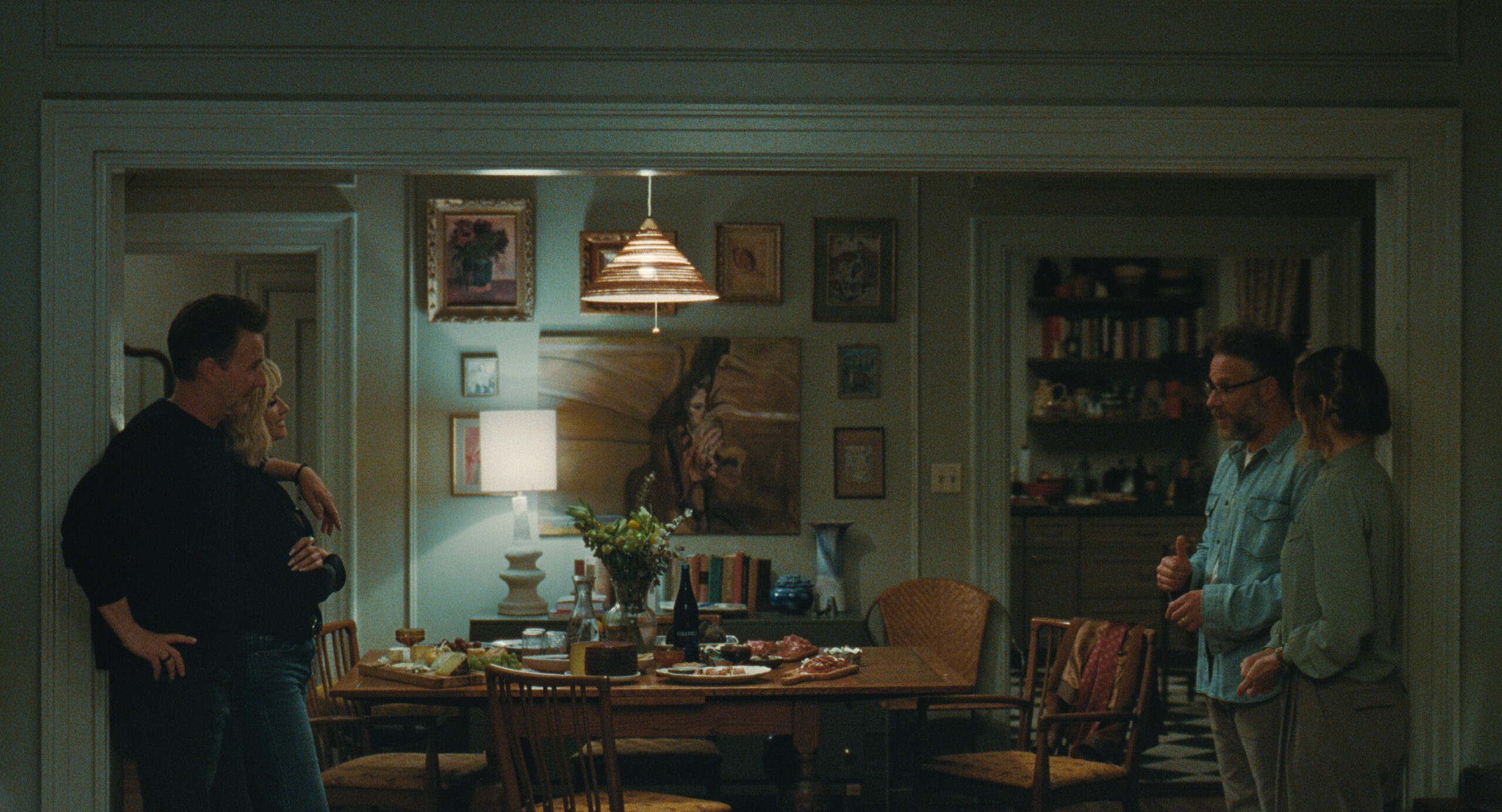
“The Invite” takes place in a single night, a couple of hours entrapped in an apartment, where truths will be revealed, lies uncovered, and pain is shared. Angela (Olivia Wilde, delivering what I may consider her best work both as an actress and as a filmmaker) has always thought about inviting her upstairs neighbors, Pina (Penélope Cruz) and Hawk (Edward Norton), to her apartment. She has become infatuated with them for myriad reasons, all of which are slowly revealed throughout the film, and she wants a proper conversation outside the cordial elevator small talk. Her husband, Joe (Seth Rogen), isn’t that fond of them. In fact, he despises them, not because they talk a lot during the elevator rides or their occasional smarmy demeanor, but the loud orgasms that come from their room at three in the morning.
Two Couples, a Few Hours of Conversation, and Many Revelations
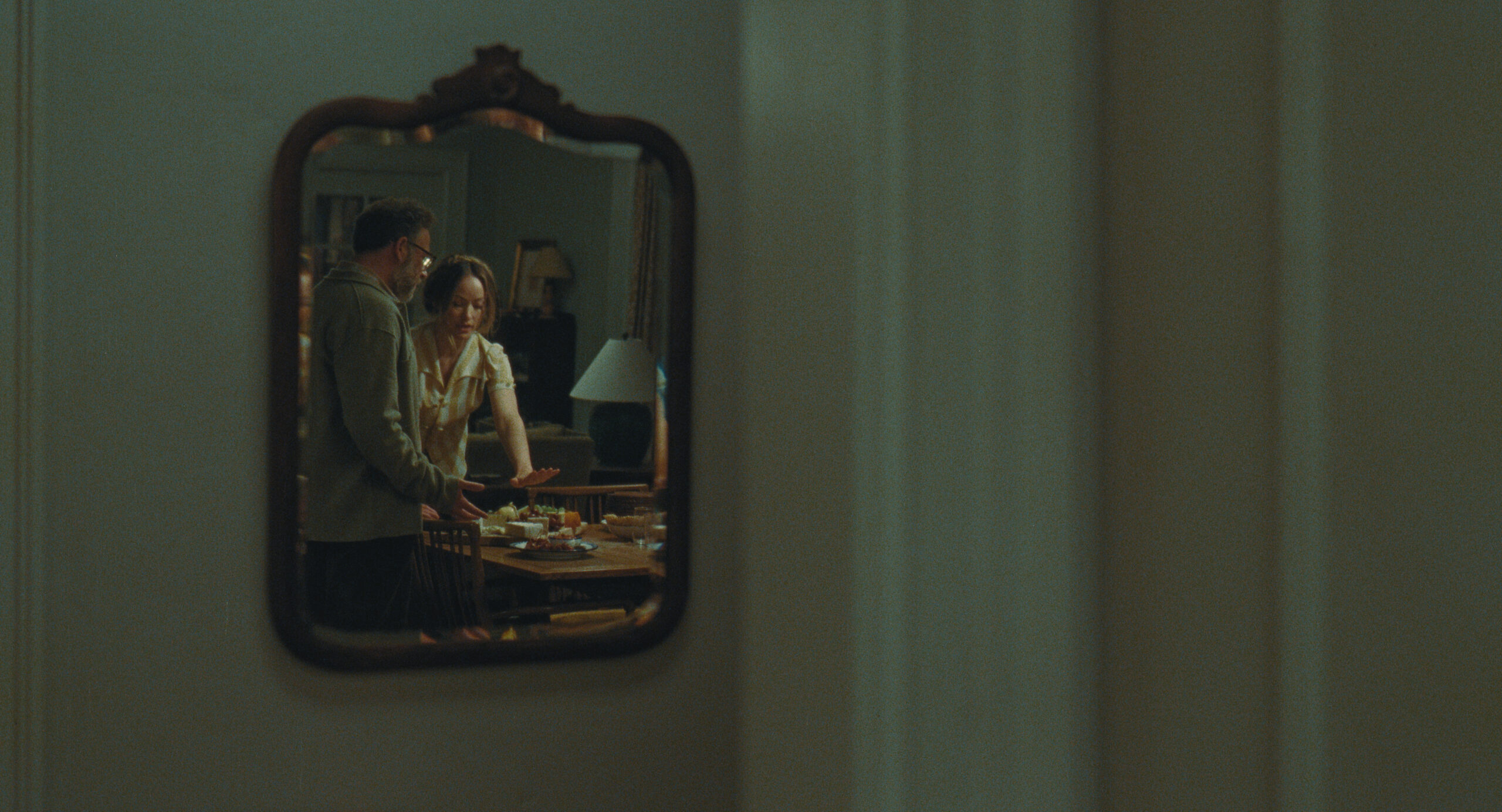
Joe can’t stand it anymore; he can’t tolerate one more night of waking up to their pleasure. What also bothers him is that he has to come up with an excuse to her daughter about what those loud noises are. He wants to tell them to their face that they are an annoyance. And that time to do so arrives when he least expects it, as Angela has decided, on a random morning, to invite them over for dinner without Joe’s knowledge. The first scenes of the film are of Joe and Angela on their way home. One teaches music at a small music school, and the other buys rugs, fancy cheeses, and flowers to impress the neighbors. From these mere scenes, you can get a taste of their personalities and how their unhappiness is rooted in their current relationship.
Joe is depressed about how everything is going, which is why he responds to most questions with a sarcastic or uninterested tone. He doesn’t want to be teaching at a local music school. Joe would rather be making art — creating his own pieces like he once did before with his old band, which had a two-week hit titled “My Girl,” written about his now-wife Angela. His inspiration and adoration for music have dissipated through time, and he doesn’t want to go near his instruments, especially the piano, his token of creativity. For him, it is a reminder of his failure as a musician, of what could have been and never occurred. He distances himself into a cavernous hole of self-despair and regret.
Joe and Angela, a Doomed Couple or a Fixable Relationship?

On the other hand, Angela is a stay-at-home mother. Her art degree didn’t land her a job, and she has tried, so she stays in the apartment organizing and styling it to her taste. This entertains her and keeps Angela’s creative spark alive, even if only for a quick second. She could try her hand at interior decorating, but she never seems to pursue it either. Her frustration comes from a place similar to Joe’s: a dream that she couldn’t achieve. Angela does not paint much anymore, just like Joe does not play the piano. But both were emerging artists who aspired to bloom together as artists and as a couple. Life had other plans, and now, in their forties, they are unable to contain their sadness and dissatisfaction, even if what they currently have many would die for.
From the moment Joe comes through the door, an argument begins. And when he gets the news that Pina and Hawk are coming over, the argument spirals out of control. Many topics come and go, and everything bottles up — letting the audience know how bad things have become in their household, where they can’t have a single conversation without it transitioning into a fight. The tension rises as the comedic quips drive the dialogue, with Rogen precisely delivering his sarcastic lines and Wilde delivering very expressive, acute reactions and rebuttals. The two characters have a fractured chemistry, but the actors playing them bounce off each other with ease. Their acting control helps give these scenes a realistic tone, while the dialogue may be heightened to add more comedic flair; there is some realism behind their arguments, especially those further in the film.
Late-Night Swings Might Do the Trick
There are some truths, both hidden and easily seen, behind each back-and-forth, ones that don’t stray far from arguments you may have heard from your parents or random couples somewhere. The two are fighting as they hear a knock on the door. Immediately, they stop and pause their argument, but it will be a temporary pause, as they will bicker plenty. Upon entering, Pina and Hawk already sense the tension in the room–the scent of a recent argument: frustration mixed with sadness and the bickering party’s drink of choice. They ask if it is a good time for them to come by after hearing part of their fight from outside the door. But Angela is keen for them to stay. The night is long, but the effects of what occurs here will last longer.
The four of them begin to discuss everything, from traumatic pasts and sexual desires to regret, their unhappiness, and what once brought them joy. The people Angela and Joe are at the beginning of the film will not be the same ones by the time the credits roll. What will become of them when they formally reveal their deepest feelings to each other and make damaging revelations? “The Invite” does not show us who they are before or after these events, but in the way each dialogue set-piece is mounted, you know them entirely and their grievances. The screenplay by Rashida Jones and Will McCormack offers entry into these characters’ lives through their unhappiness.
While Joe divulges about the passion he once had, revealing much about his disappointment and current position, Angela is obsessively grateful for any compliment she receives, showing that she feels unappreciated, with little to offer and often ignored. These revelations come slowly but swiftly, as joints are lit, shots are taken, and conversations spark a light into the leading pairing. The narrative swings into more sexual paths, with an expected twist from Pina and Hawk about their late-night hookups. But rather than changing the tone and trajectory like other adult comedies, “The Invite” stays focused on its characters and uses this switch-up to continue exploring another side of the married life and the loss of communication between partners: the lack of pleasure and desire.
The Hard-Hitting Reality Behind the Comedic Quips

What has made people resonate with “The Invite” is the reality behind the comedy, the way a joke can contain a multitude of realizations. The best jokes told are those that take the pains of our daily lives and mock them, not to laugh at those who endure such, but to show universality — that everyone goes through these things and we should find ways to resolve them. And while the film’s comedic approach feels somewhat Americanized, its wit invites others to relate and see themselves in the characters. I have had that issue with many American comedies in the past couple of years that feel unable to make non-American audiences laugh or empathize with the quips and remarks told. But in this case, it wasn’t much of an issue, although it occasionally suffers from it in my own viewing experience.
The final scene in the film leaves some ambiguity about whether Joe and Angela stay together. This is where “The Invite” made me look at the earlier scenes from a different perspective, making me want to revisit the film. It is both somber and sweet, delicate and tethering between the hopeful and melancholic. After all of the commotion, this scene stands out and breaks your heart. After receiving one blow after another between rounds of arguments, this comes as a heartbreaking relief. Wilde has said that she and Rogen worked-shopped the film’s ending, and you notice they settled on a picture-perfect closure that is open to interpretation. Whether or not you believe Joe and Angela stay together after dinner, you can see the possibility of change in both of them, which makes “The Invite” sting as you leave the theater after laughing plentifully.
–> Read More: Browse all of our A24 reviews and coverage

