


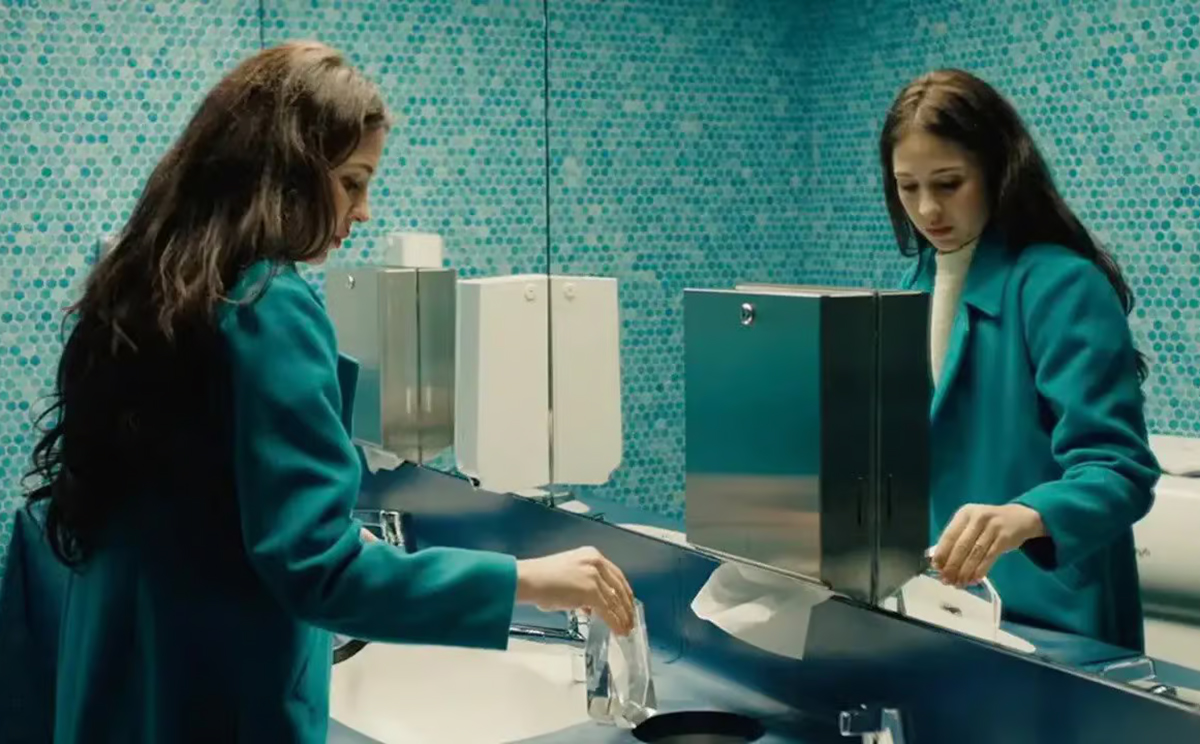
In a wordless opening sequence that launches “The Currents” (2025) designer Lina (Isabel Aimé González-Sola) graciously receives a professional award from peers. Lina then goes to the bathroom to examine herself in a mirror and toss the trophy into the garbage. Following that, on a scenic walk through Geneva, Lina hooks her leg over a bridge and plunges into the river. Director Milagros Mumenthaler tactfully withholds pat explanations for Lina’s dive, and González-Sola’s inscrutable demeanor and mod style shifts (“New hair?”) simultaneously draws in friends and family while alienating them from her private hell. An eerie, elusive and unsolvable mystery, “The Currents” foregrounds everyday white noise and a distinctive technicolor visual palate to stand in for Lina’s silences. But, like the well-meaning support system surrounding Lina, Mumenthaler loses patience with this baffling heroine. Imposing exposition through backstory and psychotherapy, Mumenthaler doesn’t so much unwrap as she does undo the vague terms of Lina’s harrowing inner pain.
A distinguishing asset of “The Currents” is how it looks and sounds, offering peeks into Lina’s wiring particularly as her behavior strays from acceptable norms. Sound Recordist Carlos Ibañez Diaz amplifies Lina’s vibrating phone — which she repeatedly ignores – and, when her husband Pedro (Esteban Bigliardi) shouts at her from inside the apartment, Lina’s earplugs dim his demands, turning the outside world down to an acceptable volume. Costume Designer Simona Martínez and Art Director Aili Chen opt for cherry-red lipstick and a purple Bardot headbands, alluding to varying arthouse cinematic icons. But compared to, say, the heightened melodramas of Pedro Almodóvar, Mumenthaler’s woman on the verge is sedate, nearly catatonic, and her tumultuous mental state swirls and swerves, suggesting another jump-scare jump looms.
Face-to-Face with the Past
Instead, Mumenthaler (who also wrote the script) brings Lina face-to-face with her past, rather than staying fixed in the wobbly current. A visit to a therapist’s office precedes a trip back home for Lina, and here the tone bobs to more conventional arc, an odd departure from the mischievous, beguiling lead-up. It links Lina’s own attempt to escape her family — her daughter Sofía (Emma Fayo Duarte) begs her to stay — to her own mom, who Lina sees at her childhood home (all lights are off and mom won’t go outside), shrinking Mumenthaler’s thesis (and Lina’s struggles) to digestible bite-sizes. And that emotional course rings hollow based on Mumenthaler’s earlier evocation of Lina’s estranged duality (calling to Kieslowski) or femme-fatalistic nature (Hitchcock), so “The Currents” bends to familiar dramatic tropes, rounded out with a prescriptive resolution at the end.
When “The Currents” allows doubt to build rather than solve itself, it’s a uniquely unsettling nightmare, draped in chic elegance and turquoise. Despite a pivot towards predictability, “The Currents” glides when Mumenthaler refuses to audit Lina’s mental state or identify a disorder’s source. Fragility and unease are the film’s primary moods, so it doesn’t seem credible for Lina — controlled in her instability, like everyone else is lost, not just her — to bolt from Pedro only to return, shrouded in maternal and domestic guilt. Actually, that’s exactly what a person would do in most mainstream films, TV shows or soap operas. Far from standard commercial fare, “The Currents” is a leering mess at its best, and Mumenthaler guides Lina towards a misdirection of her own making and, if she’s lucky, unraveling on her own terms.

“The Currents,” a Kino Lorber release, is now out in a limited theatrical release.

