


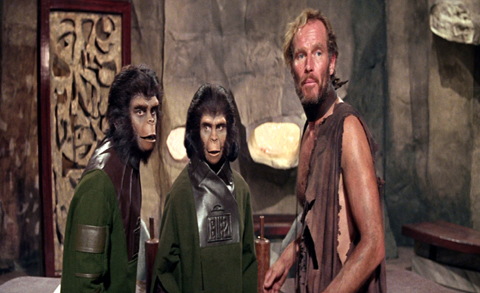
One of sci-fi’s most famous and groundbreaking movies of all time is the 1968 effort “Planet of the Apes.” Directed by Franklin J. Schaffner and based on the 1963 French novel La Planète des singes by Pierre Boulle, “Planet of the Apes” has been lauded for its costumes and set design for decades, and was selected for preservation in the United States National Film Registry by the Library of Congress.
While the final screenplay was written by Michael Wilson, the original was penned by one of my biggest influences as a writer, and all-in-all bohemian hero, the great Rod Serling. Serling’s brilliant mind and unparalleled creativity were the driving force behind the classic television series “The Twilight Zone” along with a lesser renowned though equally entertaining show called “Night Gallery.” Serling’s style has had a direct influence on many of my own short stories, and along with Alfred Hitchcock, he is one of twentieth-century horror’s most eccentric geniuses.
Serling’s original script was changed due to an abundance of budgetary costs (the technologically advanced ape society portrayed by Serling’s script would have involved expensive sets, props and special effects) but his most ardent and loyal fans can quickly identify his fingerprints all over the movie. Michael Wilson’s final draft kept the basic structure of Serling’s screenplay while updating the dialogue and setting to a more primitive society. Serling’s trademark twist ending was retained (in typical “Twilight Zone” fashion) and has become one of the most famous movie endings of all time.
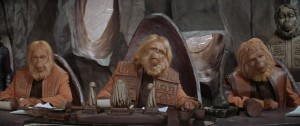
Parameters are laid out at the beginning as astronaut George Taylor (Charlton Heston) dictates into a recorder from the deck of his spaceship. Thousands of years have passed since the ship departed earth but due to its travel at light speed and hibernation chambers the crew only ages by a matter of months.
The ship crashes on a mysterious distant planet, the year is 3978, and they are said to be 320 light years from Earth. Taylor and two other survivors set out on the mysterious planet, though Taylor is the only one that matters since the other two are quickly killed off by a swarm of military-like, English speaking gorillas. Taylor is taken prisoner where he learns that the planet is controlled by the apes and that humans are considered vermin and are hunted for sport, killed outright, enslaved, or experimented upon. As Taylor begins piecing together his location and a means of escape, he befriends Animal psychologist Zira (Kim Hunter) and her fiancé, archeologist Cornelius (Roddy McDowall), along with a fellow prisoner, a mute girl named Nova (Linda Harrison).
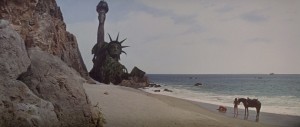 “Planet of the Apes” boasts a number of attacks on social standards and critiques of ‘60’s society – both in your face like mockery of hunting and the despicable flaws of human nature, and subtle like recurring jabs at the counterculture of hippies. There are obvious plot holes but these are to be expected from any film, especially in the genre of science fiction.
The only major speaking character in the film not decked out in gorilla-garb is Taylor. Heston was a titan of Hollywood in 1968, having reeped esteem and success with his roles in “The Ten Commandments” “Ben-Hur” and “El Cid.” In “Apes,” Heston comes across as a typical jock alpha male (his political idealism and overzealous nature in the his later years would confirm this) and the entire movie as such revolves around him. Taylor does deliver a few memorable and slightly comical lines like “Take your stinking paws off me, you damn dirty ape!” or “You did it! You cut up his brain you bloody baboon!” But generally delivers every line in such an over-the-top fashion he makes Samuel L. Jackson appear tame.
“Planet of the Apes” boasts a riveting plot that is far beyond the simplistic writing of today but sadly, is trapped by by the parameters of film and abilities from the past. Serling’s unique story (highly reminiscent of the classic “Twilight Zone” episode I shot an arrow into the air) is what drives the story. Unfortunately, the slow moving middle portion reveals that “Apes” would have been better off as a thirty-minute episode of “The Twilight Zone” rather than a full length motion picture.
I understand the hype to a degree. I’m not sure why multiple sequels were made since there really isn’t a need for them. The legendary ending scene is a perfect way to leave you hanging and what makes the boredom of the film worth watching. Hollywood could stand to borrow a chapter or two from Serling as to when a story should call it a day.
– by Matt Christopher

1 Comment
Hey Matt this film was made for cheap. It makes lots of money hence a 2,3,4,5,. The movie is a fantastic example of a b film from the 60s and truly desvers it’s cult status.