


Josh O’Connor has quietly but decisively been named 2025’s actor of the year, not by awards bodies yet, but by the accumulated weight of his choices. After his mainstream exposure in the sweaty, crowd-pleasing fun of “Challengers,” O’Connor seems dead-set on picking projects that redraw the map of his career rather than reinforce it. Following the magnetic but ultimately hollow arrogance he brought to “The Mastermind,” it came as a genuine surprise to discover that “Wake Up Dead Man—” easily the strangest and most inward-looking “Knives Out” film to date—is less a Benoit Blanc mystery than a full-blown Josh O’Connor showcase. As such, it confirms that he’s far less interested in movie-star dominance than in finding a character from the inside out and letting the camera act as a screen partner. His two-fisted holy man, Father Jud Duplenticy, is flawed, idealistic, and deeply anxious—and the first truly compelling “Knives Out” character to meaningfully complement Daniel Craig’s Benoit Blanc.
O’Connor plays Jud as a former boxer turned priest, transferred to an isolated Upstate New York parish as punishment for swinging at a colleague and as a test of spiritual resolve. Walking the grayed-out grounds of Our Lady of Perpetual Grace, Jud looks more resigned than inspired; his hands are down, but his guard is always up. The parish becomes both sentence and stress test, a place where faith is less nurtured than endured. His new superior is Josh Brolin’s Monsignor Jefferson Wicks, an Old Testament fire-and-brimstone preacher who thrives on humiliation and blame. Born into power, Wicks treats the Church as inherited territory, enforcing authority through cruelty rather than care.
Josh O’Connor is Absorbing
Wicks presides over a congregation of bruised archetypes: a loyal, long-tenured church fixture (Glenn Close); a philandering, alcoholic physician (Jeremy Renner); a stifled sci-fi writer (Andrew Scott); a wheelchair-bound musician (Cailee Spaeny); a sleek lawyer burdened by family shame (Kerry Washington); and an ascendant alt-right influencer (Daryl McCormack). As tensions rise between Jud and Wicks, the monsignor is stabbed in the back on Good Friday—murdered inside a closet with no access point. Police descend on the parish, but it isn’t until roughly forty minutes in that Benoit Blanc finally strolls into the story.
It’s to the credit of O’Connor’s performance and Rian Johnson’s screenplay that I was so absorbed in this moral and emotional terrain that I genuinely didn’t care when Blanc arrived—despite him being the ostensible engine of the franchise. It’s an audacious structural gamble, and one that pays off by reframing Blanc as a supporting instrument rather than the engine itself. Craig is, as always, wonderful, and I’d never argue the series needs less of him—but with O’Connor at the helm, the film is in remarkably good shape without its detective front and center. Making Blanc the Watson to Jud’s Sherlock is such a bold play that it feels genuinely fresh for Johnson’s hipster Agatha Christie franchise. Their chemistry crackles, and Johnson’s screenplay is easily the strongest of the “Knives Out” films, downplaying his more strident, audience-pandering political commentary in favor of an honest exploration of his own complicated relationship with religion. He aims for sincerity without slipping into mockery or sermonizing, balancing an ingeniously worked-out murder plot with genuine theological inquiry.
Blanc is Secondary to ‘Wake Up’s’ Character Studies
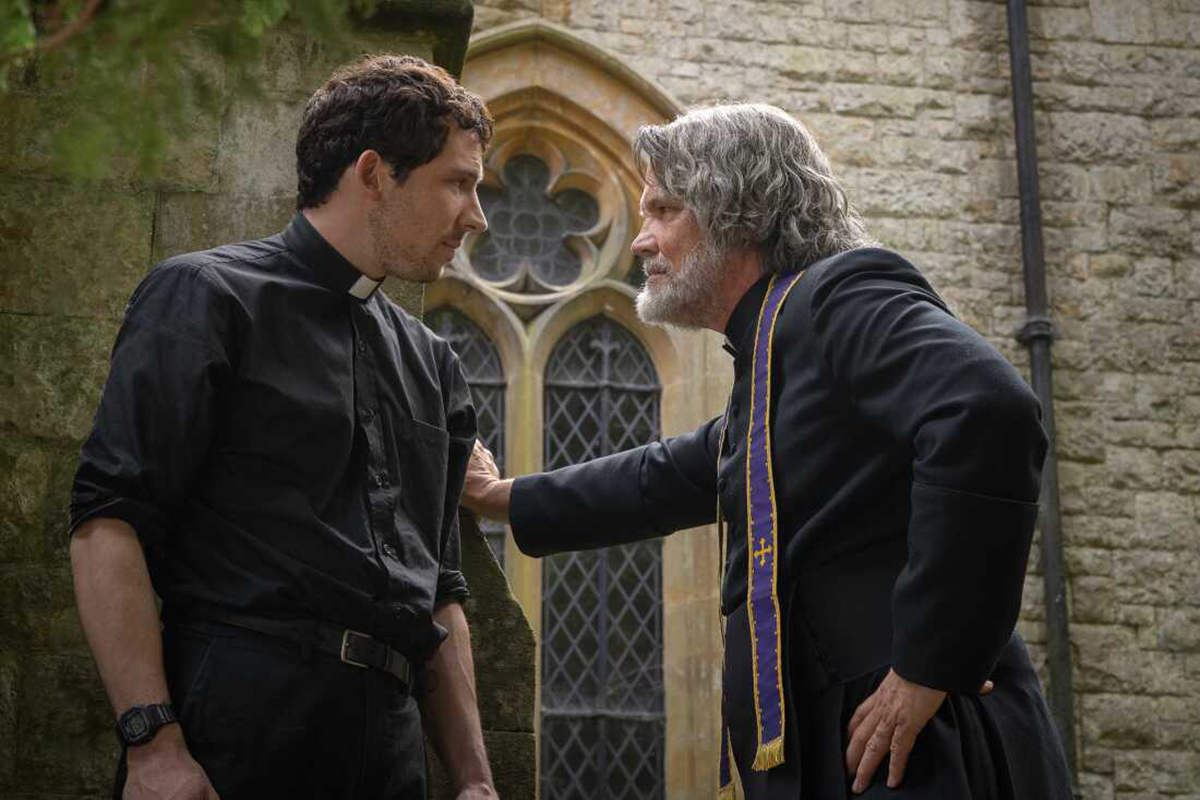
While I found both “Knives Out” and “Glass Onion” to be glossy, cozy blasts of crackerjack mystery fun, “Glass Onion” began to test my tolerance for blunt moralism and broad irreverence. O’Connor’s conflicted lead performance and Brolin’s deplorable, nasty turn as the face of religious authoritarianism-turned–Mr. Boddy prove that the franchise has far more dexterity than previously expected. That said, as a mystery, the ensemble outside of those two isn’t nearly as well drawn, making the hiding-in-plain-sight killer easier to spot than ever. Still, while predictable, the emotional payoff lands. Johnson remains skilled at reverse-engineering murder plots while skewering broadly drawn right-wing villains along the way.
Ultimately, “Wake Up Dead Man” is less compelling as a puzzle box than as a character study—and that feels entirely intentional. It’s immaculate in its construction, perhaps too tidy to truly unsettle, but undeniably emotionally satisfying. The franchise emerges healthy, confident, and crowd-pleasing as ever, buoyed by O’Connor’s exceptional work and Craig’s ever-dependable detective. Hopefully, moving forward, Johnson continues to evolve—and perhaps finally crafts a case that’s as challenging for the audience to solve as it is rewarding to watch.