


Lynne Ramsay doesn’t do explanations. She does textures, rhythms, the way light hits a window when your marriage is dissolving. “Die My Love” continues this approach, and it’s both the film’s greatest achievement and its occasional stumbling block. Adapted from Ariana Harwicz‘s novel, the film follows Grace (Jennifer Lawrence) and Jackson (Robert Pattinson) as they relocate from New York to a Montana home Jackson inherited from his uncle. Grace gives birth. Jackson travels for work. The marriage fractures. But to describe it this way feels reductive, like explaining a panic attack by listing symptoms.
In between, the film never names what’s happening to Grace. Postpartum depression? Postpartum psychosis? Major depressive disorder layered over childhood trauma? Ramsay’s movie suggests all three. None confirmed. And that refusal feels deliberate, almost aggressive. Ramsay shoots mental collapse as sensory experience: heat shimmering off grass, the incessant barking of an unwanted dog, the wet sounds of sex in the woods. There’s no clinical language here, no therapy scene where someone gently explains the DSM criteria. Instead, we get Grace touching herself in the forest. Grace throwing herself through glass. Grace demanding Jackson shoot an injured dog, then doing it herself when he refuses.
And here’s what struck me: the film isn’t asking what Grace has. It’s asking what it feels like to live inside a mind that’s unraveling while everyone around you insists you look “healthy” and “well.” Those words get repeated to Grace’s face during one welcome-home party, and each repetition lands like a slap. Because Grace doesn’t look well. She looks like someone wearing a costume of wellness, and Lawrence plays it with this terrible, brittle brightness that makes you understand why no one notices. Or why they choose not to.
Postpartum as Lived Contradiction, Not Clinical Case Study
As a heterosexual male, I’m acutely aware that I’m observing something I can’t claim to fully understand. But what the film captures, what it gestures toward without explaining, is postpartum depression not as a condition to be explained but as a lived contradiction. Desire without release. Love without relief. Grace is isolated in what everyone else calls domestic peace. Her sexual desire returns, but emotional intimacy doesn’t. She feels rage and maternal attachment at the same time. Her identity collapses the moment motherhood becomes her only role.
This, in a way, reminds me of Teyana Taylor‘s Perfidia Beverly Hills in “One Battle After Another,” in how it portrays a woman seemingly losing her sense of purpose and self after childbirth. Both films understand that motherhood doesn’t always arrive as transformation or fulfillment. Sometimes it arrives as erasure.
The Montana setting functions as more than backdrop. It’s antagonistic. All that endless space becomes a form of entrapment. Silence amplifies internal noise instead of soothing it. Nature isn’t healing here. It’s feral, sexual, destructive. The woods surrounding Grace’s home serve as a site of masturbation, fantasy, and eventually something more permanent. Seamus McGarvey‘s cinematography captures this beautifully. The landscape looks stunning and suffocating in equal measure.
When Male Decency and Emotional Negligence Live in the Same Body
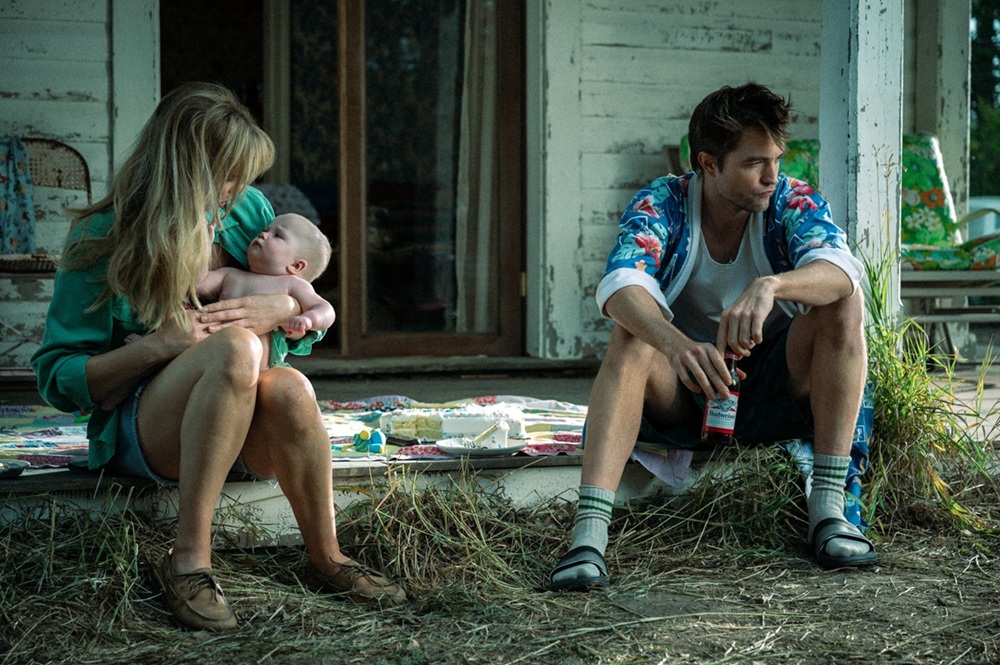
Robert Pattinson’s Jackson deserves careful consideration because he’s not a villain in any conventional sense. He provides materially. He wants marriage, family, stability. And his infidelity is treated less as betrayal than inevitability, just something that happens when he’s on the road. Personally, I feel that the film’s refusal to outright indict Jackson for his infidelities is a key choice to highlight his cluelessness.
Indeed, Jackson doesn’t see Grace. He interprets her distress as inconvenience or malfunction. His solutions are institutional (psychiatric hospitalization), cosmetic (repainting the house), or even managerial (buying a dog without asking). Here, Ramsay interrogates how male decency can coexist with emotional negligence, and how that negligence can be lethal, without turning Jackson into a monster. It’s a more uncomfortable critique because it implicates a kind of masculinity that thinks it’s doing everything right.
There’s a scene that encapsulates this perfectly. In a moment of calm between the two, Jackson declares his love for Grace, then says “I can try harder.” Suddenly the car radio plays John Prine and Iris DeMent‘s “In Spite of Ourselves,” and both Jackson and Grace sing along to it. Neither can carry a tune. But they sing anyway, off-key but in a way that suggests they know the song by heart, and it’s the most tender moment in the film. The song itself is about an imperfect union, two people promising to try harder for each other’s sake, doing so “in spite of themselves.”
Suddenly you understand exactly what this marriage is: almost-perfect, imperfect, sustained by effort that ultimately may not be enough.
Lawrence Matches Ramsay’s Uncompromising Direction
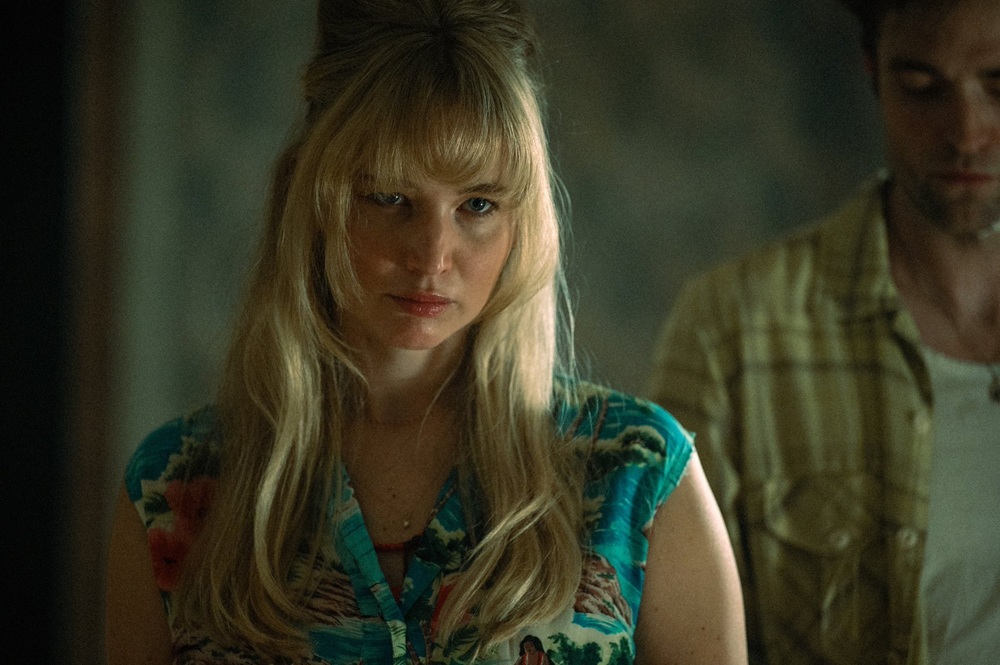
There’s something radical about a film that refuses to pathologize its protagonist while simultaneously refusing to romanticize her suffering. Grace isn’t a tragic heroine. She’s not a cautionary tale. Far from it: she’s a woman whose mind is collapsing, and the film shows us that collapse from the inside, without offering the comfort of diagnosis or the false hope of simple solutions. When Jackson remodels their home during Grace’s hospitalization, painting over everything, the metaphor is almost too obvious. But it works because we’ve seen what he’s trying to paint over: blood on broken glass, the dog’s death, Grace’s raw need for someone to actually see her.
What the film captures…is postpartum depression not as a condition to be explained but as a lived contradiction.
Lawrence gives one of her best performances here. She’s unafraid of making Grace genuinely difficult to watch. This isn’t a woman-on-the-verge performance calibrated for sympathy. Grace is erratic, destructive, sometimes cruel. Lawrence plays her as someone whose interior life has become unbearable, and the film never apologizes for how that manifests. When Grace walks around with knives or begins an affair with a stranger on a motorcycle, these aren’t “crazy person” clichés. They’re desperate attempts at feeling something, anything, other than the numbness that’s swallowing her whole.
When the Film Trusts Itself (And When It Doesn’t)
Now, the reservations. I’m someone who loves slow-burn cinema. I’m patient. I wait for payoffs, and this film delivers one. But there are moments when the screenplay (which Ramsay co-wrote with Enda Walsh and Alice Birch) becomes a little too eager to articulate its themes. The conversation with the psychiatrist about Grace’s childhood trauma and abandonment issues feels didactic in a way the rest of the film avoids. The scene with Jackson’s mother Pam (Sissy Spacek), where they discuss the uncle’s suicide, lays things out too neatly. These moments don’t ruin the film, but they feel like the filmmakers suddenly lost confidence in their own oblique approach.
Because honestly, the movie works best when it trusts its images over its dialogue. When it shows us Grace’s face during sex instead of explaining her disconnection. When it watches her stand in the woods, dress removed, journal burning behind her. Ramsay has always been a filmmaker who understands that some experiences resist language, and “Die My Love” is strongest when it honors that resistance.
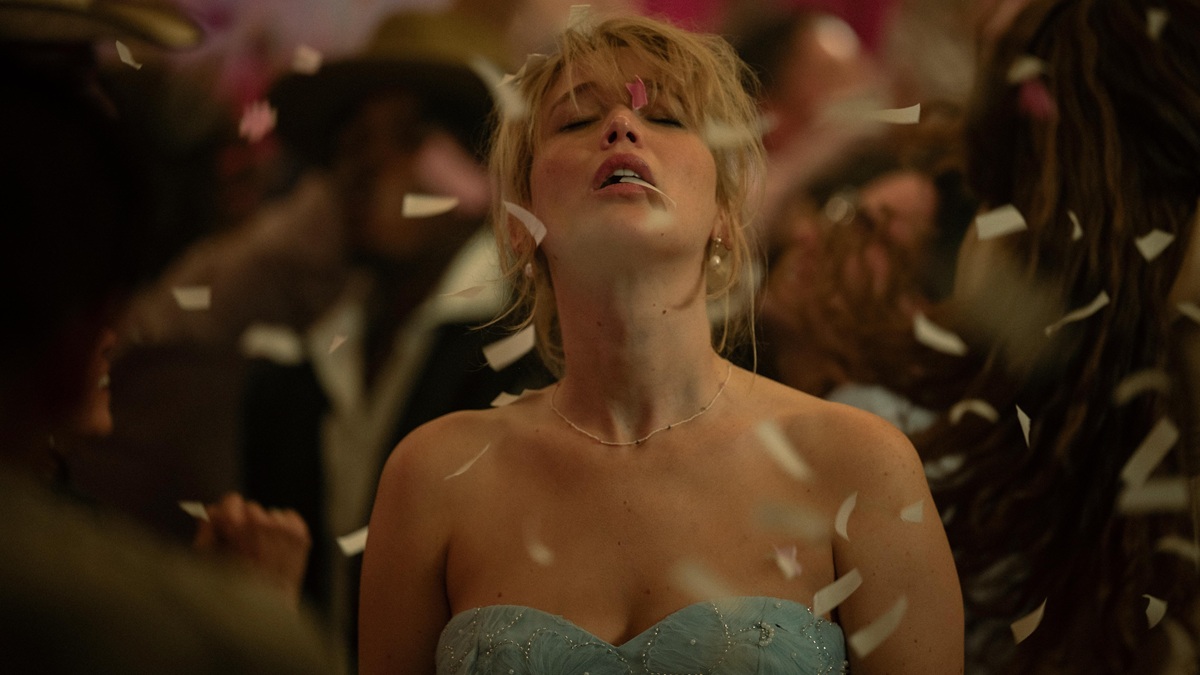
By the final act, Ramsay has fully committed to showing us Grace’s experience without mediation. The wedding sequence is masterful. It starts joyful, devolves into Jackson rebuffing Grace’s repeated requests for a kiss, and ends with Grace alone, asking the hotel receptionist to bring ice, then possibly to sing for her. She dances. She smashes her head into a mirror. Blood runs down her face. The film doesn’t explain this escalation because escalation doesn’t follow logic. It follows feeling.

‘Die My Love’: A Difficult Watch Featuring One of the Best Performances of the Year
“Die My Love” is a difficult film. It’s sometimes frustrating. It occasionally overplays its hand. But it’s also bracingly honest about how isolation, emotional negligence, and undiagnosed mental illness can combine into something catastrophic. Ramsay has made a movie that implicates the audience in the same confusion that surrounds Grace. We watch her unravel and, like everyone around her, we’re helpless to stop it.
This is exactly the kind of ambitious, uncompromising filmmaking that we need more of. Even when it stumbles, it stumbles while attempting something genuinely challenging. And when it succeeds—which is more often than not—it achieves a kind of brutal, beautiful honesty that most films about mental illness wouldn’t dare attempt.
And featuring one of the best performances of the year, Ramsay shoots madness as experience rather than diagnosis, and the result is both harder to watch and more truthful than any clinical portrait could be.

“Die My Love” was theatrically released in the United States by Mubi on November 7, 2025. Follow us for more coverage.

