I’ve been meaning to watch William Lustig’s “Maniac Cop” for some time. As a lover of the “Friday the 13th” series growing up, I’ve been trying to go through a few of these quintessential slashers from the ‘70s and ‘80s every year. And while “The Burning” and “The Toolbox Murders” weren’t perfect, they had an imperative. They found a way to celebrate their decade. “Maniac Cop,” however, did not leave me feeling the same. It stars the venerable Tom Atkins—whom I watch every year in “Halloween III” and horror icon Bruce Campbell. Yet the film is bogged down by overwriting (it tries too hard to tell a compelling story when only horror was needed) and too long a run-time at only 85 minutes. It also wastes most of its better cast and waters the rest down in cliche and stereotypes.
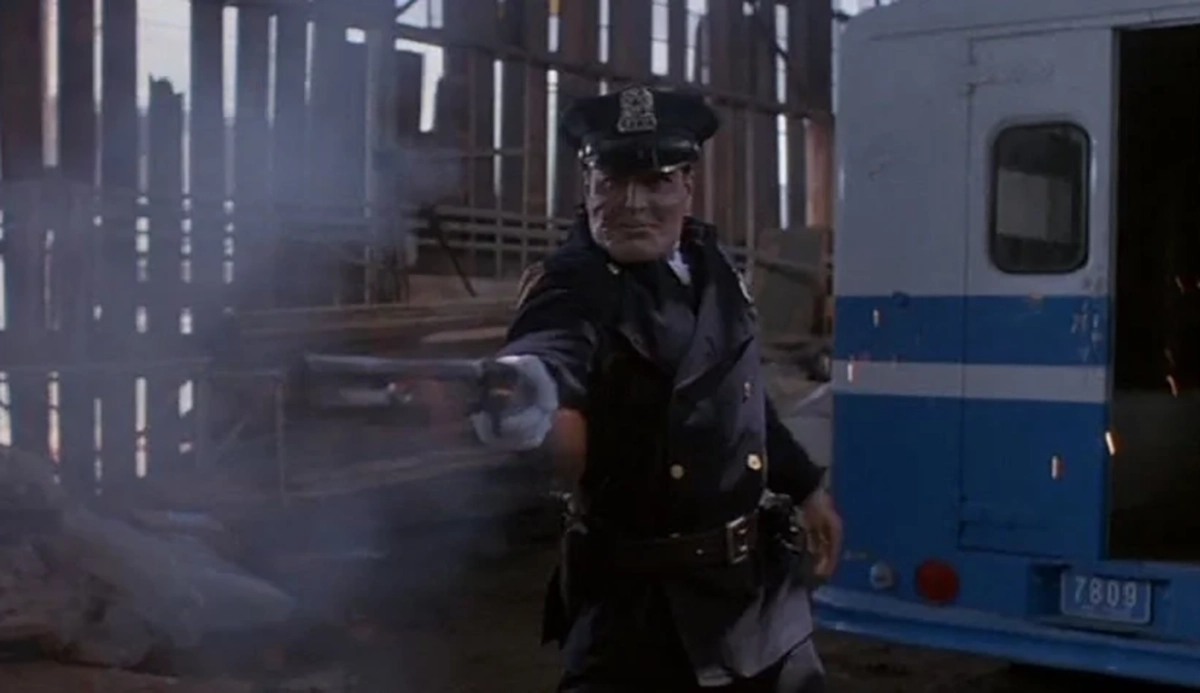
Watching this film in 1988 must have been something. I’m not sure of the exact political climate of NYC at the time, but here it presupposes a cop in uniform as someone to be respected—and, by the end, feared. I wonder if the film’s writer, Larry Cohen, was trying to make a political statement about police brutality in penning this script. Or maybe it was just an accident. Once the maniac cop starts his killing spree, people over the city start to fear cops—especially ones with white gloves. For most of the film, the creators bask the cop himself—committing the killings—in enigma. He’s tall, white, chiseled, and deformed. But we don’t really know much else about him. The opening of the film shows a pair of muggers accosting a woman for her purse. When she runs to an officer for help he strangles her and breaks her neck. The cop targets “innocent people” for most of the film’s first half.
Roundtree and Atkins Make the Film
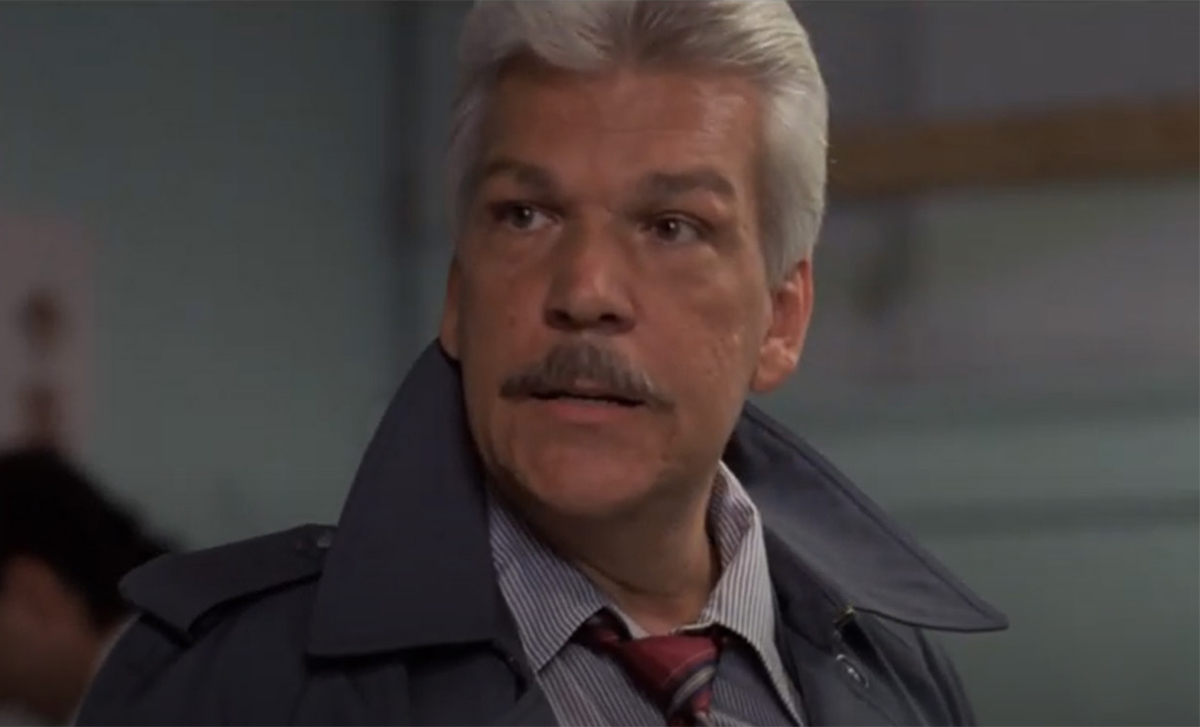
The film’s positives are its cast, which includes the aforementioned Tom Atkins, Bruce Campbell, and “Shaft” himself, Richard Roundtree, as a police commissioner. From the start, Atkins’ Det. Frank McCrae is a voice of reason. The commissioner tries to shy him away from the perp being a fellow cop, despite several eye witnesses stating the killer was a man in full police uniform. McCrae makes sense as a detective and is very likable. Atkins is six years post “Halloween III” here but looks older, more wizened. He’s once again on the trail to uncover a mystery, and I was all-in.
“Maniac Cop” also features a stellar soundtrack. It brings you into the film and is totally ‘80s, although the decade was almost over. Composer Jay Chattaway mixes synthesizers and bass beats with a darkened NYC by cinematographers James Lemmo and Vincent J. Rabe that feels like a direct precursor to the first “Teenage Mutant Ninja Turtles” movie in 1990. The way the photography hides the killer’s face (Robert Z’Dar) with upward angles, shadowed and elusive, is also key. The cop’s kills are rather milquetoast, however. One involving drying cement had potential, but I never really felt the “maniac” in “Maniac Cop.”
Where the film suffers is its attempts to build a backstory for this cop and why he’s doing this. This is a common misstep in slasher films. And the basic problem with “Maniac Cop” is it becomes a whodunnit, cop procedural after the film’s opening half hour. The film introduces another cop, Jack Forrest (played as well as the material allows by Bruce Campbell), who is having marital problems. He’s having an affair with another cop (Laurene Landon). I liked their relationship, even if it is rushed over and brusque. Another cop is then introduced (Sheree North, playing Sally Noland). And if nothing else, I do like that “Maniac Cop” introduces a number of women police officers that don’t need their hands held by its men. However, Forrest’s wife (Victoria Catlin) is written flatly and weakly, so take that as you may.
Too Much Story for a Common Slasher
What harms the film is that it abandons its slasher promise and piles plots and motives on top of its killer. He’s was a police legend who was a “shoot first and ask questions later” guy, but of course, also a “good cop.” The film also includes a number of bureaucratic types who misbelieve McCrae, Landon, and Forrest because the script demands it. The film also comments, subtly, at a police “protection code” that foreshadowed our changing views on police brutality. Campbell—who gained popularity in “Evil Dead,” released in 1981—here also seems wasted. Any sense of tough-guy status is taken away from him as a 7-foot zombie killer cop tosses him about. The film’s ending is terse and predictable, too. Its sequel plug (there would be three “Manic Cop” films) felt like it was so unsure the audience would understand, the camera reminds us for a full 10 seconds.
And while these might be minor details, what happens over the course of “Maniac Cop” is I just lost interest. I won’t spoil the film for those who haven’t seen it. However, it wastes most of the cast I liked, over-explains the story and motives of the killer, and comes up with so plausible a reason for his killings that it loses its impact and horror. There comes to mind a better “Maniac Cop” where no reason is given, where a man dressed up as an officer just lays to waste the criminals and innocents in NYC alike. I don’t know if Larry Cohen was hamstrung into the film’s narrative or just lost direction. Either way, the film lacks horror when it needed it, and at 85 minutes overstays its welcome. It’s not a total waste. But so much more could have come out of this premise, and it’s a shame it was more or less wasted here.