


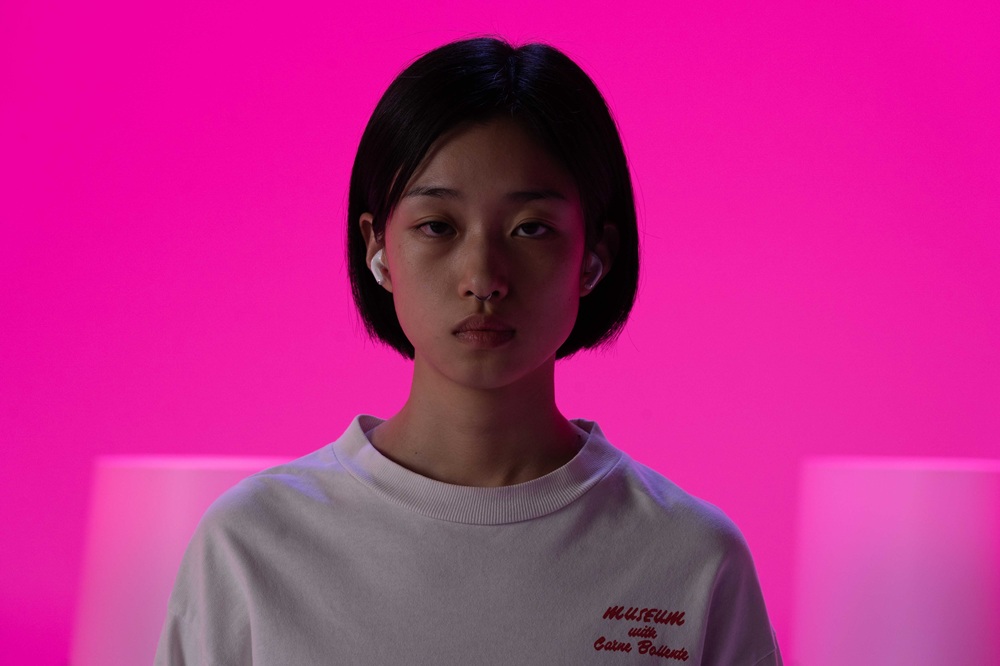
Kana can’t focus. She’s meeting a friend at a café, catching up over the kind of news that should shake her—a former classmate has taken her own life. But as her friend speaks, Kana drifts. Her attention is split between the conversation at her own table and the one growing louder at another, where men discuss patriarchy and spew casual misogyny without a second thought. Yoko Yamanaka’s latest film, “Desert of Namibia,” does something remarkable here: through layered sound design and overlapping subtitles, we hear both conversations clearly, yet fully absorb neither. Kana, and by extension the audience, is caught in a fog of words and distractions.
It’s a moment that encapsulates “Desert of Namibia” in its entirety—restless, unfocused thoughts, emotional distance, and a protagonist who floats through life without ever fully engaging.
A Slow Burn in a State of Suspension
Yamanaka’s film is a slow burn, one that echoes the patient storytelling of “Drive My Car”—right down to its delayed title card, which doesn’t appear until nearly 45 minutes in. But where that film was about processing grief and finding meaning in loss, “Desert of Namibia” lingers in a much murkier space: the restless, weightless feeling of being adrift, neither moving forward nor fully stopping.
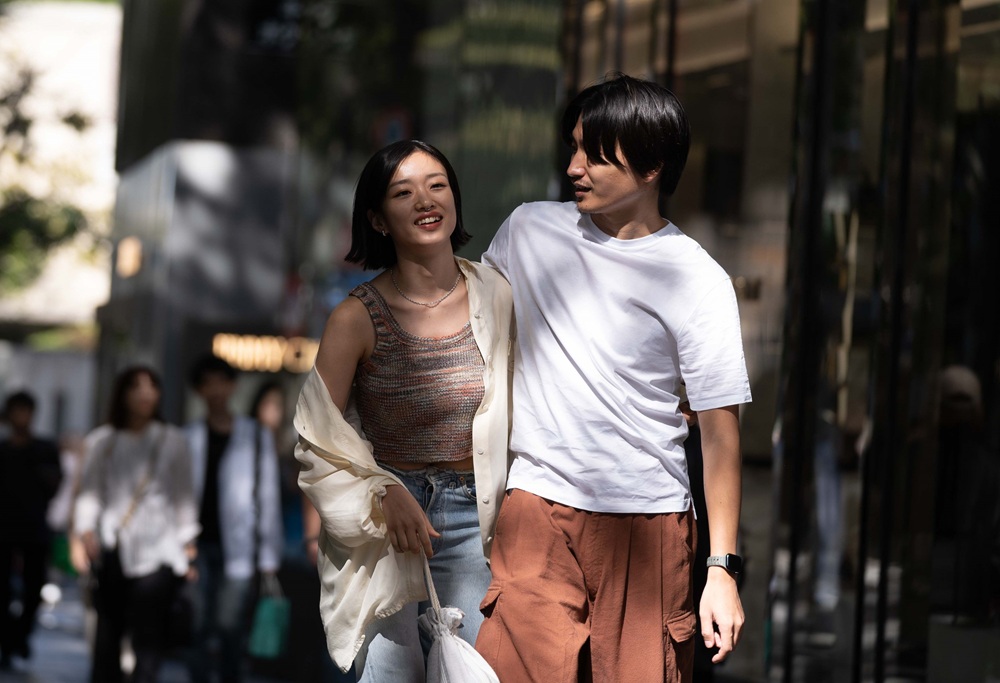
Kana (Yuumi Kawai) is 21, working at a beauty clinic, and balancing two relationships—one with the stable but uninspiring Honda (Kanichiro), and a clandestine fling with the free-spirited but volatile Hayashi (Daichi Kaneko). It’s less a love triangle than a series of half-hearted attempts to shake herself awake, as she drifts between them, hoping something will finally make her feel something.
The Weight of an Empty Landscape
The title, “Desert of Namibia,” is a strange choice for a film so deeply steeped in Japanese life, but that strangeness is precisely what makes it work. The desert itself only appears briefly in a documentary Kana watches in passing, but it lingers in her mind—and in ours. It’s a landscape defined by absence, where survival is harsh and sustenance is scarce. The metaphor is almost too on the nose, but it’s effective: Kana, too, exists in a kind of emotional wasteland, watching life happen from a distance but never fully stepping into it.
There’s also an irony here: deserts aren’t truly lifeless. Beneath the surface, hidden ecosystems persist, just as Kana—despite her detachment—is still searching for something real. Yamanaka doesn’t give us a clear answer as to what that is, but that ambiguity is part of what makes the film so hypnotic.
At the center of all this is Yuumi Kawai, whose portrayal of Kana is a livewire of emotion and electric in its unpredictability. She plays the character with an erratic energy that vacillates between euphoric, hangry, sensate, dissociative, hyperactive, and depressive—all without over-explaining any of it. Kana is not an easy character to pin down, nor is she always likable, but Kawai finds a way to make her feel alarmingly real. Whether she’s impulsively throwing herself into a new relationship or staring blankly at a world that no longer registers, Kawai ensures that even in Kana’s stillest moments, there’s something roiling underneath.
The Unflinching Look at Toxic Relationships
Yamanaka doesn’t shy away from the ugliness of these dynamics either. Kana’s affair with Hayashi begins as an escape but quickly turns into something far more destructive, built on grand declarations like, “I think we can help each other grow.” The reality, of course, is much bleaker. Their relationship spirals into emotional and physical conflict, captured with a detached, almost clinical eye that makes it all the more unsettling. Meanwhile, Honda, oblivious to Kana’s infidelity, represents a different kind of trap—a life of quiet stability that she resents, even as she fails to recognize the structure it provides.
Some scenes are hard to watch, while others toe the line between raw and unintentionally comedic. The film’s tonal control slips at times, especially in its repetitive depictions of Kana and Hayashi’s downward spiral. But even when “Desert of Namibia” stumbles, it remains gripping, not because it offers grand revelations, but because it captures something truthful about the way people sabotage themselves—how they reach for things they know will hurt them, just to feel the impact.

Yamanaka’s Style: Between Observation and Surrealism
Yamanaka, who made her debut “Amiko” as a teenager, brings a sharp observational eye to this follow-up. “Desert of Namibia” exists in that delicate space between detached realism and simmering surrealism. The film is largely grounded, too. Handheld camerawork lingers on Kana as she moves through Tokyo’s streets, long takes emphasize the weight of everyday interactions, and quiet moments of solitude stretch out, forcing us to sit in her aimlessness. At times, it feels almost documentary-like, as if Yamanaka is merely observing rather than shaping Kana’s world.
But beneath this realism, something more stylized is at play. There are moments where the film slips into abstraction—a suffocating pink room, a violent argument replayed on a phone screen like a scene within a scene—that hint at Kana’s fractured mental state. The final act fully embraces this detachment, culminating in a meta-textual moment that acknowledges the film’s own slow, meandering rhythm. It’s an unexpected, even darkly funny shift, though whether it deepens the film’s impact or merely underlines its indulgences depends entirely on the viewer’s patience.
‘Desert of Namibia’: A Story That Doesn’t Offer Closure
If there’s a flaw in Yamanaka’s approach, it’s that the film’s meandering nature occasionally veers into aimlessness. Its refusal to tie up loose ends is likely intentional—after all, real life doesn’t always offer closure—but that doesn’t make it any less frustrating. The film ends on an unresolved note, not so much concluding as simply stopping, leaving us with more questions than answers. For some, that ambiguity will feel profound. For others, it may just feel like an incomplete thought.
Still, for those willing to sit with its quiet, messy truths, “Desert of Namibia” offers a deeply felt, if sometimes exhausting, meditation on emotional inertia and the search for meaning in a world that rarely provides it.

“Desert of Namibia” screened in this year’s First Look, the annual film showcase of the Museum of the Moving Image (MoMI). The festival runs from March 12 to 16, 2025. Follow us for more coverage.

