


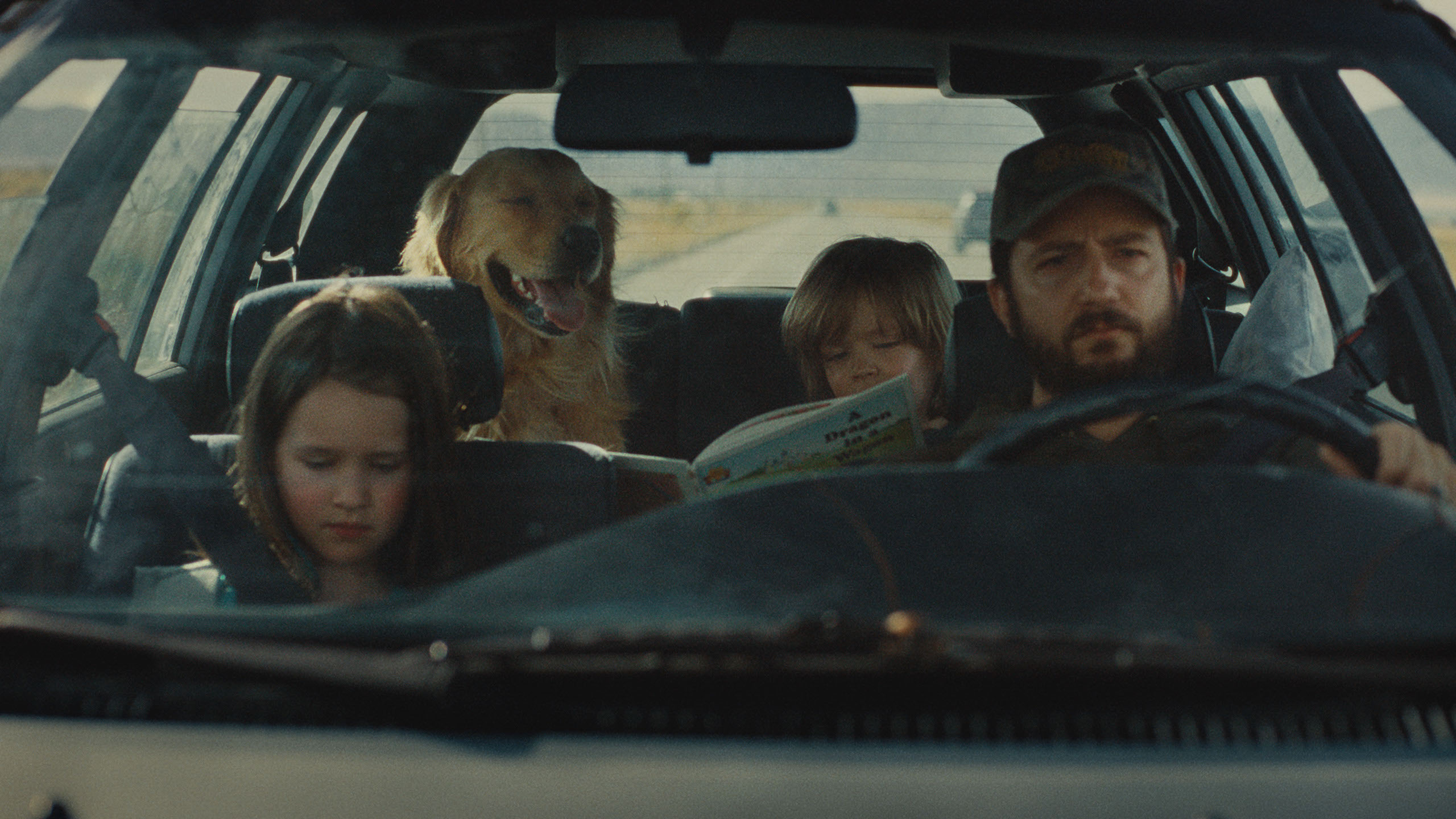
A man wakes up his kids, a daughter and a son, to take them on a trip. The kids don’t know where exactly they are going. But sooner rather than later, details will be revealed. And it will not be easy to swallow. This so-called trip will be more of a departure than a few days of joy and happiness. This is the simple premise at face value that Cole Webley’s “Omaha” (screening at the 2025 Sundance Film Festival in the U.S. Dramatic Feature Competition) has. It develops into something more substantial as it goes, albeit garnering some fluctuating storytelling decisions that took me out of the film and its emotional weight.
Scenes of Remembrance and Melancholy
Scenes of remembrance and melancholy are played on a more dramatized level instead of dwelling on a grounded nature. There is an intention behind this decision. Webley wants to cut deeper and disrupt the viewer by creating a new flow. However, this causes a strange effect that Webley does not wish to. It works against his story rather than adding a positive note to it. There are some things that Webley prompts along the way that spark some intrigue. For example, the themes and topics he covers—the 2008 housing crisis in the United States and the Safe Haven law implemented in Nebraska—have not been covered that much in recent history, at least to this degree and introspection.
In addition, they are contemporary and relevant to today’s age, even nearly crossing almost a decade of this occurrence, due to the difficulty of people worldwide not being able to afford appropriate housing for themselves and their kids. The completely fractured economy, rapidly submerged by a president making one ridiculous decision after another, is causing many to live complex lives. Webley explores this duality between 2008 and the present day with a story that interlaces a father’s personal struggle to search for a new, better life for him and his kids with the border socio-political landscape of families being caught in the whirlwind of a world-shattering itself into oblivion.
In between stability and confrontation lies John Magaro’s lead character—the father in the picture—who decides to make this desperate move to save what he loves the most: his children. This act pierces his heart more than anything he may have experienced. The father continually bleeds throughout the entire film until he bursts into a shell of himself. He is left with nothing but knows his kids are safe and sound. “Omaha” plays with the audience’s heartstrings, even through its questionable storytelling decisions, becoming a “Sundance winner” if there ever was one, on the level of “Boyhood,” “Little Miss Sunshine” (to which there is a light aesthetic similarity in its soundtrack–more on that later), and, most recently, “A Real Pain.”
Cole Webley Introduces ‘Omaha’ with Subtlety and Slight Foreshadowing
The first shot of “Omaha” is that of a dark room. Magaro’s smooth, calm voice tells his daughter, Ella (Molly Belle Wright), to wake up and pack her essentials. He asks her to grab the first things she would keep if they moved that instance. Ella takes a picture of her mother, who is currently not in the picture, and later reveals that she has passed, leading the audience to believe that this trip will break everyone’s heart, including the viewers. She holds this photograph as if it were from a time long past. Their present is broken, and a new, unknown path—traveling from one state to another, stopping and going to different locations that paint a picture of remembrance and longing for a better life—is in sight.
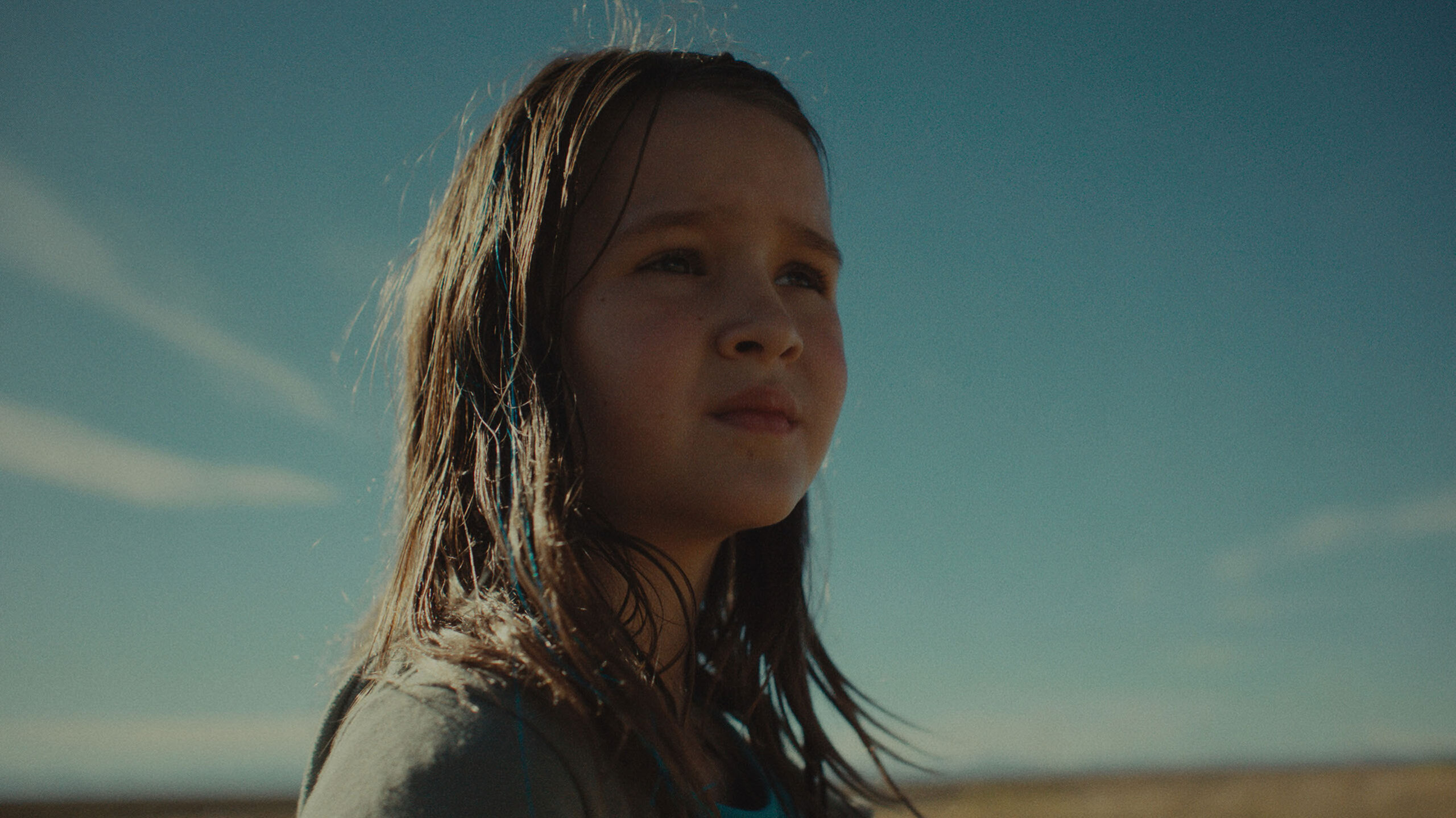
When they leave the door, a police officer stops him. She says their property will be taken from them because of unpaid bills. With a saddened face of a million sorrys and a thousand goodbyes, he walks up to the car to try and put up a facade to mask his emotions and make his kids not worry or be aware of his intentions on this trip. By this mere introduction, the audience already gets the gist of it, a minor fault that somewhat stains the emotional weight of “Omaha.” However, since the performance by Magaro is so convincing and moving, you stay along on this trip, even though you know this will end up with a gut punch.
That is how Cole Webley introduces his film, with subtlety on one hand and slight foreshadowing on the other. This simple trick works wonders on indie flicks about troubled parenthood or flashbacks of a fractured childhood. Take Charlotte Wells’ excellent debut “Aftersun” for example, to which Webley’s picture has some similarities. This “trick” has helped many directors put the final nail in the coffin of their features’ emotional tangibility. They work with the audience in many ways, mostly in their favor. While there are a few quibbles in “Omaha” that arise from a separation of this sensibility between subtlety and foreshadowing, Webley makes sure to stay clear of any false emotions or cliched moments from films covering these topics, aside from one scene near the film’s climax.
John Magaro is One of the Best Acts in American Independent Cinema
“Omaha” is set around 2008, during the housing crisis that plagued the status of those living in that day-by-day hustle. Many resorted to seeking out other places where they could reside. They moved from one place to another in search of opportunity and an escape from this societal injustice surged by inflation and governmental abuse. Others did the same yet left their children in hospitals around Nebraska under the ‘Safe Haven’ law, which allows people to surrender their babies and children up to ninety days old without fear of prosecution. At first, this law was made to protect infants. However, there were many cases where people left their children over the age of five, eight, or even ten years old.
What would drive a father or mother to do this? Leaving behind their kin, never to see them again? It is heartbreaking just thinking about it. This is what Ella and Charlie’s (Wyatt Solis) father faces in this film. Across a cross-country trip, their father takes his kids to Nebraska while on the drive, contemplating if he should or shouldn’t go with the action of leaving them behind. He bears a saddened face as he masks his intentions. The kids slowly realize something is wrong when they see their social security cards and birth certificates in a hidden folder. The eldest kid, Ella, notices by minute details that her father is keeping some secrets. There are details in his expressions, which Magaro delivers so well and very acutely that she can easily see them.
With this performance, John Magaro proves he is one of the most talented actors in independent American cinema. By just being so damn good at expressing the inexpressible, Magaro shares a beauty behind the silence of his characters. He has a way of doing the most minimal things. Magaro says very few words and lets the audience know everything he is going through emotionally and psychologically through his face and eyes. Magaro continually rises to the occasion and often steals each scene with grace and poise. It was difficult for him to do so in Celine Song’s “Past Lives.” However, in each scene, he destroys you. In “Omaha,” you have that for an entire run-time.
A Tonal Dysfunction in its Happy-Go-Lucky Soundtrack
During the film, Webley does a couple of segways that serve as happy-sad moments, whether to a local zoo or a supermarket to buy Lunchables, to get the kids to stop thinking about the destination (the separation) and enjoy these last few moments with their father. Thematically, they do fit with the story properly. These scenes give way to these internal emotions that will soon be fractured by heartbreak. They are moments of bliss that also serve as a farewell, which stings plenty. However, most of them have an odd song choice attached to them that takes you out of the experience due to the mismatch in tone and tune. Sometimes, it is a rock track backing the scene; in others, it is a melodic pop joint.
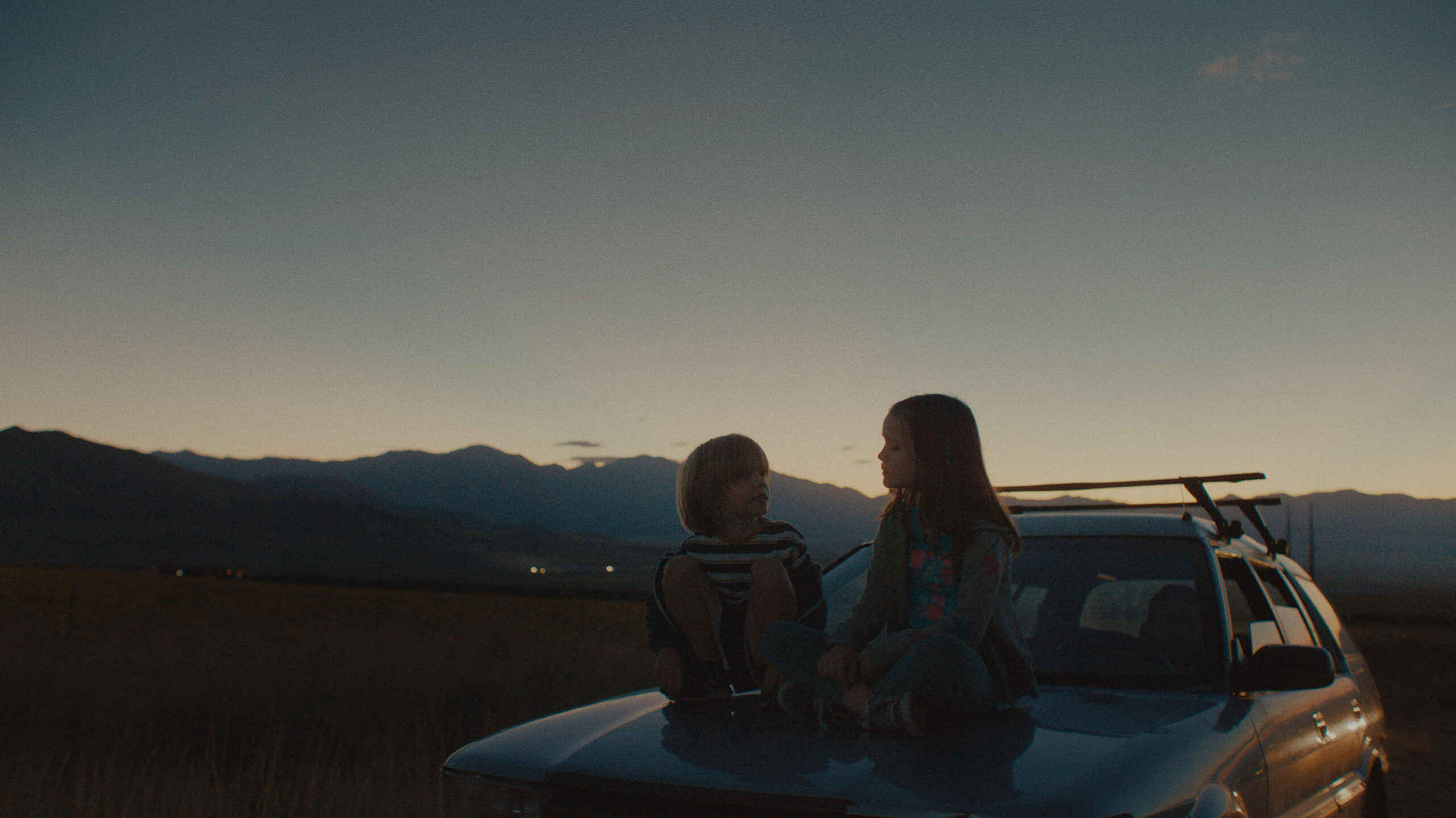
No matter the genre, they do not fit with the story or its themes. These songs turn a powerful scene or image into an unnecessarily sappy and kitsch one. This happens in the aforementioned Sundance hit, “Little Miss Sunshine,” which I dislike. (Side note: “Omaha” is a far better and tonally organized picture than “Little Miss Sunshine.” The latter is more focused on providing a deeper lens into the fall of American society. It shows how people cope with it. They occasionally do acts of desperation to save what little they have or the people and things they love. The former utilizes an imagined version of such, bolstering fakery through syrupy scenarios, tacky dialogue, and odd character traits that all feel incredibly distant from our world.)
The film drowns sad moments in comedy or happy-go-lucky tunes that give the film a sense of faux joy. It makes us feel the opposite of what Cole Webley in “Omaha” and Valerie Faris and Jonathan Dayton in “Little Miss Sunshine” want to convey. These scenes are few and far from the main narrative thread. But still, they do tend to bother me plenty, although not as much as one of the last scenes in the film, where Webley decides that Magaro’s character must have a scene where he belts out his frustration upon his decision. In a coffee shop, the father starts screaming and throwing objects in the locale after doing the act that he has contemplated whether or not to do.
A Faulty Climactic Scene That Breaks the Film’s Silence
His inner bottle has broken. He can’t contain the bleeding. Sadness and angst are all over the floor. Although you expect this to happen, there are other ways of portraying this disruption. There’s no need to tend to the classic screaming match scene when “Omaha” basks and thrives off its silence and the inexpressible—showing, not telling, or, in this case, screaming. Think about “Aftersun” for a second. Paul Mescal’s Calum is on a trip with his daughter, Sophie (played by Frankie Corio), on one of their last trips together. Sophie, like Ella, does not know. But she suspects something is wrong and her father won’t be with her much longer. Calum’s melancholy and angst are not expressed in one of these screaming matches or a talkative scene.
Instead, Wells does an ultimately staggering sequence, backed by a remixed version of David Bowie and Freddie Mercury’s ‘Under Pressure’ (oh, does that song hit differently after “Aftersun”), that its imagery tells the entire story–expresses the inexpressible, hits its thematic core while gut-punching us hardly with no way of escape. Webley could have found a different or creative way to show us the pain this father is going through without the need for words or a highly dramatized scene. This may be nitpicking on my part. However, I believe there is a way of concluding a story deeply by relying on silence and hidden desolation.
These two elements—the odd soundtrack choices and this coffee shop scene–make “Omaha” a quite soft entry into the festival instead of the poignant piece about fatherhood, the American housing system, and abandonment it wants to be. Its heart is pure, and Cole Webley crafts his film with care, maybe too much care. Nevertheless, you’d wish that directors, particularly American independent ones coming to the scene, trusted the audience enough to leave their cards hidden from the viewer, not showing them at each given opportunity. This is neither a terrible nor a mediocre film, primarily thanks to the performances leading the way. However, it is disappointing due to the use of tacky tactics to move the audience in key scenes. The same thing happened with “Little Miss Sunshine.” And, instead, unfortunately, now history repeats itself in “Omaha.”
“Omaha” screened at the 2025 Sundance Film Festival in the U.S. Dramatic Feature Competition.

