



While overstuffed story-wise, Barry Levinson’s “Disclosure” holds up over the years due to its performances and fealty to its source material. Michael Crichton would gain worldwide acclaim a year earlier when Steven Spielberg turned “Jurassic Park” into a Box Office phenom. That film’s success, however, worked to shed light on Crichton’s earlier works. “Disclosure” hit the bookshelves in 1994 and became a movie the same year. The film uses Crichton and Paul Attanasio as writers, and it shows in its closeness to Crichton’s original story. As a novel about a tech exec set up to fail by higher ups, it’s exciting. But “Disclosure” earns ultimate kudos as a cinematic parable that flips the sexual harassment script on its head. By following its lead, Tom Sanders, after sexual harassment by a woman, we see the ugliness women who go through this affair have dealt with for time immemorial.
For the 1990s, “Disclosure” follows suit by showing the burgeoning tech world through its makers’ minds. Like “The Net”—released a year later—email, computers, and virtual reality are on full display. The way Levinson and Crichton envision them taking over our lives is endearing and quaint. This is especially true in one scene that playfully mocks the foot-long cell phones as being ‘too big,’ even as they’ve come quite a way since the ‘80s. Spinning ‘e’ symbols on boxy computer terminals indicate an incoming email. Tom Sanders (Michael Douglas) is a tech executive we garner makes a decent salary. His company, DigiCom, is merging with another and he assumes he’s up for promotion. That he’s not the one the company has in mind is only the first of many subversions this film has in store.
Sexual Harassment Amidst a ’90s Tech Thriller
“Disclosure” lives in a patriarchal world that, until the “me too” movement, operated without question. Sanders has a wife he cares about, but doesn’t think twice about patting his secretary’s butt with a file folder as normal office banter. He isn’t really a bad guy and probably doesn’t think he is either. We glimpse a conspiracy to pass Sanders over for promotion, though, and have him take the fall for a number of production line problems. Sanders has always cared for the ‘little guys’ in production, though, which comes into play later. His colleagues (Dennis Miller, Nicholas Sadler) make sexual innuendos towards women in the office. It’s par for the course. That is until Sanders’ boss (Donald Sutherland) promotes a former flame of Sanders to the VP spot he was eyeing. Meredith Johnson (Demi Moore) is quick to assert herself as the ‘take no crap’ female exec she must.
Where “Disclosure” had the danger of falling into a dramatic or court-based thriller depicting a sexist male’s anger explosion at being passed over, that’s not the story Crichton decided to tell. Here, Meredith Johnson is part of a trio of conspirators that seek to destroy Sanders, except she takes it too far. At a late night meeting she sets up, she forces herself on—and sexually harasses—Sanders in a steamy scene that makes him seem less a victim than it ought. Moore and Douglas are in command of their characters. And when she, the next day, accuses Sanders of sexual harassment after he declined her advances, it sets up a reverse stereotype scenario.
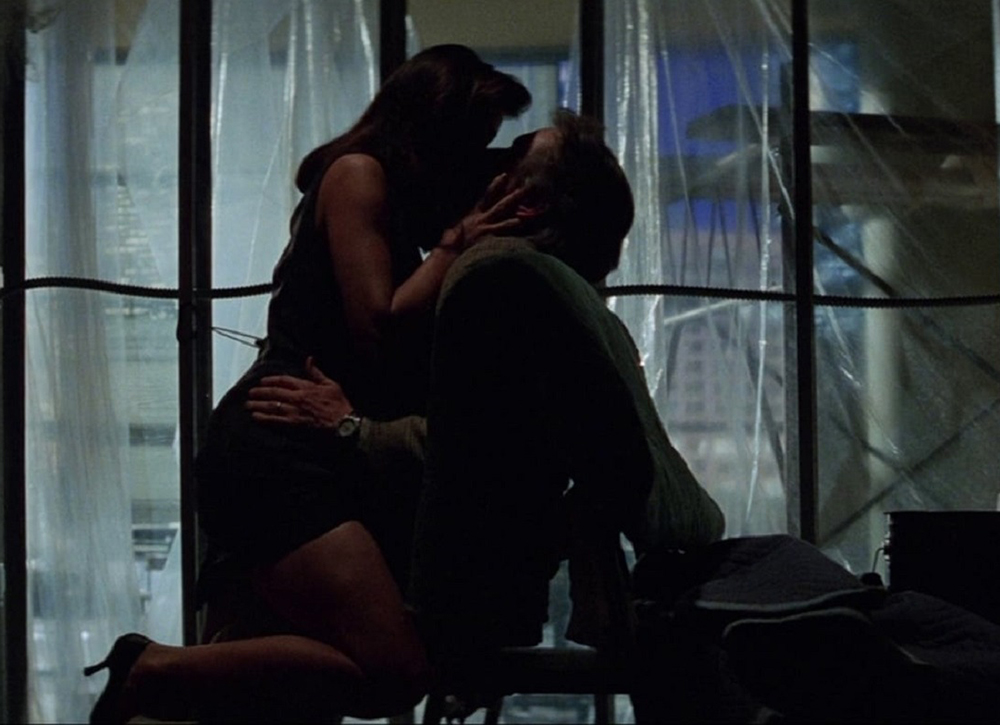
“Disclosure” works because it isn’t preachy. It’s a ‘90s corporate espionage thriller that includes sexual harassment, instead of that being its sole focus. In that way, it feels—sometimes—too much like something somebody cooked up. Which of course Crichton did. However, amidst this, it allows us to understand something many of us have no experience with. Those that do know better. Sanders’ life soon spins out of control. Realizing something mischievous is going on, he hires a lawyer (an excellent Roma Maffia) and is dragged through the mud as the sexual assault is mediated. His wife, played aptly by Caroline Goodall, goes through understandable emotions: can I support my husband when he hid this from me and I find out how utterly sexual it was until he changed his mind?
Sometimes ‘Disclosure’ Feels Like a Book
The mystery behind what’s happening to Sanders is explained, somewhat, by what we can see. Johnson—along with two others: Bob Gavin (Sutherland) and his cohort Philip Blackburn (Dylan Baker)—conspire behind Sanders’ back. There’s a lot of tech filler, but Crichton and Paul Attanasio tone it down for movie audiences. Like “Jurassic Park,” most of the hyper-complex science and industry stuff is left by the wayside. Honestly, that’s a shame, as it was one of the more interesting parts of “Disclosure” the book. You actually felt you were in the tech world working with computer chips and assembly lines amidst its sexual tension. A shaky alliance Sanders has with another co-worker (Mary Anne Hunter), adds some mystery and intrigue.
The actors are all good here and carry us along. The most screen-time lands on Douglas, and he handles the material well. He was on a roll in the ‘90s, this film sandwiched between “Falling Down” (1993) and “The American President” (1995). But Moore preforms aptly aside him. She’s dangerous towards the film’s first half and desperate later as the film spirals on. Miller, Maffia, and Goodall support the cast, with even Sadler turning in memorable scenes. Of the costars, Maffia probably packs the most punch.
Douglas Leads a Winning Cast
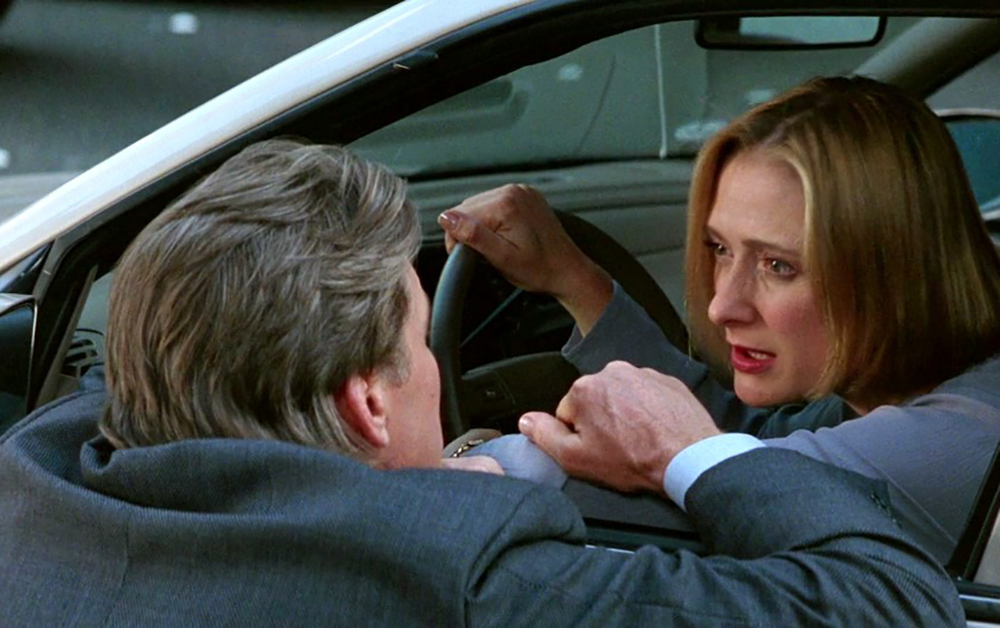
Yet, amidst it all, intentional or not, Crichton and Levinson give us a takedown of workplace sexual harassment we weren’t expecting. The questions Sanders confronts are hard—harder so as he is part of a patriarchal system he’s never suffered from. He’s treated like so many women we’ve seen in proceedings like this: doubted, disparaged, and threatened. “I’ve never even heard of a woman sexually harassing a man” one character utters, and the effect it leaves behind is stark. Yet the female characters in the film—aside Johnson—are all supportive and sympathetic. Sanders learns some important lessons along the way. And by the time he apologizes for his inappropriate flirtation towards his secretary (Jacqueline Kim), we believe he’s learned something. “Disclosure” has much to teach us if we let it.
“Disclosure” holds up well. As a tech thriller, it’s on par with “The Net,” despite that film’s jump into the dramatic with murders and coverups. It gets a little too ambitious along the way (sexual harassment on top of corporate scheming, etc.) but has its heart in the right place. And aside criticism I’ve read that the film doesn’t age well—particularly dealign with male patriarchal attitudes—I’d argue that’s the point. “Disclosure” is effective entertainment. But if you get upset at the way that Tom Sanders is being railroaded and the way his name is dragged through the mud, it doesn’t matter that this happened to a man. You can understand what it feels like to see it happen to a person, creating empathy along the way. It ends the only way it can and is progressive for the times. That alone may save “Disclosure” from obscurity.
“Disclosure” is available to watch from most streaming services.


1 Comment
Just watched it in May 2026 – and I’d agree with this review. Standing sexual harassment on its head must have been a little unusual 32 years ago. Clearly the Michael Douglas character was going to “win” in the end, but there were several twists along the way (as well as an interesting open-plan set of offices).
The character of Demi Moore has plenty of tough comments about women in senior executive positions, too. Well worth watching, even if women in CEO positions is now more frequent and accepted. Australia has just appointed a three-star female soldier as the head of our army and the new civilian head of the Defence Department itself is a woman (moved from head of the Industry Department).