

Close Menu
    Facebook X (Twitter) Instagram
    Friday, March 6
    Facebook X (Twitter) Instagram Bluesky
    The Movie Buff
    • Home
    • About
      • Critics
      • Press & Testimonials
      • Friends of the Buff
      • Terms of Use
      • Thank You!
    • Film Reviews & Coverage
      • Movie Reviews
      • TV/Streaming Reviews
      • Film Festival Coverage
      • Interviews
    • Podcasts
    • Indie Film
      • Reviews & Articles
    • Advertise
    • Contact
      • Write for us
    The Movie Buff
    Drama

    Review: And Then Home: Wenders Channels Ozu to Show One Man’s ‘Perfect Days’

    Kevin ParksBy Kevin ParksJanuary 15, 2024No Comments4 Mins Read
    Facebook Twitter Pinterest LinkedIn Tumblr Email Copy Link
    Perfect Days
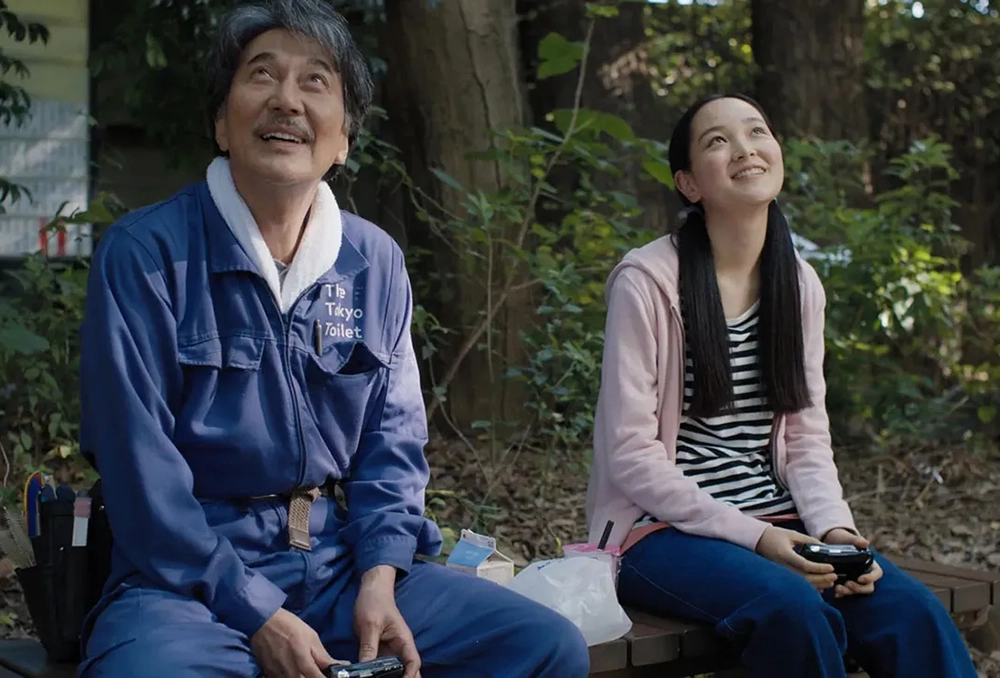
    Koji Yakusho and Arisa Nakano in "Perfect Days." (Photo: Master Mind).
    Share
    Facebook Twitter Email Copy Link

    Hirayama’s on the road, off to clean some toilets. The soundtrack, a cassette tape, preferably The Kinks, Patti Smith, or Loud Reed. For lunch: a sandwich in the park, then after a solo ramen dinner, nod off reading Faulker or Highsmith. Such is the life of the solitary Hirayama (Koji Yakusho) and his routine mirrors the controlled, contemplative inner lives of plenty of Wim Wenders’ heroes. Then again, Hirayama’s no Travis Henderson (“Paris, Texas”), who abandoned his family and wandered for years or Jonathan Zimmerman (“The American Friend”) a terminally-ill man with an ominous friend named Ripley. Wenders’ direction maintains a low profile to suit his man in Tokyo, introducing enough tension to rattle Hirayama but never passing judgment on him for staying the course. Hirayama’s calm demeanor reveals rather than withholds, and the stripped-down style heightens the self-contained perfection that he seeks out each day.

    Wenders’ unobtrusive austerity matches that of his protagonist, and the early scenes flow with a gentle, peaceful energy. Nothing appears extraordinary about Hirayama, a man who lives alone and savors that first breath of fresh air he takes before the morning commute to work. But, understanding Hirayama through his quiet inner life does generate some unspoken tension about what would happen if his repetition was derailed. Wenders does introduce some clues into a distant past his hero is avoiding, but it unfolds cautiously, without a major jolt. Splitting the difference between an aging Yasujirō Ozu widow and the piano savant turned slacker runaway Bobby Dupea (“Five Easy Pieces”), Hirayama’s a new kind of rebel, someone who opts to live in isolation surrounded by the companions who matter most to him: music, work, food to live.

    Wenders the documentarian

    Hirayama does have a family, but Wenders keeps the details spare. It’s only when Hirayama’s niece shows up at his doorstep that his family story hazily emerges into focus. This casual bend towards melodrama doesn’t sink the film. Instead, it’s a brief and telling challenge to the introspective lens of the main character and, for that matter, the audience. Yakusho is the right man for the job, and he’s a dynamic lead despite having so few lines. His expressive gaze carries much of the film, earning Yakusho the Best Actor prize at Cannes. Hirayama works hard—on his feet all day, mostly working solo, scrubbing and moving aside when nature calls for others—and plays hard (in his own way). Wenders the documentarian is skilled at evoking the sights, smells and sounds of Hirayama’s Tokyo. 

    It’s an honest, truthful depiction of a full life, following someone who lives alone but is far from a hermit. A man of few words, he inspires consternation from his co-worker (“Hirayama doesn’t like to talk”) and curiosity, even admiration from his colleague’s girlfriend (who wants the Patti Smith tape) and his own niece (who asks to join him at work, and essentially shadow him for the day). The generational conflict and knotty family ties again evokes Wenders’ hero Ozu, particularly how the camera’s sympathy leans towards the wiser, world-weary Hirayama. Not much happens during his days, but that he can choose what to do with his time means everything. Instead of explaining this, Hirayama and Wenders show the tangible pleasure—abundant grins, deep breaths, and lounging—and Lou Reed does the talking, describing in song his version of ideal day (“Drink sangria in the park/and then we go home.”)

    Temperate doses of joy

    Perfect Days
    A scene from “Perfect Days.” (Photo: Master Mind).

    Perhaps the song’s refrain, however, of “You’re going to reap what you sow” provides greater insight into Hirayama’s outlook. Hirayama isn’t perfect, but he’s got control over his life, and curates each moment to his tastes, reporting only to himself  Blocking out the noise, though, means carrying around a protective shield from the wider world, and when Hirayama contends with his past life (specifically, his niece and her mother/his sister), the messaging seems too predictable. Although, perhaps the plot twist needs to be forced on the audience as unwillingly as it was foisted on Hirayama. Wenders’ film—on the Academy Awards’ shortlist for ‘Best International Feature’—is more effective when it knows its limits. And like Hirayama, it follows the same script on repeat. Banal for some, it’s bliss for Hirayama, this series of humdrum tasks and temperate doses of joy into a life that’s imperfect to everyone besides him. 


    “Perfect Days” had a limited release in New York and Los Angeles, and is set for a February 7th theatrical release. 

    Arisa Nakano happiness janitor japan Koji Yakusho Oscars Wim Winders world cinema Yasujirō Ozu
    Share. Facebook Twitter Pinterest LinkedIn Tumblr Email
    Previous Article24 in 24: DAY ONE – Iconic Series Starts with a Bang. *Explosion
    Next Article Sundance 2024: Our Most Anticipated Films from the Festival
    Kevin Parks

    Kevin is a freelance writer and film critic who lives in New York. His favorite director is Robert Altman and he dearly misses Netflix's delivery DVD service.

    Related Posts

    Drama March 4, 2026

    ‘Rosemead’ Review: A Mother and Son Stare Down the Barrel in a Tragic Eye-Opener

    Independent March 2, 2026

    The Short Film ‘Jam Boy’ by Sriram Emani is Rich with Culture and Social Commentary

    Horror March 2, 2026

    ‘Scream 7’ Review: A New Chapter as the Franchise Rewrites the Rules

    Drama March 1, 2026

    “Wuthering Heights” (2026) Review: A Preposterous Retelling, Rich in Aesthetic Yet Weightless in Text

    Horror February 28, 2026

    Why Do We Keep Returning to the ‘Scream’ Films?

    Action February 26, 2026

    ‘Man on Fire:’ Violent and Unforgiving, but Features Both Denzel and Fanning at their Best

    Leave A Reply Cancel Reply

    Latest Posts

    ‘Rosemead’ Review: A Mother and Son Stare Down the Barrel in a Tragic Eye-Opener

    By Vidal DcostaMarch 4, 20260

    The Short Film ‘Jam Boy’ by Sriram Emani is Rich with Culture and Social Commentary

    By Mark ZiobroMarch 2, 20260

    ‘Scream 7’ Review: A New Chapter as the Franchise Rewrites the Rules

    By Holly MarieMarch 2, 20260

    “Wuthering Heights” (2026) Review: A Preposterous Retelling, Rich in Aesthetic Yet Weightless in Text

    By Hector GonzalezMarch 1, 20260
    • Facebook
    • Twitter
    • Instagram
    • YouTube
    Indie Film Highlights

    ‘Rosemead’ Review: A Mother and Son Stare Down the Barrel in a Tragic Eye-Opener

    By Vidal DcostaMarch 4, 20260

    “Rosemead” is based on “A dying mother’s plan: Buy a gun. Rent a hotel room.…

    The Short Film ‘Jam Boy’ by Sriram Emani is Rich with Culture and Social Commentary

    By Mark ZiobroMarch 2, 20260

    Review: Rough Sex and Rougher Relationship Dynamics Intertwine in the Risqué ‘Pillion’

    By Vidal DcostaFebruary 24, 20260

    Interview: Filmmaker Sriram Emani on Exploring Self-Erasure and Breaking Patterns in his Debut Short ‘Jam Boy’

    By Vidal DcostaFebruary 20, 20260

    Acclaimed Violinist Lara St. John Talks About ‘Dear Lara’ Doc in Post SBIFF Interview

    By Mark ZiobroFebruary 16, 20260
    Spotlight on Classic Film

    ‘The Innocents’ Review: One of the First Haunted House Films of the Modern Horror Era

    ‘Gone With the Wind’ Review: Epic Film from the Golden Age of Hollywood

    ‘The Count of Monte Cristo’ QCinema 2024 Review: A Thoughtful, If Rushed, Study of Revenge and Redemption

    ‘Thirteen Women’ Review: A Precursor of the Slasher Genre, with a Devilishly Divine Femme Fatale at its Helm

    The Movie Buff is a multimedia platform devoted to covering all forms of entertainment. From Hollywood Blockbusters to Classic Comfort faves. Broadcast Television, on-demand streaming, bingeworthy series'; We're the most versatile source.

    The Movie Buff is also the leading supporter of Indie film, covering all genres and budgets from around the globe.

    Facebook X (Twitter) Instagram YouTube LinkedIn TikTok
    Copyright @2011-2025 by The Movie Buff | Stock Photos provided by our partner Depositphotos

    Type above and press Enter to search. Press Esc to cancel.