


Approaching Andrew Haigh’s bewitching “All of Us Strangers,” it’s best to submit to the film’s every whim. This intimate, heartbreaking fantasy centers around an irresistible premise: what if we had more time with someone we lost? Taking it further, Haigh (45 Years) cranks up the emotional stakes: what if that person, those people, weren’t actual angels but warm bodies with the capacity to express true love and dish out judgment and pain in equal measure. Backed by a stunning foursome (Andrew Scott, Paul Mescal, Claire Foy, and Jamie Bell), Haigh’s film earns and rewards the audience’s buy-in. Avoiding rote sentimentality, “Strangers” trades on the considerable chemistry between its key performers (Scott and Foy especially) to spin an imaginative conceit into an extraordinary fable which layers on the heartbreak, offering a complex tribute to love, death and life itself.
Watching a movie in a theater can feel like a public event; but really, it’s a private experience, since each person brings their own histories—all of the hurt, loss, and hope—into a viewing. The moments that sting in “Strangers” might vary from person-to-person, but the suffering rendered is ample, spread fairly evenly among the stars. Far from a dreary downer, Haigh deals with loneliness and loss with a roving, curious eye, going for the jugular and then pulling back, giving all viewers room to process what’s happening on screen and make those fictional maladies our own. At no point does Haigh or any of his game cast feel like they’re overdoing it, nor manipulating emotions for easy tears. The waterworks come, to be sure, but it’s the personal baggage that each viewer carries which will dictate the response, and that’s a testament to the story’s depth.
Of Time Passed and Walls Coming Down
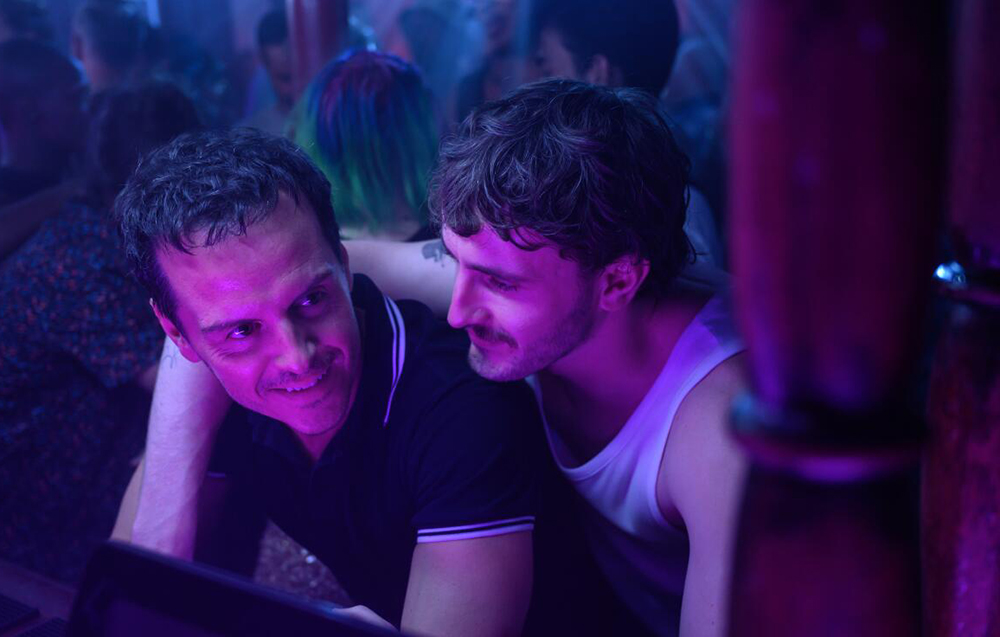
A plot description is necessary, but inadequate: Adam (Andrew Scott) is a blocked writer who lives alone in a London flat. One night, his neighbor Harry (Paul Mescal) introduces himself, knocking on his door and flirting with a bottle in hand. Adam’s flattered, and maybe a bit scared, and above all he needs to get back to work, so he seeks inspiration back where he grew up, taking a train to the suburbs. Once off the train, he follows a mysteriously familiar face—seen exiting a liquor store—back to his childhood home. It’s Adam’s dad (Jamie Bell), mustachioed and looking not a year older than his son. The easygoing banter between the two leads and the warm greeting from Adam’s mum (Claire Foy) at the house overshadows the fact that both of Adam’s parents died in a car accident when he was twelve years old.
The casual reunion slips back to the ‘80s (soundtrack included) with ease, no need to rush discussing the obvious elephant in the room. But, in acknowledging how Adam has grown into a man, dad and mum aren’t ignoring the surreal dreamscape the trio inhabits. Invigorated, or maybe just love-drunk, Adam goes home and invites a sober and embarrassed Harry (“I don’t drink anymore”) over, and the walls quickly come down. That they have sex doesn’t hurt to break the ice, but it’s Harry’s sensitive inquisition and sharing of his own personal history which brings out Adam’s honesty. Adam admits that he hadn’t favored sex (“Because I was afraid it would kill me”) over the years, and when Harry mentions his family, Adam then reveals that both parents were killed decades ago. Harry’s therapeutic grace—neither shocked nor per-formatively pitying—has an almost angelic quality, a foil to Adam’s hardened exterior.
Humanizing the Dead and Paying Respect
Emboldened, and a bit mystified by his abundant companionship, Adam returns home again the next day. When his mum asks if he has a girlfriend, Adam clenchingly delivers the news that he’s gay. Watch this exchange on mute, and the two faces tell all the story. Foy is aghast, stripped of a poker face and making no effort to withhold disappointment, while Adam is wounded, yet continues to reassure mum (“It’s different now”), assuming the role of caretaker when he’s the one who deserves compassion and empathy. The next day, Adam’s father (mum won’t come downstairs to see them) wonders why he didn’t come out when he was younger, and in a shocking admission, tells his son that he probably would have bullied—or at best ignored—a kid like Adam growing up.
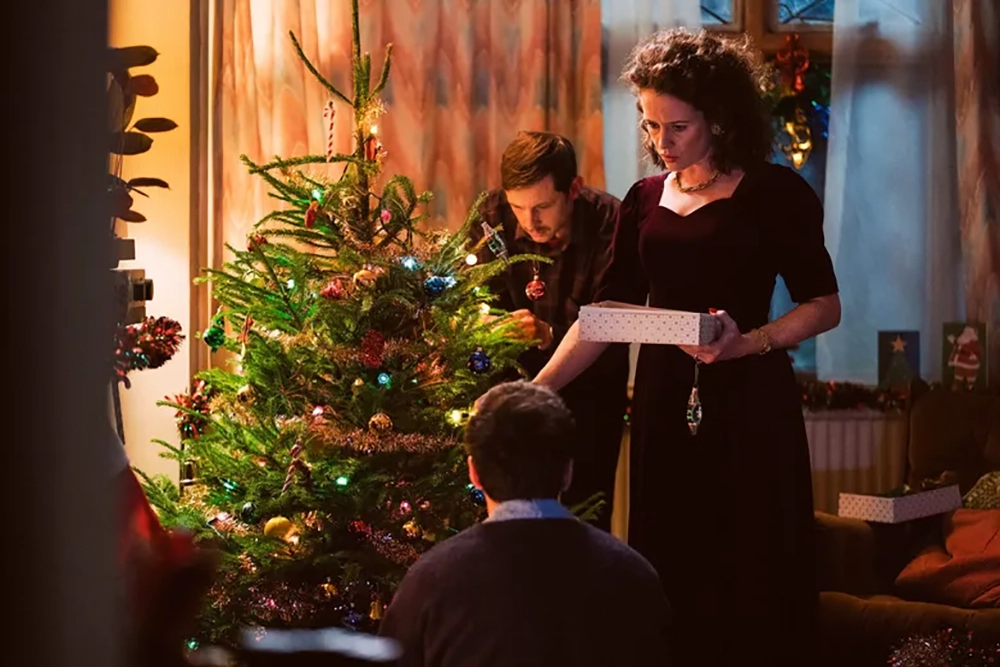
No one apologizes for these harsh prejudices, and Haigh’s storytelling skill is evident here, allowing the people to resolve conflict instead of editorializing or inserting some heavy-handed lesson about why mum and dad acted so horribly. They’re dead, after all. And by humanizing the parents, in all their folly, Haigh pays respect to the dead, letting them be who they are, or who they would’ve been, rather than summoning a more predictable trope of the all-knowing heavenly figures in classics such as “A Matter of Life and Death” (1946) and “Here Comes Mr. Jordan” (1941). The ignorance, in Adam’s eyes, doesn’t make his parents less capable—or worthy—of love. So he forges ahead, literally sandwiching himself between his parents in their bed, wearing his old pajamas, and talking about his childhood dreams of going on vacation with his mum, fighting and making up.
The Necessity of Preserving the Past
Of course, Adam insists that Harry meet the parents, and when that visit goes awry, it sets in motion a breathtaking, enigmatic finale. Part of why a plot synopsis here is particularly insufficient is because any number of Haigh’s strategies could come off as contrived or frivolous. (A grown-up Adam wearing his childhood clothing, for one.) But these are calculated risks, and Haigh’s leaning on his own imagination, subverting certain death-and-after-life cinematic touchstones to unveil a singular love story, whose components: father/son, mother/son, mother/father and Adam/Harry are all so clearly too good to be true. Credit goes to Haigh for pulling this off, but much needs to be said about the otherworldly performances. Foy, to me, is the beating heart, and her two-hander scenes with Scott (equally commanding) are still vibrating in my head, like so many of Haigh’s on-point needle drops.
It’s customary to see the bereaved on-screen, mourning a loss and, if they’re lucky, achieving some closure. But Haigh’s gamble is to show that those who survive and grieve aren’t the only ones who have suffered. Dead parents hurt too. And if that sounds glib, it’s just another coup of Haigh’s to make us cry for the departed, not because we miss them—there’s that too—but because they’ll never live to see us love, hurt, fall down flat and soar again. This is a film that offers a realistic depiction of a magical scenario, and is less concerned with answers than questions. Talking to his mum in bed, Adam describes—with a smile—a dream in which they went on vacation and just kept fighting. Death might kill part of the future, but luckily for Adam, the past didn’t evaporate alongside it.
“All of Us Strangers” is currently only available to watch in theaters.

