



In this gallant and inventive directorial debut, Blitz Bazawule crafts a unique family drama infused with West African folklore. “The Burial of Kojo” overflows with creativity and although the plot feels only ancillary to its striking craftsmanship; this is a thoughtful elegy that explores the torment of regret and the importance of self-forgiveness.
This fable follows young Ghanaian girl Esi (Cynthia Dankwa) as she navigates her family’s past and her memories with her father Kojo (Joseph Otsiman). One day, the two encounter an enigmatic visitor who foretells the arrival of an otherworldly entity. This entity is known as “The Crow” and is in pursuit of its antithesis, “The Sacred Bird.” The strange visitor entrusts this bird to Esi for protection before departing. Almost immediately after this encounter, Kojo’s estranged brother Kwabena (Kobina Amissah-Sam) appears, inviting Kojo to return with him to the home city of the brothers, which Kojo had not returned to for seven years. Esi learns of the strained history between the brothers and their lifelong sibling rivalry, which reached a boiling point on the night of Kwabena’s wedding to a woman who Kojo was also in love with.
Otsiman gives a sensitive portrayal of the quietly troubled Kojo that manages to convey a deep despondence with a minimalist performance. The character clearly carries a burden of regret and has been living with its weight for quite some time. Otsiman is able to flesh out the different levels to Kojo through his interactions with his family members. Opposite the intensity of Amissah-Sam’s Kwabena, Kojo’s mournful melancholy manifests as desperation—there is a need to make retribution for a mistake from his past and also a terror in the knowledge that this will never be possible. However, alongside Esi, Kojo is almost at peace. Despite still seeming preoccupied to some level, his guard is lowered and there is a symmetry between the two akin to a friendship rather than just a parental relationship. The bond between the father and daughter is coloured with a halcyon glow and there is a warm serenity in every scene between the pair.
Although this is the story of Kojo, it is through Esi’s enchanted eyes that it is told. Esi’s memories of her father are soaked in fantasy and we experience the story in the style of the magical tales her father once told her in childhood. This gives way to the many surrealist elements of the film such as its striking ethereal visuals, which are delivered in profusion. The surrealism seeps into multiple facets of the film. One example is the camera, which interferes with the audience’s perception by turning these images upside-down. Meanwhile, simple character actions such as smoking a cigarette are played in reverse-motion, warping any sense of reality. The settings also appear to be painted by Esi’s lens, with the film skating from tense red rooms and sombre blue shores to mystifying purple skies.
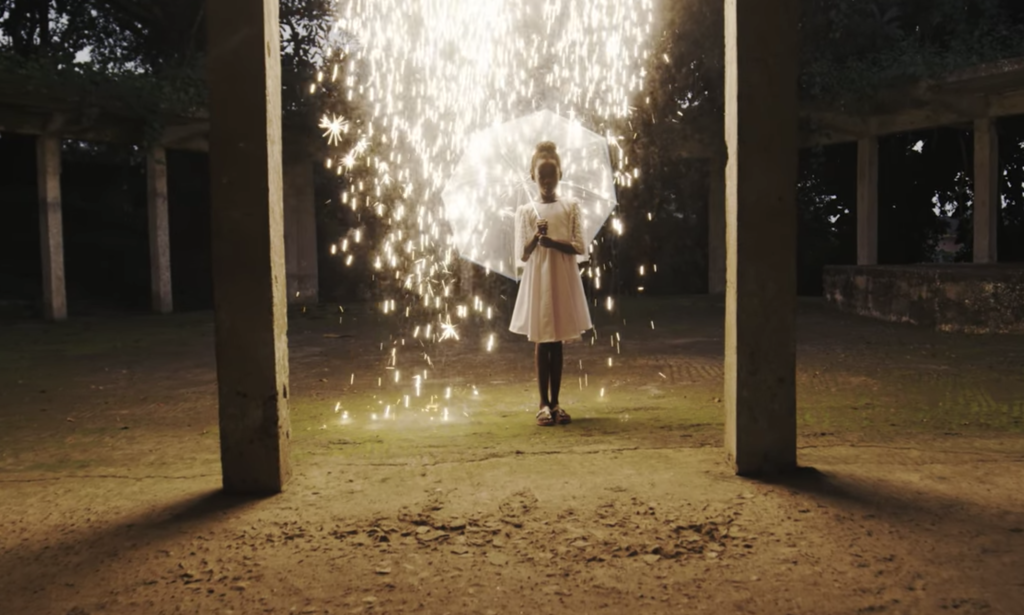
Certain images throughout the film are immensely evocative in a way makes them near-impossible to forget. My personal favourite instance of this is when these elements come together in transfixing nightmare scene introducing The Crow, who waits ominously on the back of a stationary horse amid a rosy sky. This scene is a sensory feast and hammers home the power of the film’s original score. Although, with Bazawule’s musical background, this strength should be a surprise to no one. The standouts from this include intoxicating tracks such as “The Sacred Bird” and “The Crow’s Theme,” which perfectly contrast one another with their respective tranquil flutes and foreboding percussion.
With an approach that is in some ways a double-edged sword, the film opts for storytelling that is propelled by its rich symbolism rather than a concrete plot. Whilst this makes way for more of the unique traits that make it special, it also leaves the experience feeling somewhat incomplete. Much of the plot exists as backstory that is delivered through narration and what remains is thin enough to hinder tale when it comes to forming a well-earned and satisfying conclusion. The resolution that it reaches feels hasty even in spite of the closure provided by its bittersweet ending. Fortunately, there is a good chance that the abstract charm of the film will engross the audience enough to appreciate the beauty in what little story is told.
The passion and originality behind “The Burial of Kojo” is undeniable. Blitz Bazawule dances to his own rhythm with the boldness of a seasoned filmmaker. The staggering cinematography and resonant themes make this a triumphant debut and an exhilarating victory for Ghanaian film.