


(Spoiler warning: This essay discusses major plot details, including the ending of “La La Land.”)
A decade is plenty of time for a rave to become embarrassing. When I wrote about “La La Land” in January 2017, I called it “definitely one of the best films of the decade.” I went further. No other film from 2016, I wrote, “made me reaffirm my love of movies the way ‘La La Land’ did.” Damien Chazelle had taken an original story, given it the effervescence and heart of the classic Hollywood musicals, and made what I was already willing to call “the ‘Singin’ in the Rain’ of this generation.”
Three years later, the initial high apparently hadn’t worn off. When I ranked what I considered the 25 essential movie musicals, “La La Land” came in fifth, behind only “Mary Poppins,” “West Side Story,” “Singin’ in the Rain,” and “The Sound of Music.” That’s some company to put a movie in before it’s even old enough to start grade school.
Ten years later, I might phrase some of those claims differently. The enthusiasm, though, hasn’t really changed.
By the time “La La Land” arrived, Chazelle had already given me reason to expect something special. I saw “Whiplash” in theaters, and I remember stepping outside after the credits with that rush you get from watching a filmmaker announce himself. Here was someone obsessed with greatness, yes, but even more interested in what pursuing greatness extracts from the person doing the pursuing. Andrew Neiman could become the drummer he wanted to be, but Chazelle made sure we understood the blood price attached to getting there. I wanted to know what kind of film this director would make next.
Then came “La La Land,” and the answer was somehow bigger, warmer, more romantic, and more devastating at once.
What has changed in ten years is my understanding of why.
The Dream Gets Harder as You Get Older
I’ve thought about this before with “Interstellar,” another film whose emotional gravity shifts depending on when in your life you encounter it. You can watch Christopher Nolan’s film as a child thinking about a parent, as a son thinking about everything your parents gave up, as an adult considering a family of your own, or as a parent confronting the terror of time moving faster than you can control. The film stays put. You move around it.
“La La Land” does something similar with ambition.
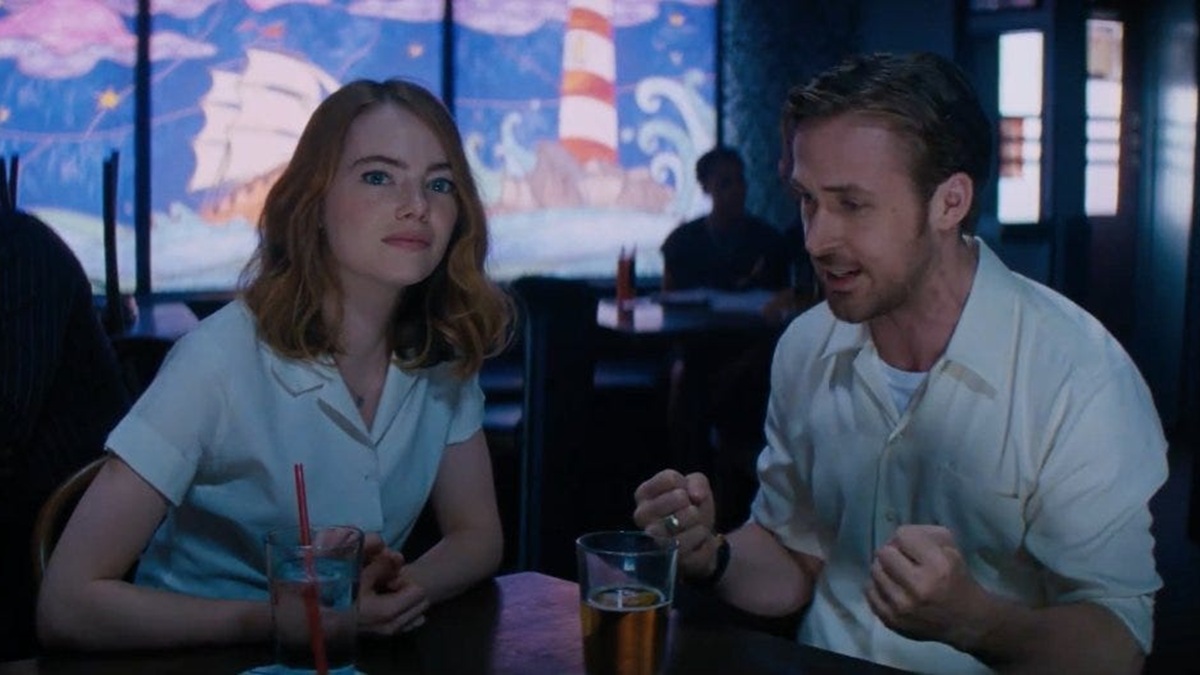
Mia (Emma Stone) wants to act. Sebastian (Ryan Gosling) wants to open a jazz club. At its simplest, theirs is the familiar language of youthful aspiration: find the thing you love, believe in it fiercely enough, and don’t let the world beat it out of you. When you’re younger, “follow your dreams” can sound almost like an instruction. Keep going. Don’t sell out. Bet on yourself.
Getting older makes that sentence harder to swallow whole. Dreams acquire rent, schedules, financial obligations, exhaustion, relationships, competing priorities, and responsibilities to other people. Sometimes the dream itself changes. Sometimes you get what you once wanted and realize the person receiving it isn’t quite the same person who first imagined it. Yet the strange thing is that the gravity remains. You may want something different at 40 than you wanted at 20, but wanting a life to become something still carries the same pull.
That part of “La La Land” weighs more heavily on me now. Mia and Sebastian don’t separate because one of them stops caring. They separate partly because they help each other become the people they said they wanted to be, and those lives eventually carry them in different directions.
Sebastian encourages Mia to stop waiting for somebody to hand her a role and write something herself. Later, after her one-woman show bombs and she retreats home convinced she has embarrassed herself enough, he drives out to get her for the audition that changes her life. Mia, meanwhile, sees Sebastian’s club before it exists. She pushes him toward the version of himself he keeps talking about and even gives the place the name he eventually uses: Seb’s.
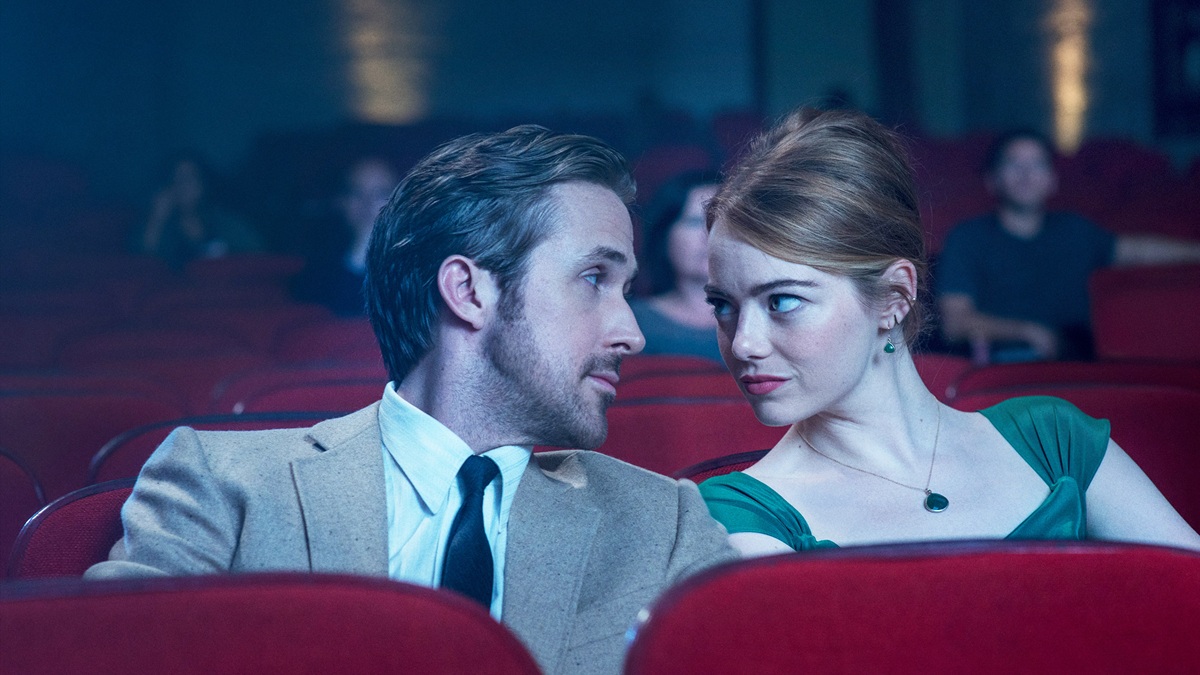
Years later, when Mia walks into that club with her husband, she is literally entering a dream she helped another person imagine. Sebastian, looking back at her from the piano, is seeing the actress whose career exists in some small but crucial way because he once refused to let her surrender it.
Their relationship ends. Its consequences don’t.
We tend to measure relationships through duration, as though permanence were the only proof that something succeeded. “La La Land” understands otherwise. Mia and Sebastian don’t get forever, but they permanently alter the trajectories of each other’s lives. Neither reaches the ending without the other, and Chazelle never turns that into consolation-prize sentimentality. The loss is real; so is everything they gave each other before losing it.
What Ambition Takes in Return
Even the seasonal structure gets sadder with age. Winter becomes spring, spring becomes summer, summer becomes fall, and eventually we return to winter. Their romance has a season. Chazelle doesn’t treat its ending as evidence that what came before was false, nor does he insist that love must survive unchanged to have mattered.
He is tougher on dreams than the film’s reputation for romantic whimsy might suggest. “Here’s to the fools who dream” became one of its defining phrases, but I hear fools more loudly now. Chazelle knows dreaming can make people ridiculous. Mia humiliates herself in auditions where casting directors barely look up. Her play loses money. Sebastian’s refusal to compromise can make him pompous and exhausting. When he finally takes a steady job playing with Keith’s (John Legend) band, he gets the sort of professional success people are supposed to want, only to discover that security can become another kind of dissatisfaction.
Sebastian’s detour with The Messengers also gets more complicated the older I get. When I first saw the film, it was easy to absorb his decision as the familiar artist-sells-out beat. He abandons the pure thing he loves, becomes successful doing something commercial, and starts looking miserable. Except adulthood makes the practical side harder to dismiss. He needs money. Mia has heard him complain about his lack of stability. He takes a job that pays well, travels, gives him an audience and still involves playing music. None of that is absurd. The problem is that he has built a life around choices he can’t quite recognize as his own.
Mia sees it before he does. Their dinner argument hurts because she isn’t simply scolding him for selling out. She realizes he has begun defending a life he once said he didn’t want, and Sebastian hears her concern as judgment because some part of him already knows she’s right. Love can encourage ambition, but it can also become another place where ambition gets negotiated.
That tension connects “La La Land” to almost everything Chazelle has made. “Whiplash” asks how much blood someone should be willing to leave on the drum kit for greatness. “First Man” turns one of humanity’s greatest achievements into something haunted by grief and sacrifice. “Babylon” watches people surrender themselves to an industry capable of immortalizing their images while chewing through their lives.
For me, neither of Chazelle’s features after “La La Land” has reached this film’s level. There are remarkable things in both, and “Babylon” in particular swings with the confidence of someone who would rather make an enormous mess than something timid. Still, “La La Land” remains his high-water mark because it finds the clearest emotional expression of the question he keeps returning to: What are you willing to give up to become the person you want to be, and what happens when you finally get there?
“Whiplash” made me think Chazelle could become one of the filmmakers worth following. “La La Land” made that early hunch seem almost embarrassingly easy.
Old Hollywood Dreams, Modern Los Angeles
Part of what made the film so intoxicating in 2016 was how confidently Chazelle borrowed the language of old musicals without letting “La La Land” become cosplay.
The references are everywhere. Gene Kelly and Stanley Donen hover over it. So do Vincente Minnelli, “An American in Paris,” Jacques Demy’s “The Umbrellas of Cherbourg,” and “The Young Girls of Rochefort.” You can trace individual colors, camera movements, costumes, and romantic gestures backward through decades of movie-musical history. Chazelle clearly loves those films, but the point isn’t proving that he has seen them. Plenty of filmmakers can reproduce a reference. The harder trick is understanding what made an old form emotionally useful in the first place.
That’s where “La La Land” separates itself from imitation.
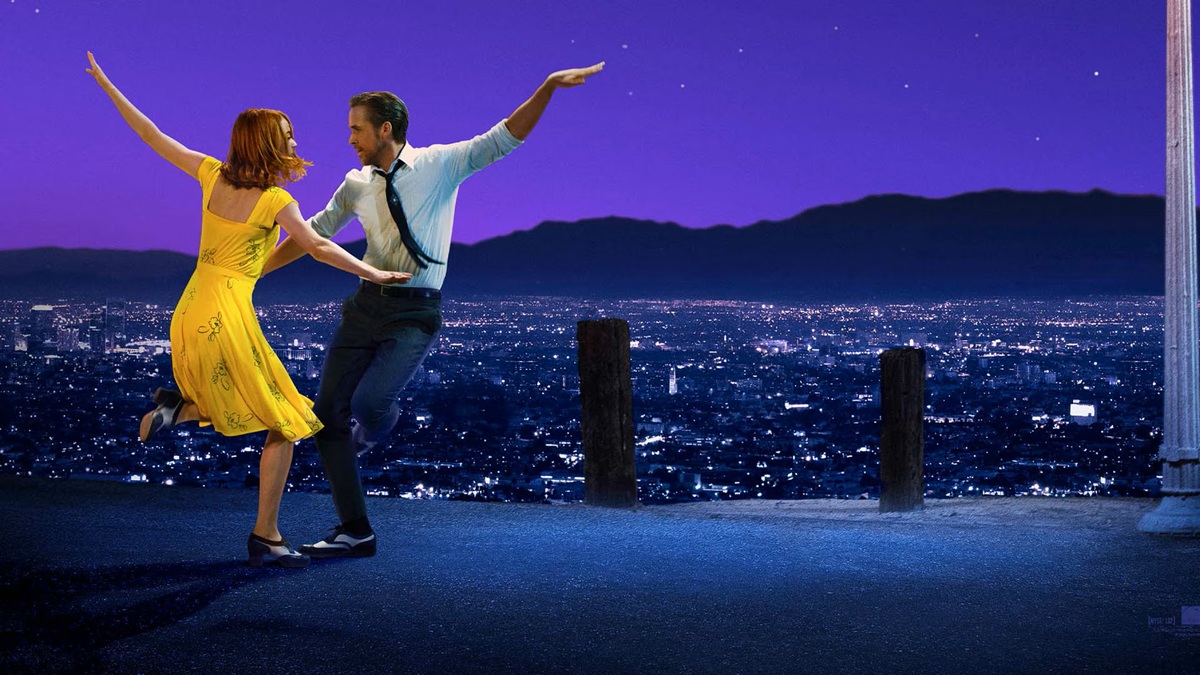
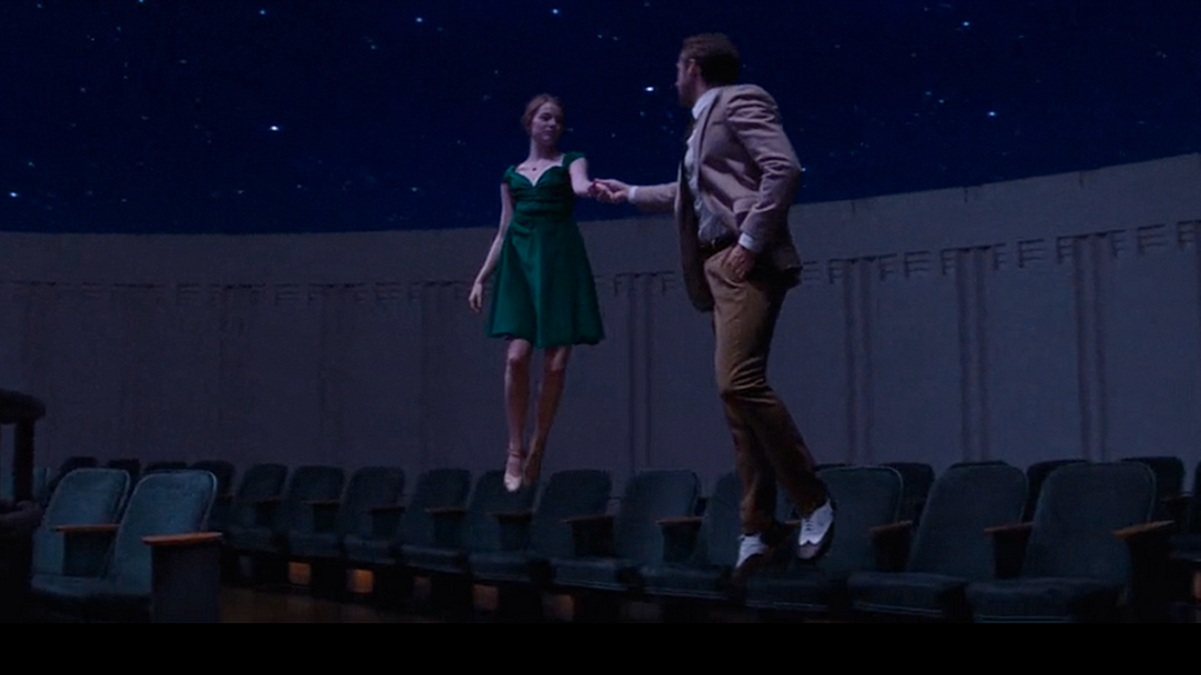
Golden Age musicals often used song and dance to make desire physical. People couldn’t simply say what they wanted, so they moved through it. Chazelle borrows that freedom but places it inside a modern story where fantasy can’t permanently protect anyone from disappointment. Mia and Sebastian can float into the Griffith Observatory because they’re falling in love. They can dance against a painted-looking Los Angeles sky because for a few minutes their possibilities seem limitless. Yet Chazelle knows that gravity eventually returns.
Everybody in This City Is Waiting for Something
Los Angeles is the perfect place for this contradiction. The city is both real and deliberately unreal, a landscape where ordinary streets, studio lots, diners, freeways, and apartments keep brushing against the machinery that manufactures dreams for everyone else. Even the title carries a little joke. “La-la land” can mean Los Angeles, fantasy, or a state of being pleasantly detached from reality. The movie lives somewhere among all three.
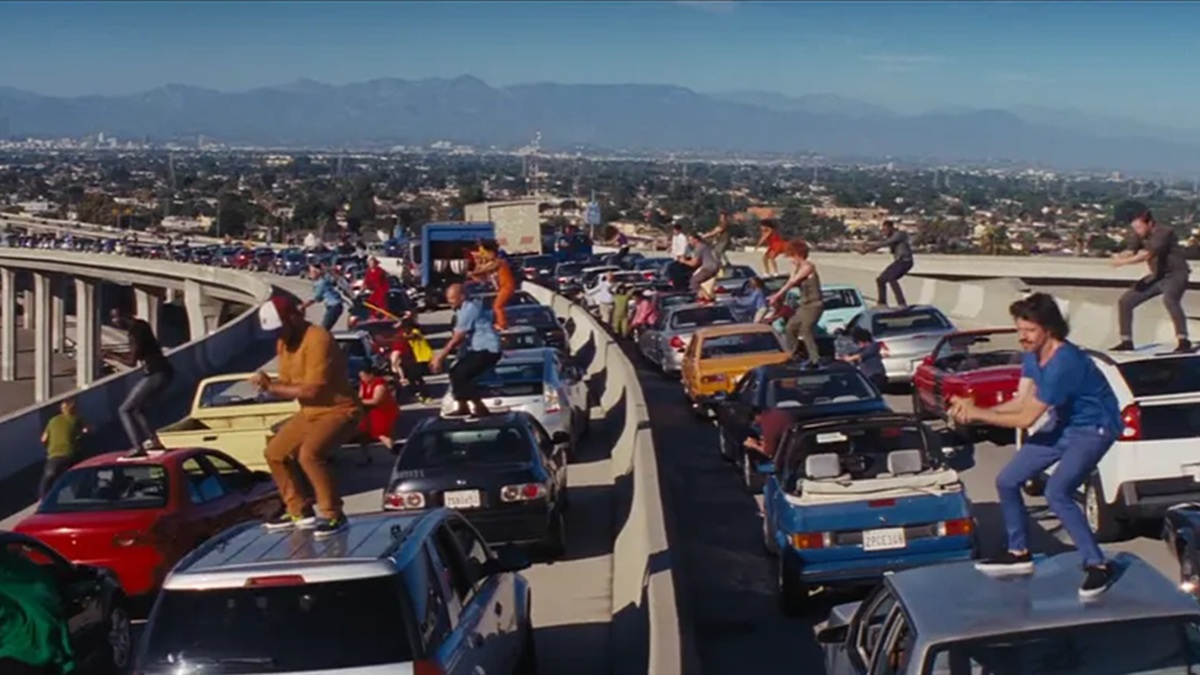
The opening number makes the idea clear before Mia and Sebastian have properly entered the story. A traffic jam stalls hundreds of people on a freeway, perhaps the most mundane Los Angeles frustration imaginable, and suddenly everyone gets out of their cars and starts singing “Another Day of Sun.” The sequence explodes with optimism, but listen to what these people are singing about: leaving someone behind, arriving in a city that doesn’t care who you are, enduring disappointment because maybe tomorrow will finally be your day.
The sunshine is real. So is the desperation underneath it.
That mixture keeps “La La Land” from aging into mere nostalgia. Chazelle loves old Hollywood, but his characters know what rejection emails, dead-end jobs, and creative insecurity feel like. Mia works on a studio lot while being reminded every day that she hasn’t been invited into the world she serves coffee to. Sebastian plays Christmas standards for diners who don’t care about the music he wants to make. They inhabit the dream factory while standing outside the dream.
The camera keeps giving them temporary access anyway. Linus Sandgren’s cinematography can turn a Los Angeles dusk into something halfway between natural light and painted backdrop, and the extended takes allow Stone and Gosling to move through those spaces without the choreography being chopped into coverage. The filmmaking is showy, but rarely for empty display. Chazelle wants us to experience the seduction before he starts taking it away.
When the Movie Stops Singing
None of these ideas would carry nearly as much weight if Stone and Gosling didn’t make us believe in Mia and Sebastian together.
Romantic musicals have always asked star chemistry to do enormous amounts of work. Fred Astaire and Ginger Rogers made choreography look like courtship. Gene Kelly sold romance through the physical pleasure of movement. “La La Land” needed performers who could belong to that tradition without looking as though they were attending a costume party dressed as Golden Age movie stars.
Stone and Gosling have that wattage. They had already worked together before “La La Land,” and Chazelle exploits the ease between them. Mia and Sebastian can flirt through irritation. “A Lovely Night” works because the lyrics insist these two people aren’t interested while every movement says otherwise. The dancing isn’t technically intimidating, either. Neither performer is presented as a superhuman hoofer, and that slight roughness helps. We’re watching movie stars, but we can still see two contemporary people underneath the glamour.
Stone, especially, gives “La La Land” much of its pain. The auditions become tiny rituals of humiliation: perform vulnerability on command, get interrupted, compose yourself, try again. Someone answers a phone in the middle of her scene. Another room barely acknowledges her. Acting, which the movies can make look like the glamorous part of Hollywood, becomes an exhausting process of asking strangers to believe you deserve to be seen.
By the time Mia reaches “Audition (The Fools Who Dream),” Chazelle strips almost everything away. There’s Stone, her face, her voice and a story about an aunt who jumped into the Seine. The film has spent two hours showing off what it can do, then recognizes that the right choice is simply to watch her.
The musical structure follows the relationship just as carefully. Early on, fantasy keeps overtaking reality. Mia and Sebastian dance above the city. They float among stars. Music lets them say things conversation cannot. Then their relationship begins to buckle and the film gradually loses that escape hatch.
The dinner argument has no choreography to soften it. No melody lets them harmonize their resentment. They sit across from each other and realize that love doesn’t automatically solve the incompatible demands of two lives. Only after reality has separated them completely does “La La Land” allow itself its most extravagant musical fantasy.
A Melody for the Life They Didn’t Live
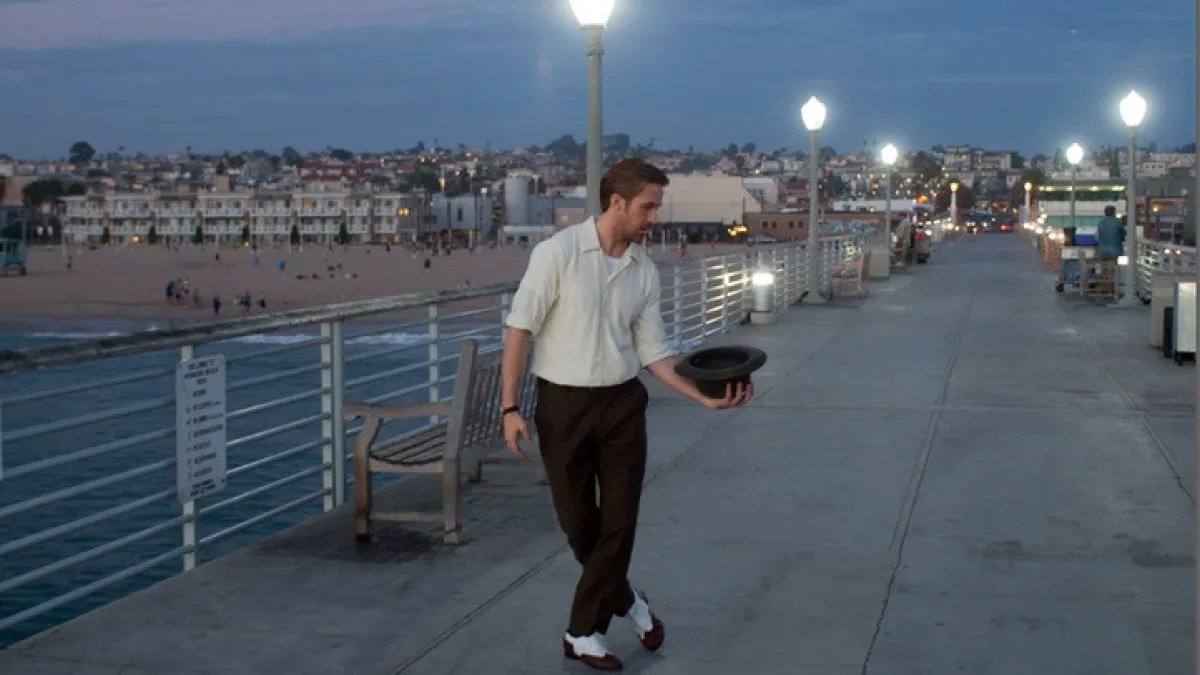
Justin Hurwitz’s music remains inseparable from why that final movement hurts. The soundtrack still slaps ten years later. Give me that little “City of Stars” figure and I can picture Gosling strolling alone by the pier, hat in hand. Start “Someone in the Crowd” and Mia and her friends are walking toward that party again. The first bars of “Another Day of Sun” can reconstruct the freeway before the vocals even begin. These songs don’t survive only because they’re catchy; they carry images around with them.
“Mia and Sebastian’s Theme” is the piece I return to most personally. I’m a frustrated musician, and I love playing it because even under amateur hands there is something in that melody that carries longing before you attach any images to it. During the romance, it belongs to their shared possibility, two people trying to build separate dreams while believing for a while that they can build a life together too.
Then Mia hears Sebastian play it again five years later, and the movie breaks open.
The epilogue gives them another life. Sebastian kisses Mia instead of brushing past her at the restaurant. Their arguments disappear. Career and romance stop competing. He goes with her to Paris. They marry, and they have a child. They get the house, the work, the music, the love. Chazelle restages the entire film as though somebody has gone back and corrected every wrong turn.
Ten years ago, I primarily felt the heartbreak of watching the life they should have had. Now I’m not sure should belongs there.
It’s the life they could have had, and that hurts more.
Adulthood accumulates these invisible parallel lives. Jobs you might have taken, cities you might have moved to, people you might have stayed with, dreams you abandoned and dreams you achieved at the expense of something else. Most of us don’t spend every day mourning every road not taken. But occasionally a song, a place or a familiar face lets us glimpse the person who might have existed had one decision gone differently.
Reality doesn’t let us step into that life. Movies can. And for a few minutes, “La La Land” lets Mia and Sebastian live there.
More Than a Great Movie Musical
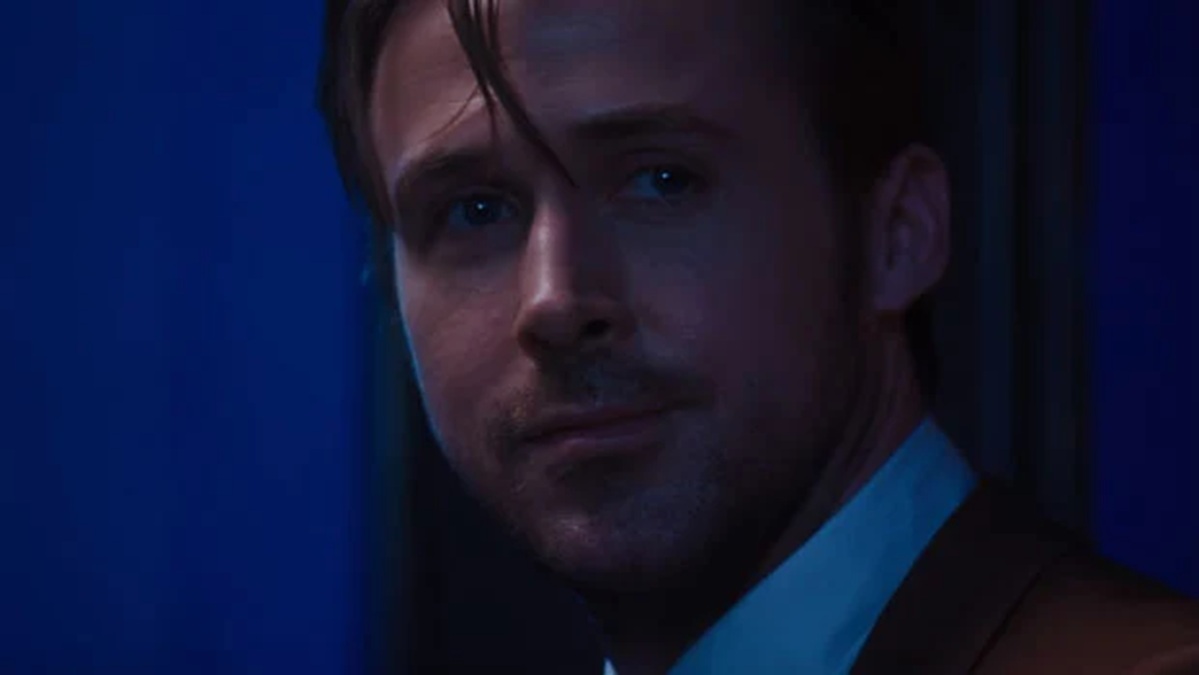
There are aspects of the film I see more critically now, particularly its treatment of jazz. Sebastian, a white musician, is positioned as a passionate custodian of a Black American art form, and the screenplay can be clumsy about where preservation ends and possessiveness begins. Keith, played by John Legend, makes the entirely reasonable argument that jazz survives by changing. There’s an irony there because “La La Land” itself succeeds by doing what Sebastian sometimes resists: it keeps an old form alive not by embalming it, but by letting it become something contemporary.
Ten years also make it easier to acknowledge those limitations without turning the exercise into a prosecution or defense. Loving a movie for this long doesn’t require pretending every choice inside it has improved with age.
Judged as a film, though, “La La Land” remains extraordinary. That part matters when considering its cultural life because musicals face peculiar competition for longevity. The most enduring songs often belong to family entertainment, particularly Disney, where generations can grow up with the music before they understand anything about the filmmaking around it. Other modern musicals arrive with Broadway pedigrees, jukebox catalogs, or preexisting fan bases.
“La La Land” had none of those advantages. Its songs were new. Its central romance doesn’t end happily. More importantly, its concerns are painfully adult. Yet the images and melodies became immediately recognizable because every department is pulling in the same direction: Sandgren’s photography, Hurwitz’s score, Tom Cross’ editing, the production design, the choreography, and Stone and Gosling’s faces.
A soundtrack can keep a musical popular. “La La Land” has remained memorable because the movie around the soundtrack is just as good.
The Best Picture Ending It Almost Had
Perhaps nothing illustrates how completely it occupied popular culture in early 2017 better than the Academy Awards disaster. It’s easy now to reduce the Best Picture mix-up to a meme. Warren Beatty and Faye Dunaway announce “La La Land.” The producers come onstage. Acceptance speeches begin. Then Jordan Horowitz takes the microphone and tells everyone that “Moonlight” actually won.
The reason the mistake initially seemed so believable was obvious: “La La Land” had been dominating awards season. It entered the Oscars with 14 nominations and won six prizes that evening. Hollywood clearly loved a movie about artists trying to survive Hollywood, which says something amusing about an industry’s enduring affection for congratulating itself.
That explanation only gets us so far, though. Critics and audiences loved the damn thing, too.
Mia and Sebastian’s ambitions translate beyond acting and jazz. You don’t have to audition for movies or dream of owning a club to recognize the terror of wanting a life you haven’t figured out how to reach. The story is specific enough to be about Hollywood while broad enough to be about anyone who has organized part of a life around a hope that may never pay off.
And the Oscar fiasco accidentally gave “La La Land” the most La La Land ending imaginable. For a few minutes, it won Best Picture. Its producers held the award. They gave speeches. The happy ending had arrived, until reality interrupted.
A movie whose climax allows its characters to inhabit an ideal alternate life before returning them to the one they actually have was itself permitted to inhabit an alternate ending before being returned to reality. “Moonlight” was the rightful Best Picture winner. “La La Land” simply got to dream otherwise for a moment.
How strangely appropriate.
‘La La Land’: A Love Letter to the Fools Who Dream
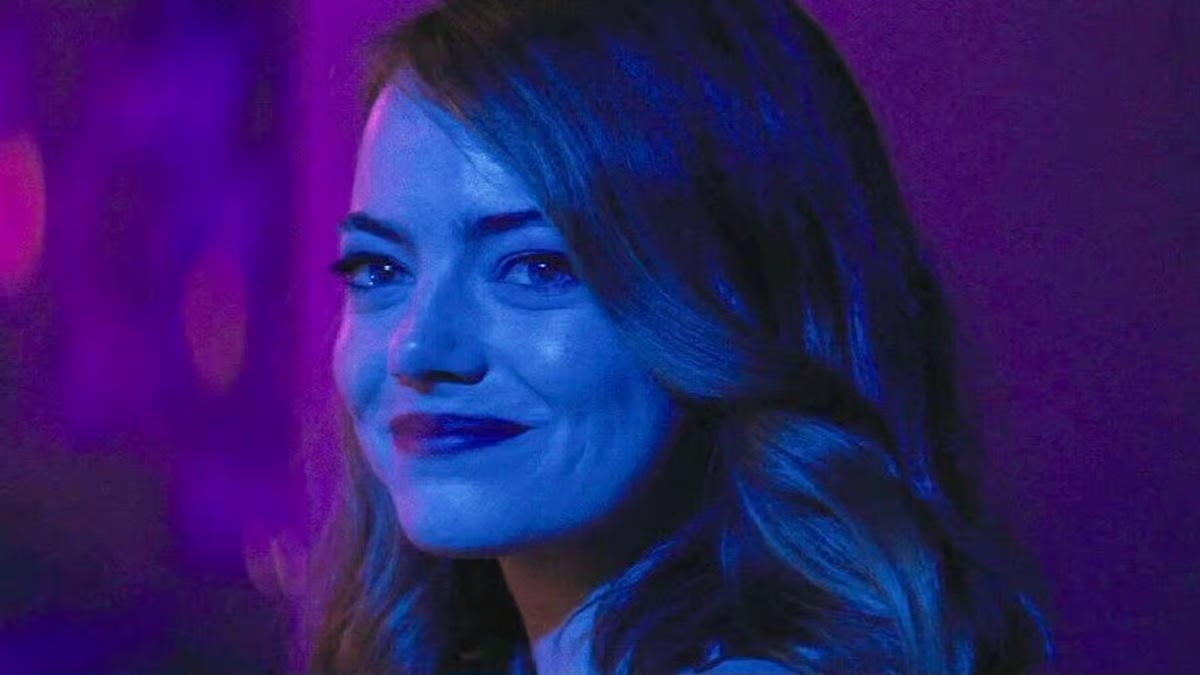
Ten years ago, I loved “La La Land” because it made me fall in love with movies again. I loved the colors, the songs, that purple Los Angeles sky, Stone and Gosling dancing against it, and the confidence of a young filmmaker reaching backward through movie history while making something unmistakably his own. I still love all of that, but time has made the film sadder because dreams don’t remain theoretical as you get older. You learn what they cost. You change them, you achieve some, and you abandon others. Sometimes you discover that getting what you wanted required leaving another version of your life behind.
Mia becomes the actress she dreamed of becoming. Sebastian opens the club. They made it. Yet when their eyes meet across Seb’s years later, neither asks the other to undo any of it. There’s recognition in that look, and gratitude, perhaps. Love, too, in whatever form love takes after it can no longer be a shared life. Mia smiles. Sebastian smiles back. The music ends, and she leaves.
In 2017, I called “La La Land” one of the best films of its decade because of the way it reaffirmed my love of movies. Ten years later, I’m struck by something I couldn’t have fully understood then: “La La Land” knew our dreams would change before we did.
And maybe that’s why the film hasn’t.
Damien Chazelle’s “La La Land” was re-released in theaters on August 16, 2026 for its 10th anniversary. It screened in Dolby Vision high dynamic range picture and Dolby Atmos immersive audio for the first time in AMC Theatres. Follow us for more coverage.

