


Nathan Flynn
2025 was a huge year for my relationship to film. It was the first year I took my role as a critic more seriously than ever before—becoming a member of the AFCA and beginning to write for The Movie Buff—and it coincided with a moment when the medium itself felt unusually unstable. Conversations around the viability of the theatrical experience, shrinking attention spans, and Hollywood’s continued reliance on franchises (particularly the cape-adjacent variety) dominated much of the year’s discourse.
Great cinema has never died. If anything, 2025 reaffirmed that when it’s threatened, it pushes back.
What connects most of the films on this list is a shared sense of resistance: people struggling against institutions of power—political systems, entrenched wealth, inherited hierarchies—or reckoning with the quieter but equally devastating force of time as it reshapes bodies, communities, and belief systems. These are movies about friction: between individuals and systems, between past and present, between the world as it was promised and the one that actually exists.
Many of my favorite films of the year were major studio releases—even blockbusters—that trusted audiences to meet them on challenging, surprising terms. These were movies that demanded attention rather than background noise, that justified leaving the house and sitting in a dark room with strangers. For a stretch in late summer, I worried my end-of-year list might be locked in far too early—but October and November arrived with a jolt, reshuffling priorities and reminding me how alive the medium still is when it wants to be.
While this list is admittedly front-loaded, there was no shortage of worthy contenders just outside the top ten. Films like “Train Dreams,” “If I Had Legs I’d Kick You,” “Sentimental Value,” “Eddington” (which continues to age beautifully), “Weapons,” “The Phoenician Scheme,” “Avatar: Fire and Ash,” “Jay Kelly,” “Black Bag,” “The Mastermind,” “The Shrouds,” and my beloved “The Woman in the Yard” all made lasting impressions in a crowded year.
The best movies of 2025 didn’t chase audiences—they asked them to come closer. And that’s exactly how it should be.
Honorable Mention
Before getting into the official list, one film deserves special recognition for sitting just outside the top ten—less a consolation prize than a testament to how competitive the year ultimately became.
“28 Years Later” (Dir. Danny Boyle)

I went into Danny Boyle’s long-awaited legacy sequel expecting a cautious retreat. Instead, “28 Years Later” emerged as his most visually adventurous work in years—a future-shock phantasmagoria that expands the series’ world while pushing its aesthetic in unnervingly pristine new directions. Reuniting with cinematographer Anthony Dod Mantle, Boyle transforms the English countryside into a stage for cosmic horror, while Alex Garland delivers what may be his strongest script, layering pulpy propulsion with literary allusion and pointed reflections on isolationist Britain.
For all its scale and spectacle, the film’s most striking achievement is its meditation on mortality. Zombie movies are always about decay, but “28 Years Later” treats death with an unexpectedly poetic gravity, culminating in a late-film turn so strange and tender it nearly transcends the genre altogether. Anchored by an Oscar-worthy performance from Ralph Fiennes, Boyle allows death to arrive not as spectacle but as an intimate, unavoidable truth.
The film’s coda—openly teeing up this week’s tremendous “28 Years Later: The Bone Temple” —may strike some as goofy franchise maneuvering. Taken as the opening movement of a larger, risk-taking project, however, “28 Years Later” stands as one of the rare legacy sequels that justifies its existence by refusing to play it safe. (Read our review).
10. “Sirât” (Dir. Oliver Laxe)
Pulsating cinema, “Sirât” uses the skeleton of a thriller to become something more elemental: a vision of people latching onto music and one another as the world quietly ends. Set against the backdrop of an unseen global collapse, Oliver Laxe crafts an experience where motion itself becomes a survival instinct and sound a form of shelter.
Laxe’s widescreen compositions turn the desert into a spiritual trap—suffocating and sublime in equal measure—while the film’s relentless sound design transforms EDM into a lifeline rather than an escape. Few films this year so forcefully demand the biggest screen possible, their impact inseparable from scale, volume, and physical immersion.
In a year defined by resistance, “Sirât” locates defiance not in domination or escape, but in shared rhythm—in the stubborn, human act of moving together when stopping would mean disappearing. (Read our review).
9. “Blue Moon” (Dir. Richard Linklater)
Set entirely over the course of one long night at a bar, “Blue Moon” is a finely tuned chamber piece about an artist realizing, in real time, that his moment has passed. Reuniting with his most trusted collaborator, Richard Linklater gives Ethan Hawke the space to inhabit lyricist Lorenz Hart at the precise instant when popular taste—and show business itself—begins drifting away from him.
Hawke is sensational, delivering one of the year’s very best performances and a legitimate ‘Best Actor’ contender. As funny and compelling as it is tragic, “Blue Moon” captures the bitter joke of an artist who understands too late that the world has already moved on. That resonance clearly landed: my critics group ultimately named “Blue Moon” the Best Austin Film of the Year. (Read our review).
8. “The Naked Gun” (Dir. Akiva Schaffer)
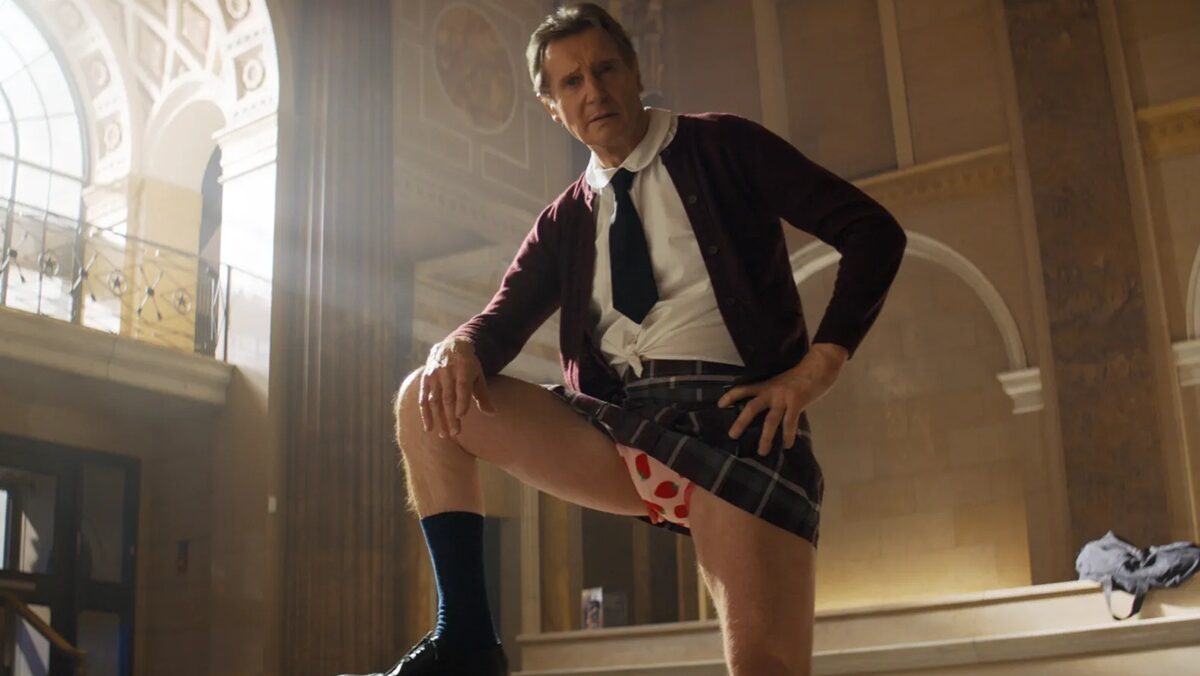
2025 was a quietly encouraging year for studio comedies trying to claw their way back into theaters— “Splitsville,” “Friendship,” and “One of Them Days” all made strong cases for laughter as a communal experience. But no film this year came closer to killing me outright than “The Naked Gun.”
The secret weapon is Liam Neeson, who delivers one of the year’s funniest performances by playing his action-hero persona with total sincerity. Like Leslie Nielsen before him, Neeson’s stone-faced gravitas becomes the joke, allowing director Akiva Schaffer to keep the gags coming with ruthless efficiency—if one bit doesn’t land, another arrives seconds later.
Pamela Anderson is a long-overdue comedic revelation, while Danny Huston gleefully chews through his role as the resident tech-billionaire creep. In an era when humor is often treated as garnish, “The Naked Gun” commits fully to stupidity, escalation, and communal laughter—and proves that theatrical comedy still works when filmmakers trust the joke. (Read our review).
7. “Cloud” (Dir. Kiyoshi Kurosawa)
After the communal release of “The Naked Gun,” “Cloud” pivots toward a far bleaker kind of humor. 2025 offered no shortage of films about a guy getting brainworms from being way too online— “Eddington,” “The Shrouds,” “Bugonia” —but none are as incisive or darkly entertaining as Kiyoshi Kurosawa’s.
What begins as a chilly study of an internet reseller gaming the system curdles into a capitalist stress dream where online grievance spills violently into the real world. Kurosawa treats the internet not as a novelty, but as a portal that amplifies resentment and anonymity until they become indistinguishable from horror.
As bleakly funny as it is unnerving, “Cloud” locates modern evil not in the supernatural but in feedback loops of late capitalism and digital life. (Read our review).
6. “Eephus” (Dir. Carson Lund)
A lovely, shaggy baseball time capsule, “Eephus” feels less like a new release than a memory drifting in from another era. In his assured debut, Carson Lund observes one last recreational-league game in 1990s Massachusetts before a local ballpark is paved over.
There’s no real plot—just men aging in place, drinking beer, missing pitches, and stretching time as long as they can. Lund’s careful framing and evocative sound design place the viewer in the bleachers, attentive to the clack of the bat and the ache of anticipation.
In a year dominated by upheaval and resistance, Eephus honors something smaller and more fragile, reminding us how much meaning can still be found in simply showing up one last time. (Read our review).
5. “Sinners” (Dir. Ryan Coogler)
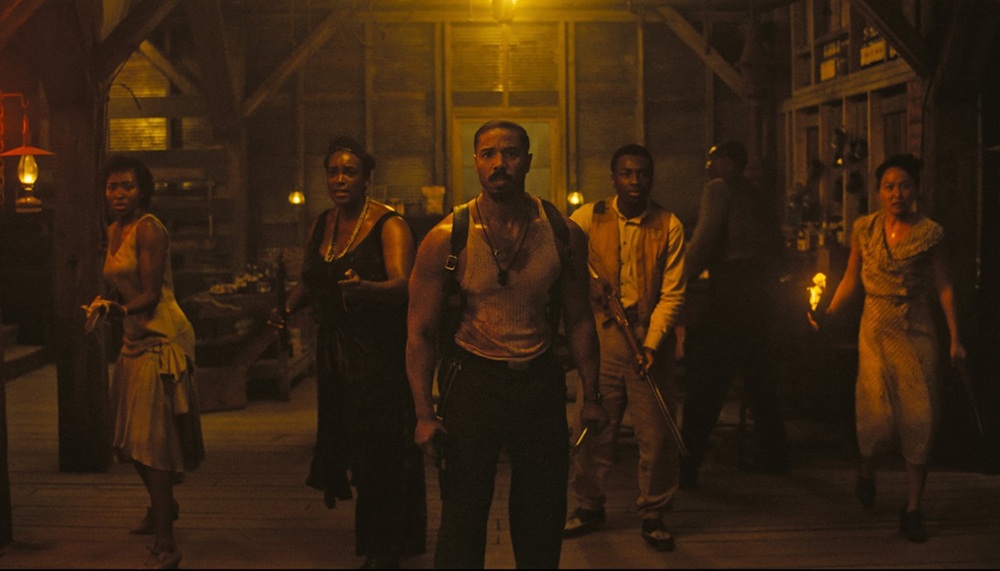
Like “Eephus,” “Sinners” unfolds over one last, fleeting night before something precious disappears—but instead of a ballpark being paved over, it’s a blues-soaked juke joint under siege by Irish vampires who want to steal the music outright.
Set in 1930s Mississippi, the film treats the blues as something elemental and dangerous—so powerful it attracts predators eager to consume and assimilate it. Coogler commits fully, building toward a transcendent musical sequence before erupting into a vicious, hard-R vampire siege.
Already a fixture on year-end lists, “Sinners” feels destined to endure: messy, soulful, endlessly rewatchable, and likely to go down as one of the most beloved films of the 2020s. (Read our review).
4. “Marty Supreme” (Dir. Josh Safdie)
If anyone understands hustling just to survive the night while battling a vampire, it’s Marty Mauser. Josh Safdie’s first solo feature follows a postwar table-tennis hustler whose ambition borders on the feral.
Timothée Chalamet is astonishing, turning manic self-belief into propulsion and punishment in equal measure. Messy, exhausting, and often exhilarating, “Marty Supreme” dares you to keep up and decide whether its hero is a monster, a marvel, or both.
3. “Caught by the Tides” (Dir. Jia Zhang-ke)
A genuinely unique experience, “Caught by the Tides” plays like a cinematic mosaic that becomes an emotional meditation on time, technology, and human connection.
I’m far from an expert on Jia Zhangke’s work, but every film of his I’ve encountered carries a quiet, unmistakable power. Anchored by Zhao Tao’s largely wordless performance, the film tracks how environments change, relationships fade, and intimacy becomes increasingly mediated by screens. (Read our review).
2. “It Was Just an Accident” (Dir. Jafar Panahi)
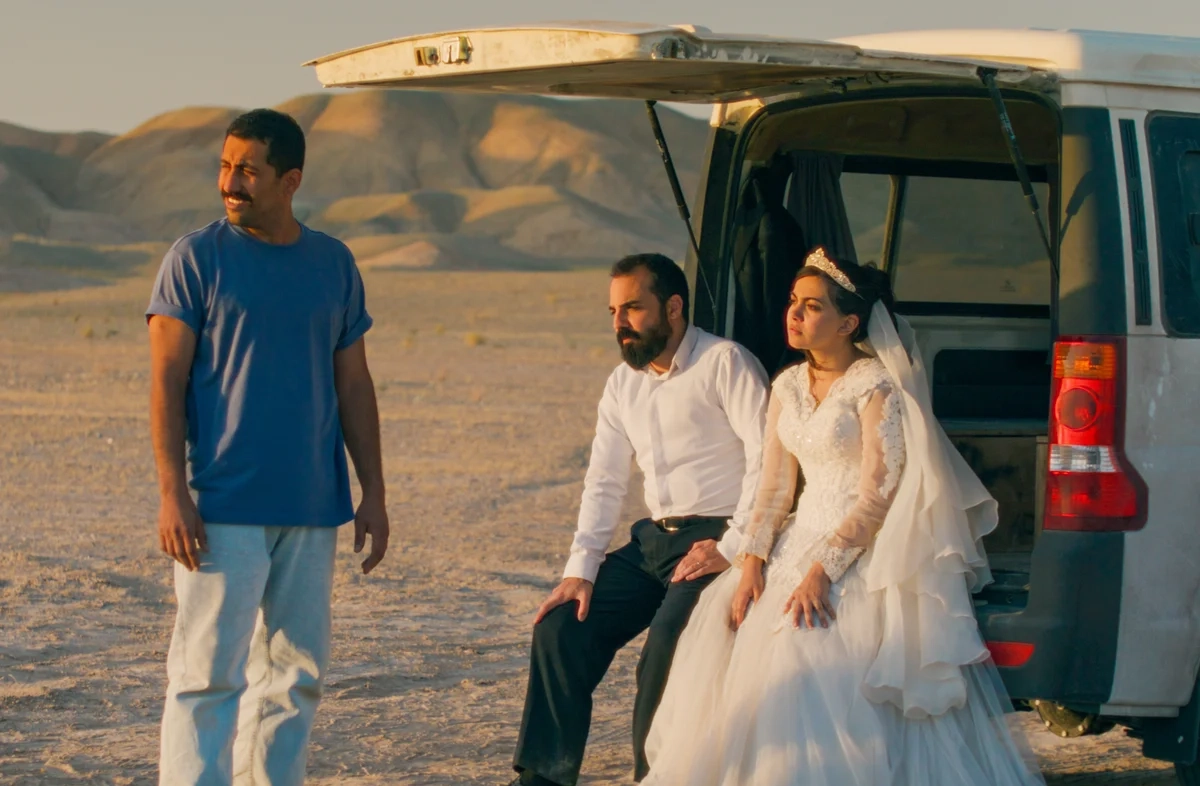
A man thinks he’s recognized the person who once tortured him and decides to act on it. From there, Jafar Panahi lets the situation unravel into something tense, strange, and deeply consequential.
Despite its subject, the film is often very funny, drawing dark humor from uncertainty and moral hesitation. What gives it its power is its humanity—its attention to doubt, contradiction, and the emotional cost of certainty.
The final fifteen minutes are the strongest of the year. The film doesn’t resolve its questions so much as insist that we live with them. (Read our review).
1. “One Battle After Another” (Dir. Paul Thomas Anderson)
It’s a boring choice to put this at number one—but sometimes a film is so rattling, funny, entertaining, and important that it feels inevitable. I’ve seen “One Battle After Another” more than six times, and it hasn’t lost its power.
Obsessed with time, inheritance, and resistance, the film frames rebellion as exhausting but necessary. Its optimism feels earned, rooted in community and care rather than naïveté.
All of this arrives as a massive, thrilling blockbuster. The action direction is astonishing—clear, tense, and propulsive—turning spectacle into expression. It’s one of the rare studio films that leaves audiences exhilarated and thinking.
Most of all, this feels like a turning point for Paul Thomas Anderson: his first film to look forward instead of backward. Already inspiring debate, criticism, and repeat viewings, “One Battle After Another” feels like a classic taking shape in real time. (Read our review).
