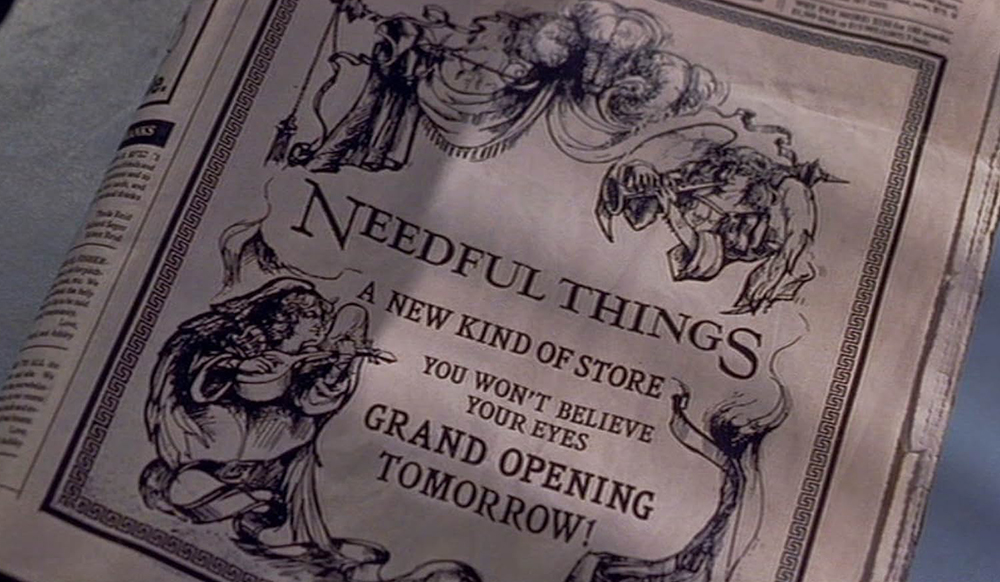
With the sheer body of more famous choices from the juggernaut, “Needful Things” by Stephen King had always been one of my favorite of his novels. It was a long book, but an easy read, and the way King crated a narrative of a town wired to explode by an outsider was intricate woven. Unfortunately, with the movie version—released in 1993—it’s a clear case of trying to squeeze too much (1,000+ pages) into a 2 hour movie. Director Fraser C. Heston does a good job at painting the quaintness of the town, but due to the necessity of a fast-moving screenplay, many of King’s eerier elements get left to the wayside. It’s still a decent film; regrettably, it loses the power of the novel, which was harrowing, patient, and skillful.
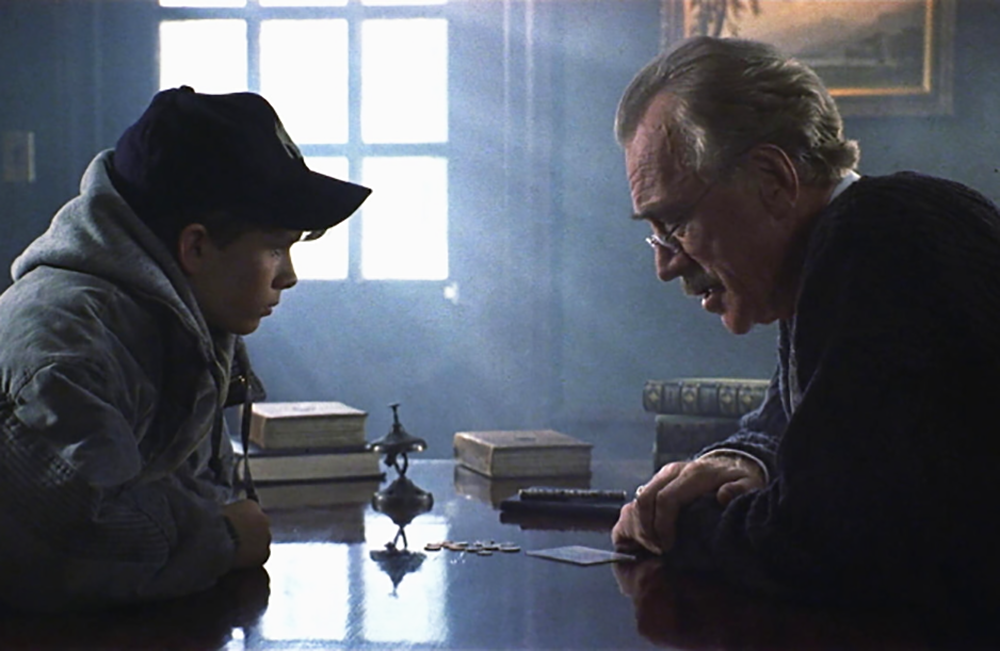
The themes of “Needful Things” are contained in its plot of a shrewd, traveling businessman (Max von Sydow) who arrives in the small town of Castle Rock (a King favorite locale) to open a consignment shop of sorts. The man’s name is Leland Gaunt, and his game is selling people their inner-most desires for pennies on the dollar—but with a price. An example is seen in the film’s opening as 11-year-old Brian Rusk (Shane Thomas Meier) wanders in and falls in love with a 1956 Mickey Mantle baseball card. Gaunt offers it to him for less than a dollar, with the condition he complete a ‘deed’ for Gaunt later. This deed turns out to be smearing mud all over an ornery Wilma Jerzyk’s sheets (Valri Bromfield), not knowing she will blame not Brian, but another—Nettie Cobb (Amanda Plummer), who works at the local diner—for the event.
A Town Wired to Explode
It’s in this way that Gaunt wires the town together, winding them up until they are ready to—and then eventually do—explode. There’s a deputy and an arrogant town selectman (Ray McKinnon, J.T. Walsh) who are already on the outs for various reasons. And then there’s Hugh Priest (Duncan Fraser), who is repeatedly thrown out of the town bar for public drunkeness but keen to remember his high school days of football glory… a time when he wasn’t a has-been townie. Two men of the cloth on different sides of the Catholic/Baptist fence (Don S. Davis, Campbell Lane) start out as feuding curmudgeons who will later be duking it out—and worse—in the streets. And rounding it off are Brian, Nettie, and Wilma, who become entangled in events that escalate beyond their control.
This is a lot of information, and King’s novel has even more. And therein lies the basic problem with “Needful Things,” despite good performances by von Sydow as the sinister Gaunt, and even Polly (Bonnie Bedelia) and Alan Pangborn (Ed Harris)—the latter who is the town sheriff and had a much wider purpose in King’s novel. Due to the sheer amount of material that must be crammed into just 2 hours and 1 minute, things get rushed or omitted from the screenplay. The backstories and way that the town’s citizens are already kind of on the outs before Gaunt appears are hurried. And because of that hurrying, when one is asked to sabotage another’s property, etc., we’re often not sure why or left scratching our heads.
A Rushed, Terse Narrative
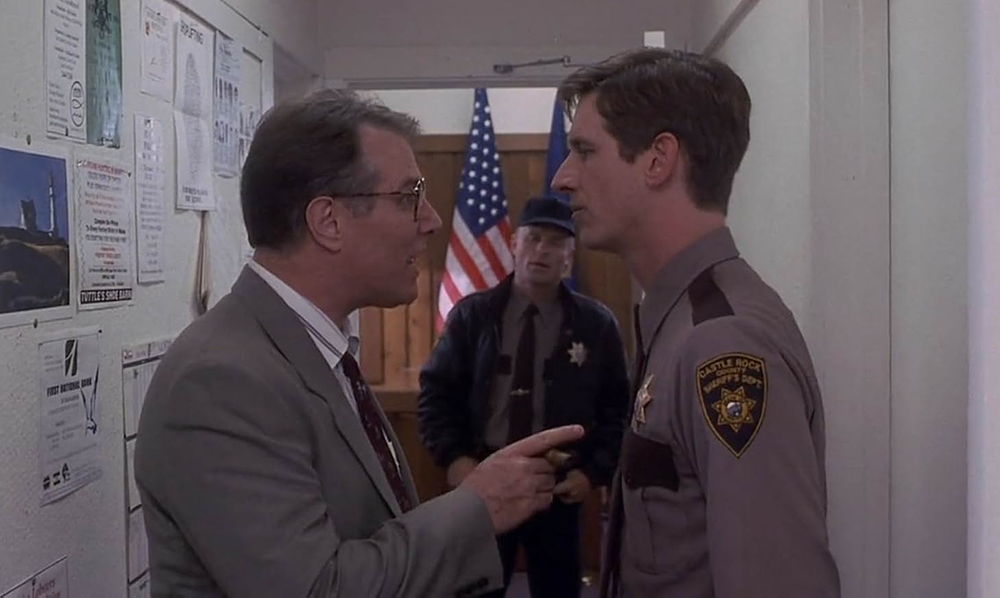
The worst is the J.T. Walsh’s Danforth Keeton III and Debut Norris Ridgewick; their rivalry is sped up to the point of confusion. Also rushed is Sheriff Pangborn (Harris), who is the hero of the novel but is relegated to a side character here. The film also takes no time to build he and Polly’s relationship, nor her struggle with arthritis. It’s touched upon in a few scenes, but not built up to the debilitating stage it was in the novel that made her decision to align herself with Gaunt’s shop later on believable.
There’s also the fact that the evil of Gaunt is over-explained to the point of ennui. Trying to avoid spoilers, he’s done this before. There’s notes of the Brothers Grimm’s “Rumplestiltskin” in it, as well as Biblical figures of demonic proportions. Max von Sydow resembles Leland Gaunt as described in the book to a T. However, his machinations—which were subtle and slow to build in the novel—are here explained by either himself or Pangborn to the point where there is simply no mystery. The film’s close is the worst offender, but it’s present throughout. Scenes between Gaunt and Polly are spelled out to the point of taking you out of the film, despite their creepy airs (similar to his scenes with the rest of the town).
Seek Out the 3-Hour Cut, if You Can
Regrettably, this is all due to a rare fact about the movie, that it was originally a 3-hour, extended version meant for a miniseries that was cut to a 2-hour run-time, likely to appease the Box Office. The editing is choppy in places, where we can see scenes cut short—or cut altogether—for the sake of the shorter timeframe. As a result, when the town explodes (and it does, in magnificent, albeit fantastical fashion), it seems too sudden, with many of the fights and insults being thrown making little sense as they seem to come out of nowhere. However, Ed Harris delivers a powerful monologue—the only one to know who Gaunt really is as an outsider who moved to Castle Rock—and the film ends the way it must.
“Needful Things” isn’t a bad movie, just rushed. The rare, 3-hour cut is a better time, provided you can find it. I caught it on television years ago, and remembered it had remedied everything that irked me about the trimmed down product this became. Still, the production value is ‘90s and foreboding, and the acting by most of the players is enjoyable. I wish they would bottom-shelf this movie and make available only the full version. However, those who have not read King’s 1991 novel and have as close a love for it as I do will likely find enjoyment in “Needful Things.” Harris and von Sydow are great to watch, and the film’s end—a full-on “Gremlins” homage but more macabre—make it worth it for its power alone.